

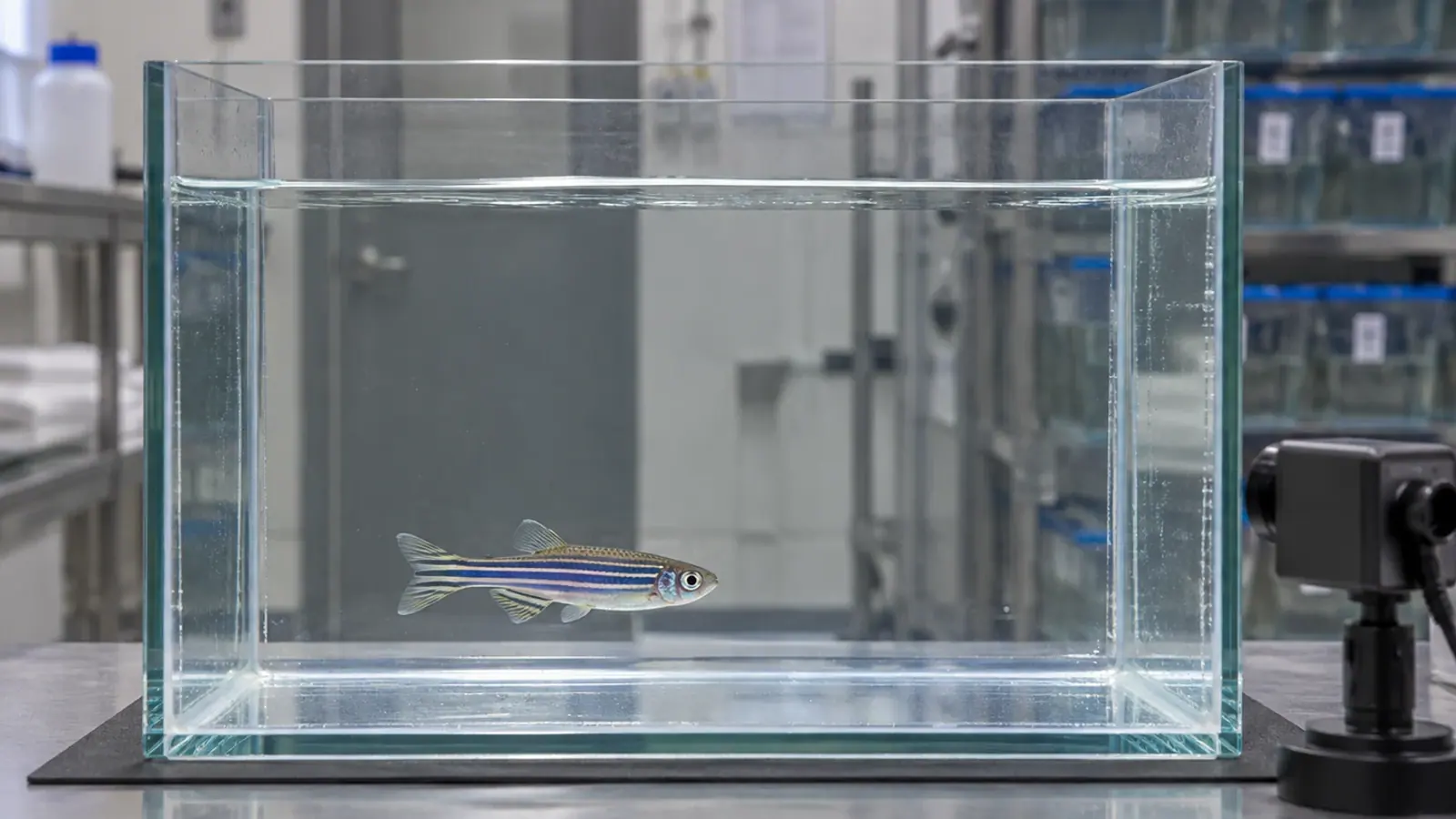
Novel tank test: what changes across zebrafish facilities?
A study across 20 laboratories tested 488 adult zebrafish in the novel tank assay. Sex, husbandry and the sequence of testing all matter when comparing trajectories across sites.


- Content type
- Scientific news
- Sector
- Research
One assay, twenty laboratories
In the novel tank test, an adult zebrafish is placed in unfamiliar water and usually spends time near the bottom before exploring higher areas. Researchers often measure time in an upper zone and the number of entries into it. These are behavioural indicators commonly interpreted as anxiety-like responses. Neither measure directly identifies a fish’s subjective experience or diagnoses an individual welfare problem.
Hillman and colleagues assembled five-minute observations of 488 adults from 20 laboratories. The scale exposed differences in husbandry and testing that a single-site study could miss. It also creates a challenge for interpretation: the laboratories were not randomly assigned to exchangeable husbandry conditions. An association between a facility feature and a test outcome cannot automatically be read as an isolated causal effect.
The study reports associations involving sex, stocking density, feed, noise and movement to a separate testing room. Some relationships changed over the five minutes. Collapsing the entire assay to one average can therefore hide the early response and subsequent habituation. The practical question for collaborating facilities is what they must record so that a comparison is meaningful, rather than which facility produces the “correct” score.
Report the fish and its immediate history
Sex mattered in the consortium’s analyses. Female fish showed more anxiety-like behaviour than males on the outcomes reported, although the result is not a claim that every female is stressed. A protocol should state how sex was determined and how the group composition enters the analysis. Age, strain and reproductive state may also be relevant, particularly when sites use different sources of fish.
Housing density and feed type were associated with responses. The authors discuss particular favourable conditions in their data, but their figures are not a universal stocking or feeding prescription. Tank volume, flow, fish size and local husbandry differ. Recording actual conditions preserves information that would be lost by replacing them with a nominal “optimal” value. A welfare assessment should also look beyond a single behavioural assay.
Handling immediately before the test is another variable. A fish moved from its home tank to a different room encounters transport and a changed environment before the camera starts. Distance, container, duration and any waiting period can vary between laboratories. These steps should be described when comparing treatment effects. The label “novel tank test” alone does not define the sequence of exposure.
Record the setting around the tank
The consortium considered light, temperature, noise, vibration, water-system configuration and activity in the facility. A transient noise or repeated staff entry can coincide with changes in exploration. This does not mean that removing every stimulus would reproduce the same result everywhere. It means the experimental setting is part of the evidence, especially when a study claims to detect a small treatment effect.
Before collection, collaborators can agree which conditions to hold steady and which to record. Tank dimensions, the exact boundary of the upper zone, lighting, time of day and video tracking settings are all worth describing. A shared behavioural coding guide should define immobility and ambiguous movements before data are scored. If different teams use different definitions, identical fish trajectories can produce different summary numbers.
Image quality also matters. Reflections on a tank wall, an uncalibrated camera or a fish hidden briefly from view can shift an estimated time in a zone. Reviewing raw video from each site and reporting exclusions helps separate measurement problems from biological variation. These checks work alongside, rather than replace, an analysis plan that can account for laboratory and batch effects.
Keep the limits visible
The multi-laboratory design captures genuine between-site variation, but not every possible source was measured consistently. The authors note gaps in reporting of features such as precise strain and housing sex ratio. Unmeasured factors may contribute to the apparent associations. The findings apply to adult zebrafish in this assay; they are not evidence for the same effect size in larvae, another fish species or a different behavioural test.
A diving response cannot be equated with a stand-alone clinical state. Novelty, transport, husbandry and the intended experimental intervention may all contribute. Welfare assessment needs observations over time and knowledge of the animals’ history. A statistically different group mean does not identify the mechanism on its own. Maintaining this distinction is important when the result is later used to refine a facility protocol.
Plan a study that others can read
Teams preparing a cross-site experiment can agree on core endpoints, video checks and a minimum set of husbandry descriptors in advance. They should specify how recorded differences enter the statistical model rather than selecting explanatory factors only after outcomes are known. A shared pilot can expose disagreement about the upper-zone boundary or the start of the five-minute period before the main dataset is collected.
This paper supports clear protocols and traceable variation. It does not supply a universal way to erase facility differences. Vetofish’s advisory service can help a research team connect husbandry records, behavioural scoring and analysis plans while keeping causal claims within the study’s design.


