

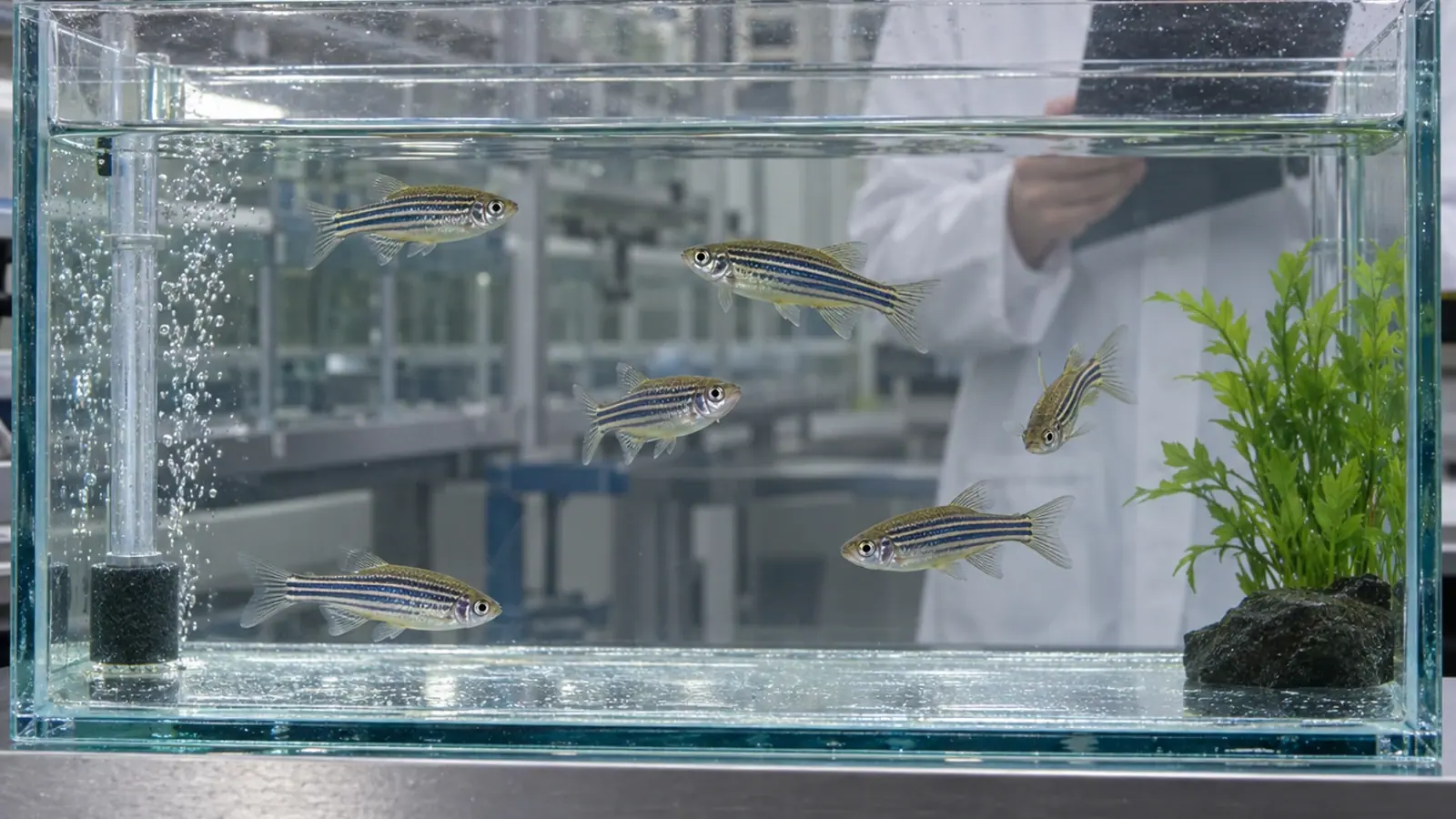
OECD fish tests: what refinement requires in practice
The 2025 versions of OECD guidelines 203 and 210 address the conduct and observation of fish tests. They support consideration of alternatives but do not establish a universal behavioural humane endpoint.


- Content type
- Regulatory analysis
- Sector
- Research
- Animal group
- Fish
- Keywords
- EcotoxicologyStressEthogram
Observing fish during a toxicity test requires a shared method. Changes in swimming, ventilation or equilibrium need to be described, timed and communicated. The team needs to connect those observations to a decision while keeping the analytical purpose of the test, animal welfare and interpretation of the results distinct. An observation record is useful only if staff know what its entries mean and what action they can trigger.
The 2025 versions of OECD guidelines 203 and 210 were adopted on 25 June 2025 and corrected on 18 September 2025. They address different experimental situations. Not all their provisions are new compared with earlier editions. OECD guideline adoption is distinct from legal application in a particular jurisdiction or approval of an individual project.
Acute toxicity and early development answer different questions
Ecotoxicology examines the effects of substances on organisms and ecological systems. Guideline 203 describes an acute fish toxicity test with a 96-hour exposure. Its central result is a median lethal concentration, or LC50, linked to exposure duration. That experimental estimate is not a no-effect concentration or a safety limit for natural waters.
Guideline 210 starts with fertilised eggs and follows early development to a species-defined juvenile phase. It considers outcomes including hatching, survival and growth against controls. Its duration and conditions cannot be substituted for those of the acute test. A developmental abnormality also needs a different interpretation from a sign observed in an adult fish.
The observation plan should make the developmental stage explicit. Embryos and newly hatched fish present different features and requirements. Staff need to know what they are examining, what is expected at that stage and how an event should be recorded. Applying one unchanged checklist across development may obscure the information needed for both welfare decisions and analysis.
Consider other evidence before preparing the exposure
The introduction to guideline 203 calls for consideration of existing information and suitable alternative approaches, including models, comparable substance data, embryo tests and cell lines. Their suitability depends on the assessment question and relevant framework. Listing an approach does not mean it automatically replaces every fish test in every regulatory setting.
The team should be able to explain whether the available evidence answers the question and, if not, where the gap lies. Prepare that justification before ordering animals or committing to the technical timetable. An alternative considered late may be harder to integrate for logistical reasons, even when it was scientifically appropriate from the outset.
Reduction also concerns test design. Guideline 203 states that concentrations do not need to be added solely to produce the extremes of zero and one hundred per cent mortality. This does not remove the need for adequate data to estimate the intended result. It requires a distinction between work needed to answer the question and additional exposure that does not provide corresponding useful information.
Record visible signs without assuming they predict death
Guideline 203 includes repeated observations of appearance, equilibrium, ventilation and activity. Observers need shared descriptions and an agreed escalation process. A note saying only that a fish was abnormal does not reveal what changed, when it happened or whether the change persisted. Another member of staff should be able to interpret the record without reconstructing the event from memory.
An ethogram can define the behaviours being recorded, but it does not automatically validate their predictive value. A single sign should not be converted into certainty that death is imminent. Position within a tank, for example, needs to be interpreted alongside other observations and the conditions of the experimental system.
Stress cannot be reduced to one behaviour. A useful record describes the visible sign, its frequency, its development and accompanying findings. Exposure conditions and control observations should be recorded on the same timeline. That information helps distinguish, as far as the evidence allows, a substance-related effect from a technical problem affecting the test system more generally.
Humane endpoints remain a contextual decision
Annex 4 of guideline 203 states that there is not yet an international consensus on signs reliably predicting moribund fish in this setting. It anticipates further development of recommendations. It would therefore be inaccurate to claim that the guideline now imposes a universal behavioural threshold for early killing.
Guideline 210 addresses deformities and associated behaviour causing considerable suffering beyond recovery. Animals removed in that situation should be euthanised and treated as mortalities in the analysis. Decisions to end an animal’s exposure and the reporting of those decisions need advance preparation with competent personnel and the framework applicable to the project. Choosing a killing method requires that project-specific preparation.
Staff need to know whom to contact, who can decide and what must be recorded when an animal deteriorates. Availability matters outside ordinary working hours as well. A written procedure that overlooks absences may leave an important observation without a timely response. An escalation plan should therefore be checked against actual staffing and responsibilities, not only against the wording of a document.
Keep the welfare decision visible in the results
Reporting needs to distinguish an observed death, an intervention motivated by welfare and other reasons for leaving the test. Terms should retain the same meaning in raw records and the final report. Better care must not make the intervention disappear or silently change the denominator used in an analysis. Traceability helps readers understand what an outcome represents.
OECD guidelines 203 and 210 provide a framework for considering alternatives and organising observations. They do not settle every refinement question on their own. Preparation, staff competence and consistency between the protocol, monitoring and report remain central. A detailed checklist has limited value if the people using it cannot distinguish an observation from a prediction or access the agreed decision maker.
Vetofish can support research facilities through its animal welfare service, reviewing observation grids and escalation procedures with the team. The aim is to develop understandable, workable criteria while preserving the limits of the evidence and the responsibilities attached to project approval.


