

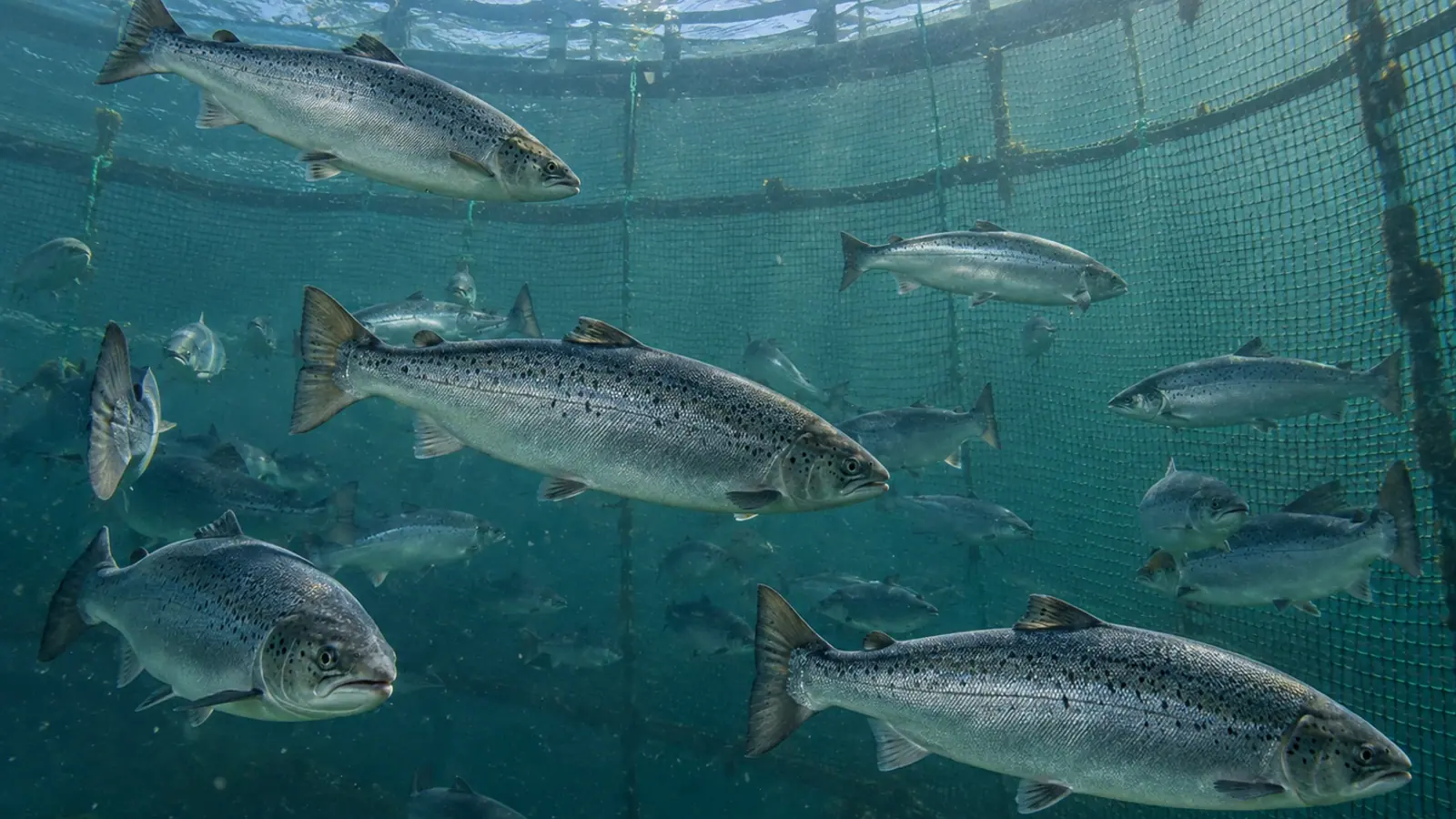
PRV and HSMI: interpreting the diagnosis in salmon
Detecting PRV-1 in Atlantic salmon does not establish heart and skeletal muscle inflammation. Two experimental studies clarify causation and differences between isolates, while farm investigations still need to connect infection, tissue lesions and the history of the affected stock.

- Content type
- Disease profile
- Sector
- Aquaculture
- Animal group
- Salmonids
- Theme
- DiseasesDiagnostics
A positive PRV-1 result answers a different question from a diagnosis of heart and skeletal muscle inflammation. HSMI describes tissue damage in Atlantic salmon, Salmo salar; infection describes the presence of the agent. Treating them as interchangeable can make a farm attribute poor feeding or mortality to the virus before the evidence supports that conclusion. It can also encourage teams to overlook lesions in stock that still appears productive.
Two experimental papers, published in 2017 and 2020, provide the basis for this diagnostic distinction. The practical approach below concerns how to investigate a farm case. It does not convert an experimental challenge into a husbandry procedure or propose a treatment.
What the infection experiments established
Wessel and colleagues purified viral particles from infected salmon blood and challenged previously uninfected fish. Their 2017 study reproduced lesions consistent with HSMI in injected salmon and in fish exposed through cohabitation. Detecting the virus within affected tissues added evidence beyond a correlation between a positive PCR and disease.
That causal demonstration has a defined scope. It does not establish that every PRV isolate will produce equivalent damage in every salmonid species. Purification, controlled exposure and scheduled examination were designed to test causation. They cannot by themselves predict the risk for a commercial stock exposed under marine cage conditions.
Blood cells are an important compartment in the infection. In that experiment, viral RNA remained abundant after viral protein levels declined. Sampling time and the material submitted therefore matter when interpreting what a molecular result represents. An RNA measurement should not automatically be described as a measure of current tissue injury.
Why isolate differences matter
The 2020 study compared six PRV-1 isolates in a standardised-dose challenge: two Norwegian field isolates from 2018, three historical Norwegian isolates and one Canadian isolate. The contemporary Norwegian isolates produced cardiac lesions consistent with HSMI. The other isolates mainly produced milder cardiac changes under the conditions examined.
This helps explain why virus detection and reported disease may differ between settings. It does not justify labelling a field isolate as highly virulent solely because of its geographical origin. The authors also found that selected genome segments alone could not explain the observed differences.
The farm veterinarian needs to connect infection with tissue damage. Molecular detection, tissue examination and the clinical history contribute different information. A change in a PCR value does not translate directly into a change in clinical severity, particularly when the samples differ in tissue, collection time or analytical method.
Start with a sampling question and a stock history
Before sampling, bring together stock origin, transfers, handling events, feeding changes, mortality records and unusual observations. Putting them on one timeline gives the veterinary team a reasoned basis for choosing a sampling window. A cumulative mortality figure without dates or a population denominator is much harder to interpret.
The investigation should distinguish fish showing signs, apparently unaffected animals and the production units involved. This is a framework for selecting samples, rather than a universal number of fish to collect. Agree the design with the laboratory according to the diagnostic question, planned tests and welfare constraints.
Molecular testing and tissue examination require different preservation arrangements. Linking every specimen to its individual fish prevents the team from inadvertently comparing a PCR result in one animal with lesions in another. Collect and preserve the heart and relevant muscle tissues according to laboratory instructions. Degraded material can leave a case unresolved even when infection is detected. Confirm shipping requirements before collection.
The record should also explain why each fish was selected. An opportunistic sample from a recently dead animal is not interchangeable with a planned sample from a live fish showing early changes. Retaining that distinction helps the laboratory interpret the findings without reconstructing the selection process after the event.
Report the level of conclusion explicitly
A case may support infection without demonstrated lesions, compatible lesions accompanied by viral detection, or a clinical problem that remains unexplained. State which conclusion the evidence supports. “Not demonstrated” is different from “excluded”, while a positive result alone does not describe disease.
When findings disagree, first check sample identity, preservation, tissues examined and timing. Keep other causes of cardiac damage, performance loss and mortality in the differential diagnosis. A water-system problem still needs correction when PRV is detected at the same time; the molecular result does not make that problem irrelevant.
Define whether a conclusion concerns an individual, a cage, one sampling visit or the entire stock. Results generated by different laboratories, tissues or methods require a comparability check before being combined. A consistent time series can answer questions that a ranking of unrelated values cannot.
Limits of the evidence and farm decisions
Both papers concern Atlantic salmon under experimental conditions. The 2020 comparison used injection to synchronise infection. Its route, dose and schedule differ from natural exposure, so the resulting severity cannot be transferred directly to commercial cages. Neither paper validates a farm treatment or vaccination strategy.
Proportionate management work includes tracing movements, reviewing shared equipment and planning operations with the health team. Avoiding unnecessary handling stress is a stock-management consideration, without a promise that it will eliminate infection. Any treatment decision requires a separate veterinary assessment and the applicable national medicines framework.
Teams should record the action taken and the evidence that prompted it. This makes the next sampling visit useful: it can address the unresolved diagnostic question rather than repeat the same test without a decision plan. It also preserves the distinction between a precautionary management response and a confirmed disease diagnosis.
Conclusion
PRV-1 can cause HSMI in Atlantic salmon, but detecting the virus does not establish that disease in an individual farm case. A useful case record connects infection, tissue lesions and stock history while retaining isolate differences and experimental limitations. That approach supports surveillance without overstating what a test proves.
Vetofish support
Vetofish can help design sampling, coordinate diagnostic investigations and analyses and interpret findings with farm teams. Our work with aquaculture facilities can also help integrate the conclusions into health monitoring and handling plans, with recommendations matched to the stock and the available evidence.


