

Water intakes: test what fish screens protect
A screen can reduce entrainment while fish still contact its surface. An Australian field study shows why approach velocity, fish size and complementary observation methods belong in the same assessment.

- Content type
- Practical guide
- Sector
- Environment
- Animal group
- Fish
A screen is not evidence of complete fish protection
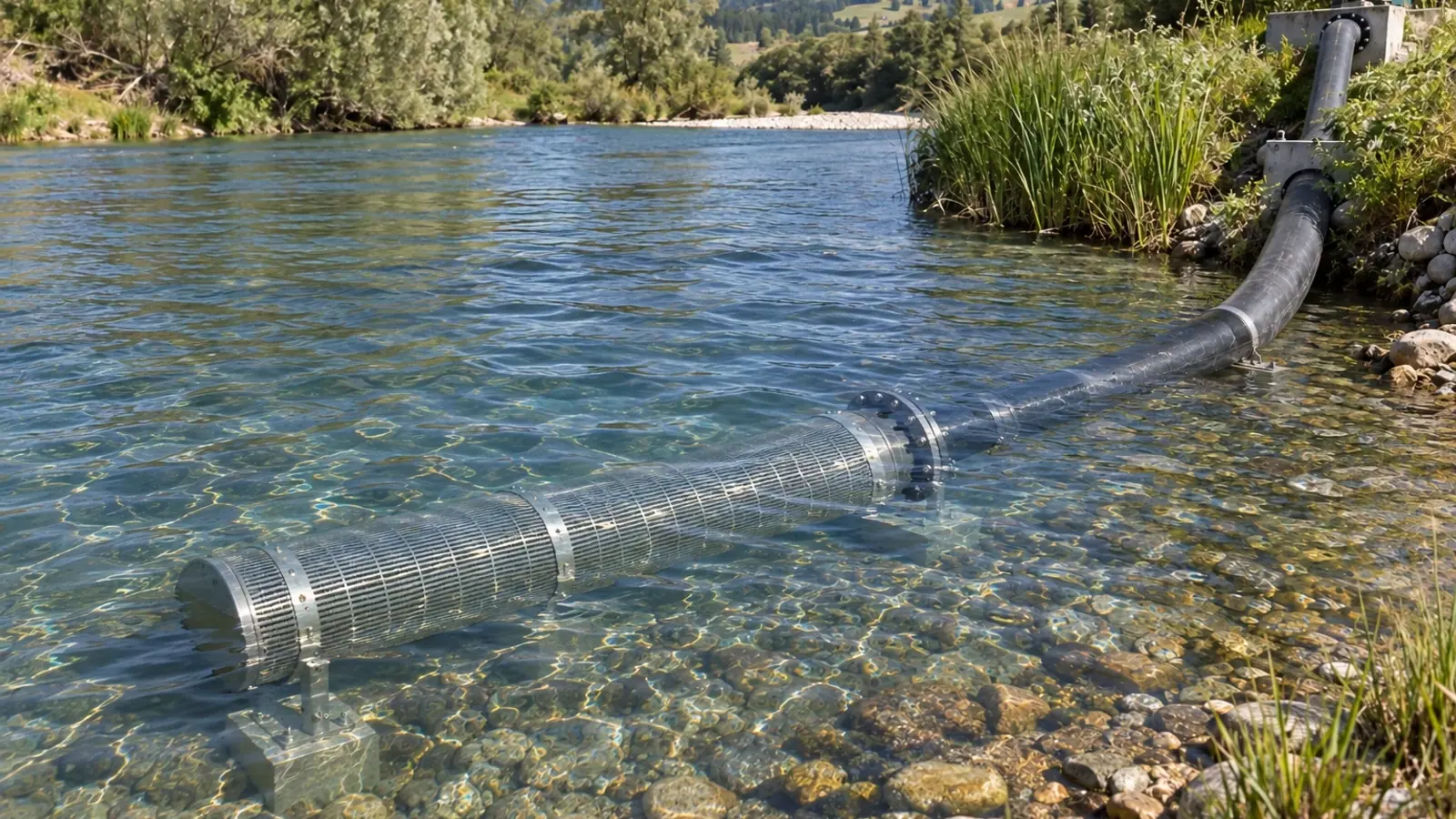
A water intake can divert fish into a system from which they cannot return to the river. Installing a screen addresses part of that problem, but does not establish that animals avoid contact or injury. An evaluation needs to consider entrainment, encounters with the screen and the hydraulic conditions together.
Boys and colleagues’ 2013 field experiment on Australia’s Namoi River illustrates this approach. It compared approach velocities and mesh sizes at an experimental irrigation pump. For a manager working in France or elsewhere, its transferable value is the assessment method: fish collected downstream of a pump do not, alone, describe every interaction at the intake.
Combine collection with observation
The investigators worked at four sites between February and March 2011. They collected entrained fish and used sonar to observe animals near the screen. The experiment compared approach velocities of 0.1 and 0.5 m/s with woven mesh openings of 5, 10 and 20 mm.
Smaller fish were more susceptible to contact and entrainment. In the sonar observations, contact occurred in 33% of observations at 0.5 m/s and 14% at 0.1 m/s. These are proportions of observed fish encounters near the equipment, not estimates of mortality across the river population.
Within the tested conditions, velocity had a greater influence than the differences between mesh sizes. That finding does not make opening size irrelevant. It demonstrates why a screen cannot be assessed solely by its aperture dimensions without considering the flow and animals encountering it.
Describe the intake in operation
Start with the actual intake: geometry, depth, abstraction rate, operating periods and maintenance conditions. A specification for clean, newly installed equipment is insufficient if the working screen becomes partly obstructed or water level changes during use.
Approach velocity describes the component of flow directed towards the screen surface. The study characterised it close to that surface. A value quoted for the pipe, or a general flow-rate figure, is not automatically the velocity experienced by a fish approaching the screen.
For a local assessment, agree on measurement locations and operating conditions with suitable hydraulic expertise. Include ordinary operation and the more demanding conditions the intake may encounter. Unmeasured periods remain evidence gaps. A single favourable reading cannot establish protection throughout the operating season.
Record maintenance alongside the measurements. Otherwise, a change in fish observations may be attributed to biology when the operating configuration has also changed. Record enough context to recover the conditions of each observation and compare measurements meaningfully.
Identify the fish and life stages of concern
The catchment provides the biological context. Species, body sizes and seasonal presence should guide the assessment. An intake evaluated through easily observed adults may leave the position of smaller juveniles or larvae unknown.
The Namoi experiment found greater vulnerability among smaller fish, but did not test larval protection. Keep that limitation explicit. A screen and a small downstream catch do not establish that all life stages are protected.
Orientation in the current also matters. Rheotaxis describes that orientation response, and the study related it to screen encounters. Behaviour near the intake can help explain contact patterns. It cannot establish the absence of fatigue, injury or a later consequence without additional evidence.
A survey record should state the identification method and its limits. When an observation cannot resolve species, retain it at the level the method supports. Assigning an attractive species label to an unclear image makes the resulting assessment less dependable.
Make sampling effort comparable
Connect each catch with the volume abstracted, observation period and operating conditions. Raw fish counts do not make two periods comparable when their sampling effort differs. Record size, identification and uncertainty with the count.
Observation near the screen provides complementary information. In the Australian experiment, sonar showed fish approaching the equipment even when downstream collection was small. Without that second method, low catches could have been mistaken for a lack of encounters.
Sonar, video and other methods have different strengths depending on water clarity and the intake configuration. Document blind spots and resolution. A system that cannot distinguish species should not produce a species-specific protection claim simply because its output contains recognisable fish silhouettes.
The monitoring design should explain which event each method measures. Collection can document entrainment, whereas observation may reveal approaches and contacts. Treating these as interchangeable results removes the very information that makes a combined approach valuable.
Distinguish contact, entrainment and mortality
A brief screen contact is not necessarily prolonged impingement. Entrainment is not automatically immediate death. Record these outcomes separately and identify the additional examination or follow-up needed to discuss injury and survival.
The authors note limitations associated with two-dimensional sonar, variable numbers of fish among sites and days, and an inability to identify species in sonar images. Some apparent contacts were difficult to classify. These are reasons to combine methods, not to regard one technology as a complete measure of impact.
Delayed mortality requires an appropriate follow-up design; it cannot be inferred from a recorded passage alone. Capture and temporary holding during an evaluation can also affect fish. Plan those procedures and account for their limitations when interpreting the results.
Keep a tested velocity in its original context
The authors propose a precautionary approach velocity of 0.1 m/s for smaller fish in the studied assemblage while the consequences of contact remain insufficiently understood. That recommendation belongs to its biological and hydraulic context. It is neither a French regulatory requirement nor a sufficient design rule for every intake.
A project in France must verify the applicable requirements and site-specific prescriptions separately. Scientific evidence informs the engineering assessment; it does not replace regulatory review or equipment design. Projects in other jurisdictions need the same distinction between published evidence and the conditions governing their own site.
The useful management conclusion
Evaluate a screen through what fish can avoid under real operating conditions. Linking hydraulics, vulnerable life stages, contact and entrainment gives a more useful assessment than downstream catches alone.
Vetofish can help environmental projects define biological observations, plan examinations and interpret findings alongside the specialists responsible for the intake. Its advisory services can clarify what has been measured, what remains uncertain and which checks the project still needs.


