

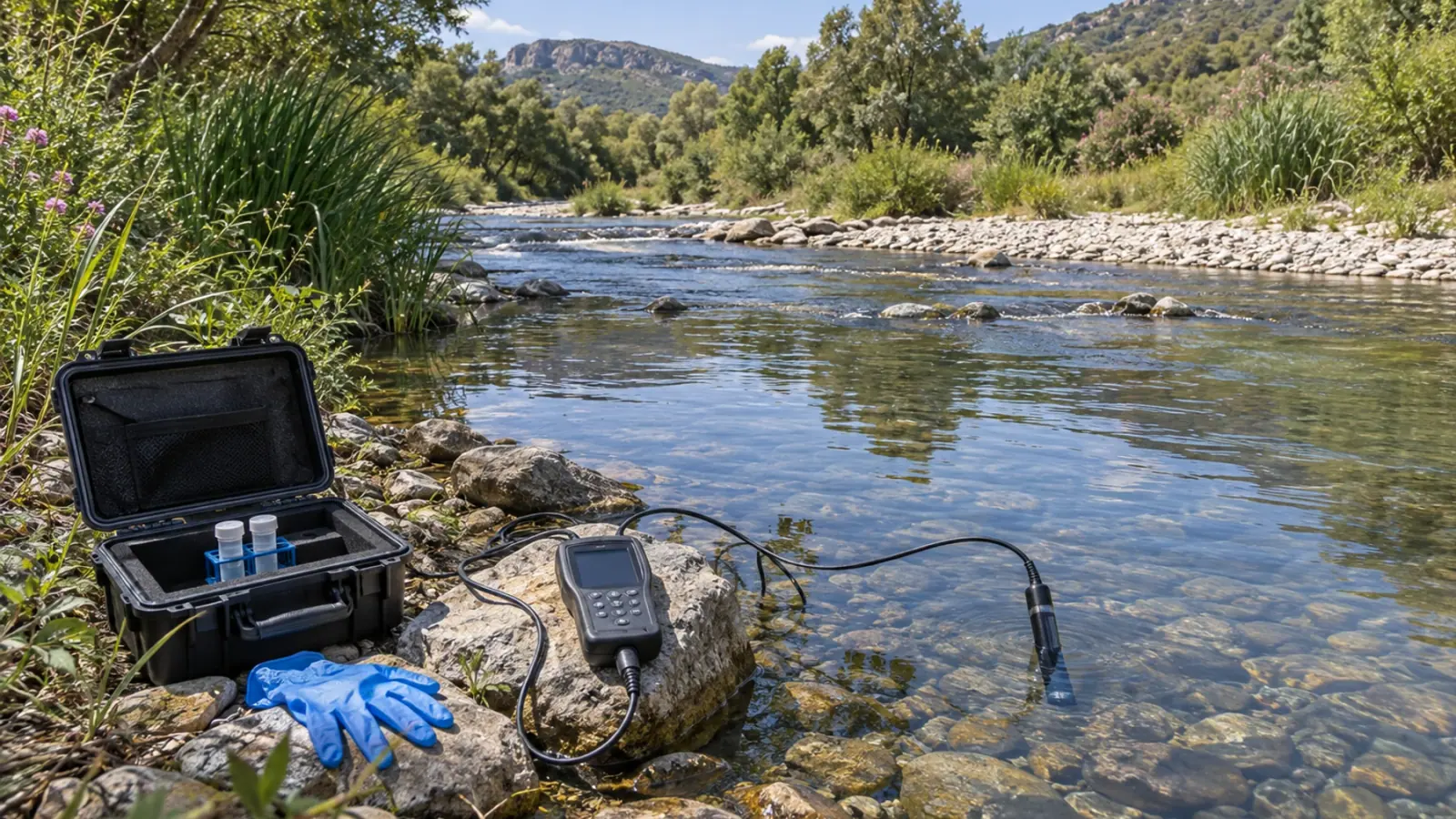
Fish mucus cortisol: account for capture before interpretation
A study in Catalan chub links mucus cortisol with blood cortisol and habitat quality. Because fish were captured and confined before sampling, the measurements cannot directly describe the undisturbed state of fish living freely in the river.

- Content type
- Practical guide
- Sector
- Environment
- Animal group
- Cyprinids
- Keywords
- StressEcotoxicologyTemperature
A useful sample still needs a defined question
Skin mucus protects the fish surface and can also provide material for physiological analysis. Measuring cortisol in mucus offers an alternative to relying exclusively on blood. However, apparently simple collection does not guarantee a straightforward interpretation. Capture, holding time and sampling conditions must be part of the result.
Carbajal and colleagues investigated this approach in Catalan chub, Squalius laietanus, in a study published in 2019. They compared fish from habitats of differing quality in northeastern Spain. The work supports development of an environmental monitoring method. It does not establish a universal stress threshold or a procedure validated for every fish species.
Three locations with unequal samples
The study included two sites within the constructed wetland system of Besòs River Park near Barcelona and an upstream reference site in a tributary. Samples comprised six fish at the first degraded site, seventeen at the second and twenty-two at the reference location. The small sample at the first site restricts the comparisons.
Sampling took place in the morning between May and June 2017, on different dates at the three sites. Reference fish were also smaller on average. The analysis considered length and body condition, but accounting for these variables does not turn the field comparison into a controlled exposure experiment.
Water chemistry and measurements of selected contaminants helped characterise the habitats. They did not isolate the effect of one substance. A difference in cortisol between locations therefore cannot identify a particular pollutant as its cause or independently measure the effectiveness of habitat works.
Capture is part of the measurement
Fish were collected by electrofishing and confined in buckets for approximately fifteen minutes before anaesthesia and collection of blood and mucus. The researchers explicitly examined the response after this combined challenge. These were not measurements obtained from undisturbed fish swimming freely in the river.
Mucus was absorbed from both flanks using a polyurethane sponge with light pressure. The fluid was then recovered and prepared for analysis. Fish were released at their capture sites after sampling. These details describe the research procedure; they are not a capture or anaesthetic protocol to reproduce without appropriate veterinary adaptation.
For a monitoring programme, elapsed time from capture to collection is therefore essential information. If fish at one station are sampled promptly while fish at another remain confined longer, the difference may reflect procedure as well as habitat. A less invasive sample can still be collected through a process that changes the response being measured.
The distinction also affects wording. Non-lethal sampling describes an important outcome of the procedure. It does not mean that handling is absent or that the method provides a direct baseline measurement of the animal’s undisturbed physiology.
Agreement with blood and complementary endpoints
Mucus and plasma cortisol concentrations were significantly correlated in the sampled fish. Both were lower at the reference site than at the degraded locations. These observations support the potential of mucus as a complementary matrix for this species under the conditions examined.
The researchers also assessed blood cells. Some red-cell abnormalities and the neutrophil-to-lymphocyte ratio provided additional information. Not every endpoint followed the same pattern across stations. That incomplete agreement is relevant: environmental disturbance may influence several biological functions without producing one uniform response.
Correlation between two matrices does not establish that they are interchangeable. It also does not produce a cortisol threshold that automatically separates healthy fish from compromised fish. Relationships need to be evaluated for the population, sampling conditions and analytical method in question.
Check the assay before comparing sites
The study included biochemical validation of the immunoassay in both plasma and mucus. This examined precision, dilution behaviour, recovery after adding known cortisol and analytical sensitivity. Such checks address whether the sample matrix may distort the reported concentration.
In a new monitoring programme, purchasing a commercial kit does not demonstrate suitability for every species and sample type. The laboratory needs to understand collection methods, storage conditions and available volumes. Variable dilution by residual water can complicate comparisons between mucus samples.
Records should connect each sample with the animal or group, location, time, water conditions, confinement duration and storage steps. The plan should also define how inadequate volumes and results outside the measurable range will be handled. Making those decisions before fieldwork reduces the risk of constructing an interpretation around inconsistent samples afterwards.
This preparation is particularly important when several teams collect material. Differences in technique can become inseparable from location unless collection and documentation are coordinated. Consistent recording does not eliminate biological variation, but it makes the procedural component easier to assess.
Use the result within an integrated assessment
Unequal sample sizes, differences in fish size and separate sampling dates constrain causal interpretation. The study examined one species during one part of the year. It does not establish that the same relationships will persist in other cyprinids, during winter or following a different capture method.
Cortisol describes an endocrine response, rather than the entirety of welfare or the identity of a toxic exposure. Some chronic exposures may alter or suppress that response. A low value is therefore not automatically evidence that environmental disturbance is absent.
For environmental managers, a proportionate approach combines mucus measurements with habitat information, water analyses, health observations and a coherent sampling plan. A pilot study can test feasibility and sample quality before the method is used for comparisons between sites or through time.
The question should be stated narrowly enough for the data to answer it. Comparing a standardised response across defined locations is different from diagnosing a pollutant or estimating undisturbed stress. Keeping those aims separate helps avoid conclusions that the measurements cannot support.
Conclusion and support from Vetofish
Mucus can contribute to non-lethal physiological monitoring of wild fish. Interpretation still depends on capture, timing, species and assay validation. The Catalan chub study supports a complementary role, without establishing an environmental diagnosis based on cortisol alone.
Vetofish can help plan collection and interpret findings through our laboratory analysis and diagnostic support for aquatic environmental work. The aim is to connect each measurement with a defined management question and the practical limits of the sampling design.


