

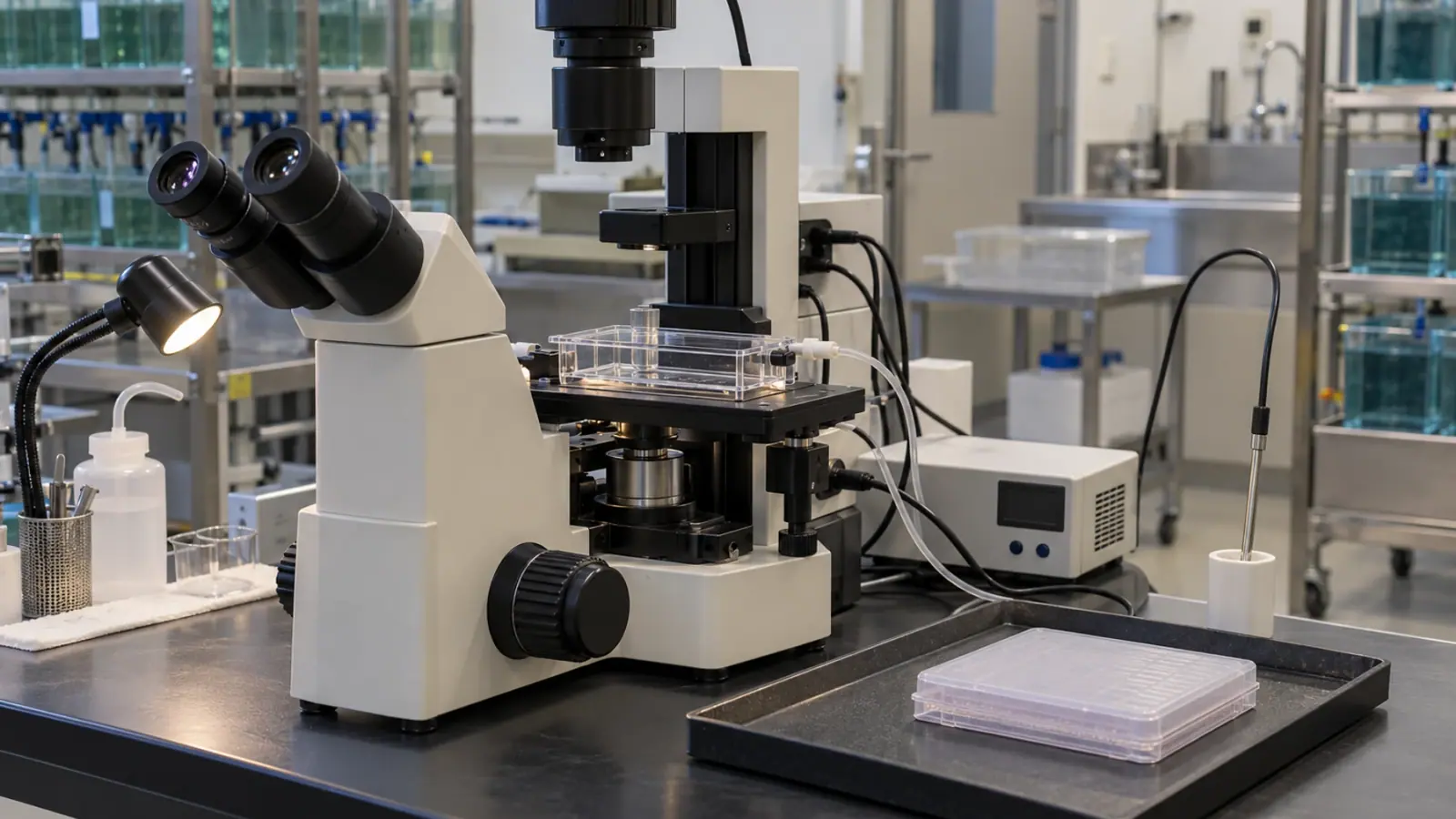
Zebrafish larval heart rate depends on stage and temperature
A difference in zebrafish larval heart rate can arise from developmental stage or water temperature during recording. A 2026 study documents these influences in AB embryos and larvae, providing context for comparisons rather than universal diagnostic ranges.


- Content type
- Scientific news
- Sector
- Research facilities
- Animal group
- Zebrafish
- Keywords
- TemperaturepHReproduction
The acquisition conditions belong with the result
A difference in larval heart rate does not necessarily originate from the treatment an experiment was designed to test. Developmental stage and the temperature of the water during recording can also change the measurement. These conditions need to accompany the result when groups, batches or studies are compared.
Patricia Fiorino and colleagues examined these influences in zebrafish, Danio rerio, in a study published in PLOS One in June 2026. They measured early cardiac function at several developmental time points and compared defined temperature and pH conditions. The work helps identify information that animal facilities and imaging teams need to share; it does not supply universal clinical reference intervals.
Optical access makes the developing heart easier to observe, but does not make its function constant. A value from one age cannot automatically serve as the control for another. Development is part of the biological comparison, even when the same camera and analysis software are used.
Define the animals and the comparison
The study used AB embryos obtained from multiple independent breeding events and randomly assigned to groups, with twenty embryos per group. Eight time points were examined between 24 and 80 hours after fertilisation. These covered a period of rapid cardiac development around the transition from embryo to hatched larva.
Recordings lasted ten seconds and were acquired without anaesthesia or immobilisation to avoid their interference with cardiac function. A ventricular region of interest was defined in each video, allowing changes in image intensity over time to be analysed for heart rate. These acquisition choices form part of the conditions under which the results were obtained.
Temperature comparisons were made at 72 hours after fertilisation, using 27, 27.5 and 28°C during observation. The pH experiment had a different exposure history: embryos were maintained at pH 7.0, 7.4 or 8.0 from 24 to 72 hours after fertilisation. Those experiments should not be treated as equivalent exposure durations or interchangeable environmental challenges.
Development changes the baseline
Heart rate generally increased between 24 and 72 hours after fertilisation. The later measurements, from 72 to 80 hours, did not differ significantly from one another. This plateau describes the observed interval in one strain under defined conditions. It does not show that cardiovascular maturation is complete or that the same pattern holds indefinitely.
The finding argues for recording ages precisely rather than pooling broad categories. Two recordings labelled “three days old” may have been acquired at different times after fertilisation. Thermal history and observed developmental stage also help explain what animals were actually compared.
Timing must still follow the scientific question. An experiment investigating an early cardiac transition cannot simply move to a later stage without changing its purpose. The relatively stable interval described in this study may help some comparisons, but it does not establish a single correct age for every cardiovascular model.
A small temperature difference had a measurable effect
At 72 hours after fertilisation, reported mean heart rate increased from 171 ± 6 beats per minute at 27°C to 205 ± 11 at 28°C. The dispersion values are standard deviations. This difference of about 20% illustrates how a small change in recording temperature can accompany a substantial change in the measured endpoint.
Zebrafish are ectotherms, so surrounding temperature contributes to physiological function. A suitable setting on the holding system does not describe the water beneath the microscope. Transfer, waiting time and acquisition conditions remain relevant even when all groups originate from the same animal facility.
The paper also reports cardiac output and ejection-fraction estimates based on two-dimensional images and geometric assumptions. These are not direct measurements of blood flow. They should remain distinct from heart rate and do not, on their own, establish the physiological mechanism underlying a temperature-related change.
Keep the negative pH result within its scope
No significant differences were detected among the three pH treatments for the cardiac endpoints examined at 72 hours. This does not prove perfect equivalence between media, or show that pH cannot affect the animals. The conclusion is limited to the tested range, duration and measurements at this facility.
Other limits include the single strain and short recordings. The results cannot be used as a universal normal range to diagnose pathology or toxicity in any zebrafish larva. A treatment comparison still requires its own controls, matched acquisition conditions and a consistent analysis method.
A useful record can bring together batch and breeding identifiers, time after fertilisation, observed stage, holding conditions, actual acquisition temperature, pH and relevant handling. The interval between leaving the housing system and recording may also reveal organisational differences that would otherwise remain hidden in a result labelled only by treatment group.
Compare measurements with known context
Stage and acquisition conditions belong with the cardiac result. A cardiac difference can be biological without being caused by the factor under investigation. Clear records of stage and acquisition water allow that alternative explanation to be examined before a treatment effect is assigned.
Vetofish can support research establishments in coordinating animal-facility and imaging records, selecting the conditions that need tracing and reviewing observation procedures. This work supports interpretable comparisons and appropriate animal monitoring; it does not replace validation of the model or scientific assessment of the project.
To move from evidence to action, explore our advice and support service and our expertise for research facilities.


