

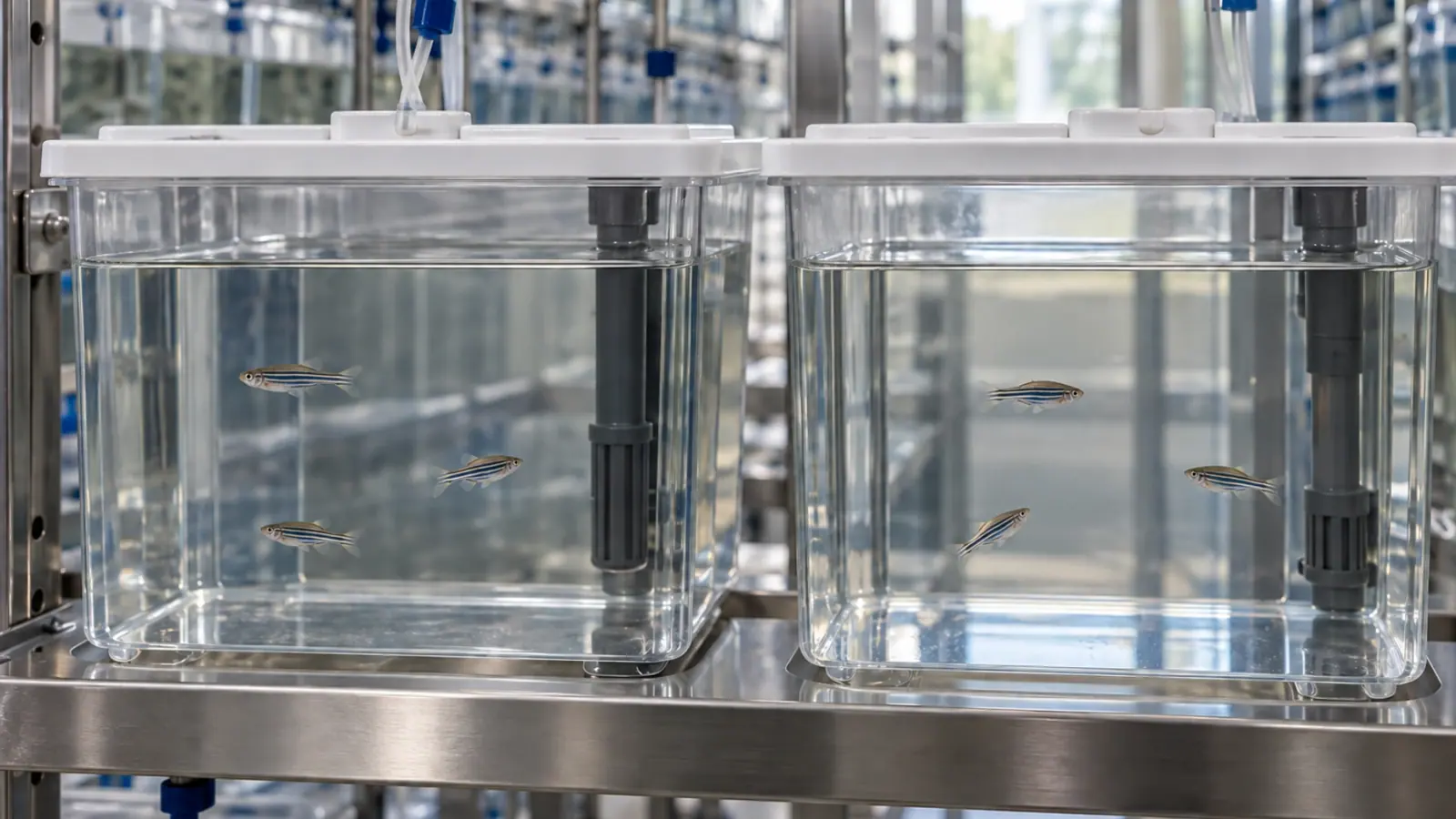
Zebrafish lines: preserve identity from tank to sample
A tank mix-up can break the connection between line, specimen and result. Link parents, clutches and movements to preserve genetic identity without mistaking diversity for error.


- Content type
- Practical guide
- Sector
- Research facilities
- Animal group
- Zebrafish
- Keywords
- ReproductionPCRBiosecurity
Scientific identity must follow the fish
A zebrafish line can acquire the wrong identity without an obvious change in appearance. The discrepancy may become apparent only when offspring or samples produce unexpected findings. Maintaining a facility’s health status and maintaining accurate genetic identity are related responsibilities, but success in one does not establish success in the other.
Bedell and colleagues’ 2025 Zebrafishology recommendations ask researchers to report strains, line origins, genetic backgrounds and relevant crosses, using nomenclature linked to ZFIN. They do not measure the frequency of tank mix-ups. Their value for this problem is to identify the information that an experiment needs if its biological material is to remain interpretable.
We propose translating those reporting requirements into a traceable connection between parents, offspring, tanks, samples and data. This approach complements health procedures for incoming lines. It does not describe a genotyping collection method or imply that every documentation error creates an infectious disease event.
Keep the line name, genotype and background distinct
A short tank label can identify a resource without describing its complete genotype. Genotype refers to the genetic characteristics being considered in an animal; an allele is a version of a gene or locus. The record should lead to the precise nomenclature and the method used to establish the information on which the project relies.
Background also matters. Zebrafishology explains that laboratory strains are not interchangeable and that wild-type stocks retain genetic diversity. Similar appearance or a label reading “WT” should therefore not replace identification of the strain actually used. A resource name is an entry point into a record, rather than a substitute for that record.
For breeding, we suggest retaining both parental identities or parental groups, the date, a clutch identifier and the destination of the offspring. A tank label need not display an entire pedigree. It does need a reliable connection to a record where that pedigree and the relevant decisions can be recovered.
Treat each movement as a recorded transaction
When fish move, their identity should move with them. A workable procedure can connect the source identifier, destination identifier, date and operator. The system may be simple, but it should prevent a correction from remaining solely in the memory of the person who carried out the transfer.
Keeping containers from different clutches physically distinct during an operation can reduce opportunities for documentary confusion. The procedure should also accommodate interruptions, including a telephone call, a staff change or an unfinished task. Someone returning to the work should be able to determine what has already happened without guessing.
A second check may be useful at steps where an error would have especially substantial consequences, such as pooling offspring or sending animals to another team. This is a proposed management arrangement, not an experimental claim of a measured reduction in mistakes. Its usefulness should be assessed in the local workflow.
Connect the test result to the animal sampled
Preserve the connection between animal, sample and result. A genotype result belongs to an identified specimen collected by a stated method. If the specimen’s origin is uncertain, a technically precise assay does not automatically restore the identity of the fish from which it was supposed to have come.
DNA testing answers the targets included in the assay. Confirming an expected allele does not establish every feature of the genetic background. Record what was tested, how the finding was interpreted and what remains unresolved. Select controls with the scientific team instead of accumulating tests without a defined question.
Experimental datasets should retain a link to the identity accepted at the time of use. A later correction to the facility database should not silently rewrite the description of a completed experiment. Date the correction and assess which samples, crosses or datasets may depend on it.
Make uncertainty visible before trying to resolve it
When identity becomes doubtful, we recommend flagging the uncertainty first and pausing uses that depend on the disputed information. This might involve a cross, a transfer or inclusion in a particular analysis. Keep the response proportionate: a damaged label alone does not demonstrate that fish have been mixed.
Reconstruct movements, clutches and associated specimens. Retain the original record and document the evidence that resolves, or fails to resolve, the discrepancy. Where targeted genetic testing could answer the question, define its purpose before collecting material and consider the implications of sampling for the animals.
Unresolved identity may require excluding data from a specific analysis or reconsidering the intended use of a group. It does not justify assigning an identity arbitrarily to make the database complete. Decisions about the animals must remain within the project framework and involve the appropriate responsible people; no automatic disposition is proposed here.
Preserve diversity while documenting its origin
Genetic diversity can be useful in a model and should not be confused with an identification error. Zebrafishology encourages researchers to consider that diversity in experimental design and report breeding practices. Traceability helps establish which backgrounds and relationships are present rather than assuming uniformity that has never been demonstrated.
Husbandry, life stage and sex where relevant should accompany genetic information in the methods. Genotype does not replace those observations. Two precisely named groups cannot be assumed experimentally comparable if their housing and treatment histories remain unknown.
Reviewing one completed experiment against the facility record can expose missing links. Can the team recover the parental background, clutch, tank history, sample identifier and test interpretation? This practical check is intended to assess the information chain, not to award a universal compliance score or claim that a single review validates every line.
Conclusion: preserve the connection between animals and data
A correctly named zebrafish line remains scientifically useful only if its identity follows parents, clutches, movements and specimens. Records should allow a discrepancy to be detected and a correction to be explained. That protects interpretation while respecting the difference between biological diversity and uncertain identification.
Vetofish can help develop these arrangements through our consultancy and support services. Our work with research establishments connects aquatic facility management, health monitoring and the information needed by projects using fish.


