

Zebrafish rheotaxis: check water flow and video tracking
Facing upstream is only one part of a larva’s response to water flow. A protocol published in 2025 describes how to measure station holding while checking the flow experienced by each fish, lighting, temperature and the reliability of video tracking.
- Content type
- Protocol / technique
- Sector
- Research facilities
- Animal group
- Zebrafish
- Keywords
- EthogramTemperatureLighting
A fish can face upstream while still being carried downstream. Orientation and station holding therefore describe different aspects of its response to water flow. A rheotaxis assay needs to establish which of these it is measuring before the resulting numbers can be compared.
Sophie Cohen-Bodénès and colleagues describe such an approach for larval zebrafish, Danio rerio, in a protocol published in 2025. The method combines a filmed microflume with analysis of movement and position. Water flow, the recording environment and tracking output all need checks before results can be compared.
Connect the measure to the biological question
The lateral line detects water movement through sensory organs called neuromasts. It contributes to rheotaxis alongside other sensory inputs. Behaviour in a current should consequently not be interpreted as an exclusive readout of lateral-line function.
Holding position requires a larva to compensate for moving water. Its orientation cannot show how successfully it does so. Trajectories, location within the chamber and fluctuations in movement provide additional information.
An assay should identify the property being compared: orientation, downstream displacement, spatial stability or time classified as rheotaxis. These outcomes are related, but their definitions differ. A result should remain linked to its operational definition and calculation.
This also sets a limit on interpretation. An unusual response can prompt further investigation without identifying the cause of a sensory or locomotor difference by itself.
The environment is part of the assay
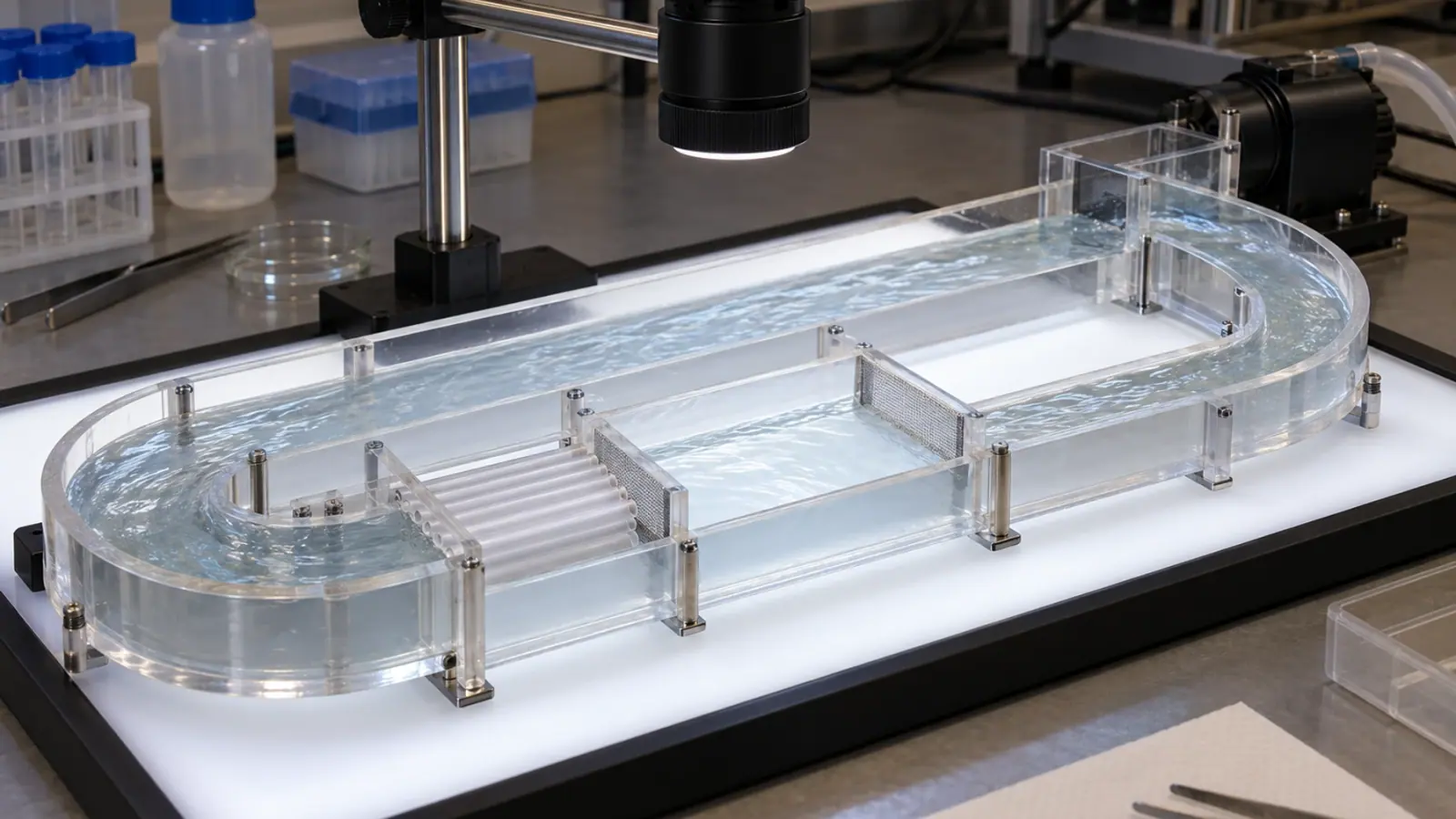
The apparatus contains a translucent microflume, a flow-straightening section and an arena holding one larva. A camera observes from above, while infrared illumination is supplied from below.
Visible light cues are reduced during the trials to limit visual guidance. This is part of the definition of the test. A recording made under different visible lighting should not be assumed to measure the same combination of sensory responses.
The reference sequence uses ten seconds without flow, twenty seconds with flow and a further ten seconds without it. The phases place the response alongside a starting activity period and a period after stimulation. They describe this protocol rather than an optimal duration for every stage or species.
For a research facility, documenting these conditions is as important as recording the identity of the group tested. Otherwise a change in the assay can be mistaken for a biological difference.
Calibrate the flow experienced by the larva
The position of a pump control is not a measurement of water velocity inside the arena. The flume’s geometry, water level and bubbles can change conditions without an obvious change to the control setting.
The protocol therefore includes a separate assessment of flow velocity without the fish. Tracking a visible front over a known distance requires a reliable spatial scale and acquisition timing. The camera’s recording frame rate must be distinguished from playback speed.
That check makes a comparison interpretable. Matching electrical settings in two runs does not necessarily match the hydrodynamic exposure. Calibration records should identify the configuration and the series of trials to which they apply.
A review can then ask whether a response changed under comparable flow conditions, rather than relying on the assumption that the same knob position produced the same current.
Review what the software followed
The analysis combines DeepLabCut tracking of body landmarks with SimBA extraction and classification of behavioural features. These tools make video analysis more manageable, but their output remains something to verify.
A bubble or piece of debris can be assigned a body-part label. A smooth-looking trajectory may then represent an object instead of the animal. The protocol includes reviewing annotated videos and correcting tracking when needed.
The analysis record should connect raw recordings, prepared videos, calibration and outputs. Cropping or changing image scale affects the conversion from pixels to distance. Changes to classification criteria can likewise alter the meaning of a reported behavioural duration.
Keeping software versions, retained settings and exclusion reasons with the results allows another reviewer to understand those choices. Many frames from one larva remain repeated observations of that individual, rather than many independent biological replicates.
Reviewing these details helps separate confidence in a numerical output from evidence that the intended behaviour was measured correctly.
Temperature and preparation can change during a session
Infrared illumination can warm the small water volume during successive trials. The authors identify heating as a practical issue and include temperature monitoring in the assay. Room or incubator settings cannot automatically describe the water inside the microflume.
Bubbles can affect both the current and image tracking. Preparation problems therefore need to be considered before an unusual trajectory is attributed to a biological treatment. Recording a technical deviation helps explain why a trial may differ from the rest of a session.
The protocol also calls for observing spontaneous swimming before a larva is tested. Inclusion criteria should be specified and recorded. Removing animals with particular starting profiles changes the population represented by the remaining results.
These are connected parts of measurement quality and animal observation. They should remain visible in the final interpretation rather than disappearing once a tracking file has been generated.
Compare defined responses under documented conditions
The protocol provides a framework linking measured flow, filmed behaviour and checked analysis. It does not establish a clinical normal range for every larva or a single response that diagnoses the source of a sensory difference.
Vetofish can support a review of the setup and help formalise observation, exclusion and traceability criteria. The aim is to make series comparable and distinguish biological variation from changes in the conditions used to observe it.
To move from evidence to action, explore our advice and support service and our expertise for research facilities.


