

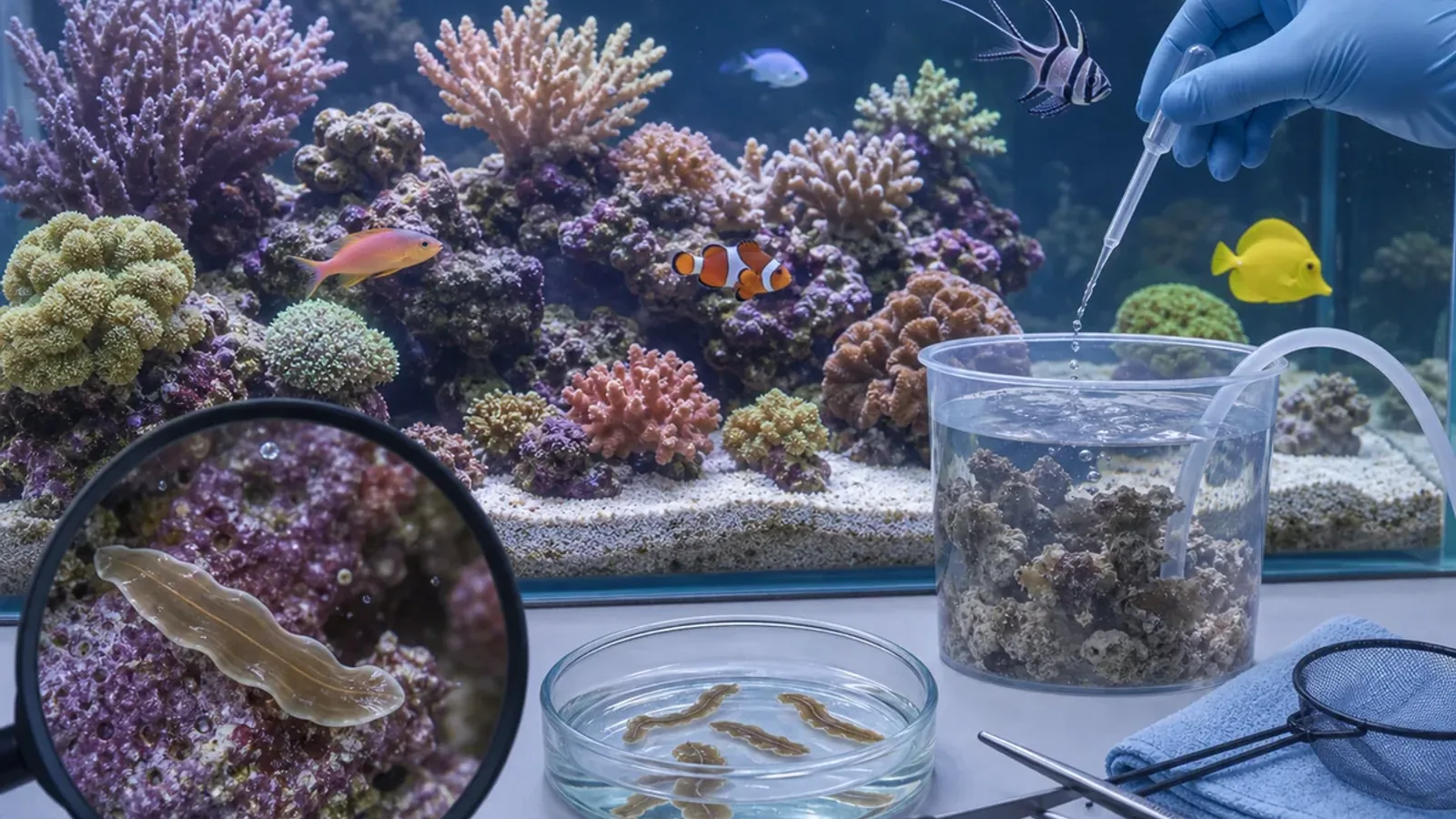
How can harmful flatworms be controlled in a reef aquarium?
Aquarists often use “planarian” for several aquarium flatworms that do not share the same hosts or level of risk. Before treating, examine their shape, location and associated damage: red or brown worms on surfaces require a different response from polyclads that feed on Acropora tissue. Clear photographs, nighttime coral inspection and expert identification help avoid treating the wrong organism.
Isolate and reduce the population
Quarantine new corals before introduction. Once an infestation is found, do not transfer water, mounts or tools to other systems. Siphon visible worms through narrow tubing and move badly affected fragments out of the display for examination. Check the underside and base of corals because attached egg clusters may survive dips and require repeated inspection. For a closer look at equipment separation and repeated inspections, see the guidance on coral quarantine.
Manual removal lowers the burden but is rarely a complete solution. Combine it with coral monitoring, removal of accessible eggs and correction of conditions that favour proliferation, while avoiding abrupt changes that destabilise the reef.
Why a predator is not a dependable treatment
Some fish and invertebrates may eat flatworms, but performance varies with the species, the individual animal and the environment. Adding an animal solely as a treatment can create compatibility or welfare problems without clearing the infestation. It cannot replace identification and quarantine.
When levamisole treatment may be appropriate
Research on an Acropora-eating flatworm found that levamisole or praziquantel combined with water movement removed more than 90% of worms from coral fragments under the experimental conditions. The study evaluated fragment dips and supports the value of these compounds, but did not test the Vetofish whole-system protocol below.
When whole-system treatment is justified and prescribed by a veterinarian, the Vetofish field protocol uses 0.5 mg levamisole per litre of treated water (0.5 ppm), equivalent to 0.5 mL of a 10% injectable solution per 100 litres. The veterinarian must confirm the product, its strength, actual water volume and compatibility with the organisms present.
Prepare the whole-system treatment
- prepare enough new seawater for a large water change;
- calculate actual water volume, including filtration and excluding displacement by décor;
- provide at least 150 g of fresh activated carbon per 100 litres;
- clean the skimmer, remove chemical filtration media and keep filtration running;
- siphon out as many worms as possible before treatment to limit the load released as they die.
Follow the Vetofish timetable
- H0: add the prescribed quantity of levamisole;
- H+2 h: place activated carbon in the filtration;
- H+4 h: siphon out dead worms;
- H+6 h: perform the prepared water change;
- H+24 h: remove the activated carbon.
This field protocol must remain under veterinary supervision. A large flatworm die-off can quickly release a harmful load affecting corals and other invertebrates. Be ready to stop the treatment, increase oxygenation and replace more water if animals respond poorly.
An external dip remains preferable when infestation is limited to identifiable fragments: use a product and protocol appropriate to the worm and coral, then rinse in a second container of clean seawater before returning the fragment to quarantine.
Monitor after intervention
Siphon detached organisms, check for eggs and repeat inspections across several life-cycle intervals. A large die-off inside the display can rapidly impair water quality, so monitor the animals, oxygenation and nitrogen compounds, including the correct interpretation of ammonia and ammonium. Seek advice from a veterinarian or an experienced coral-health professional if damage progresses rapidly or identification remains uncertain.