

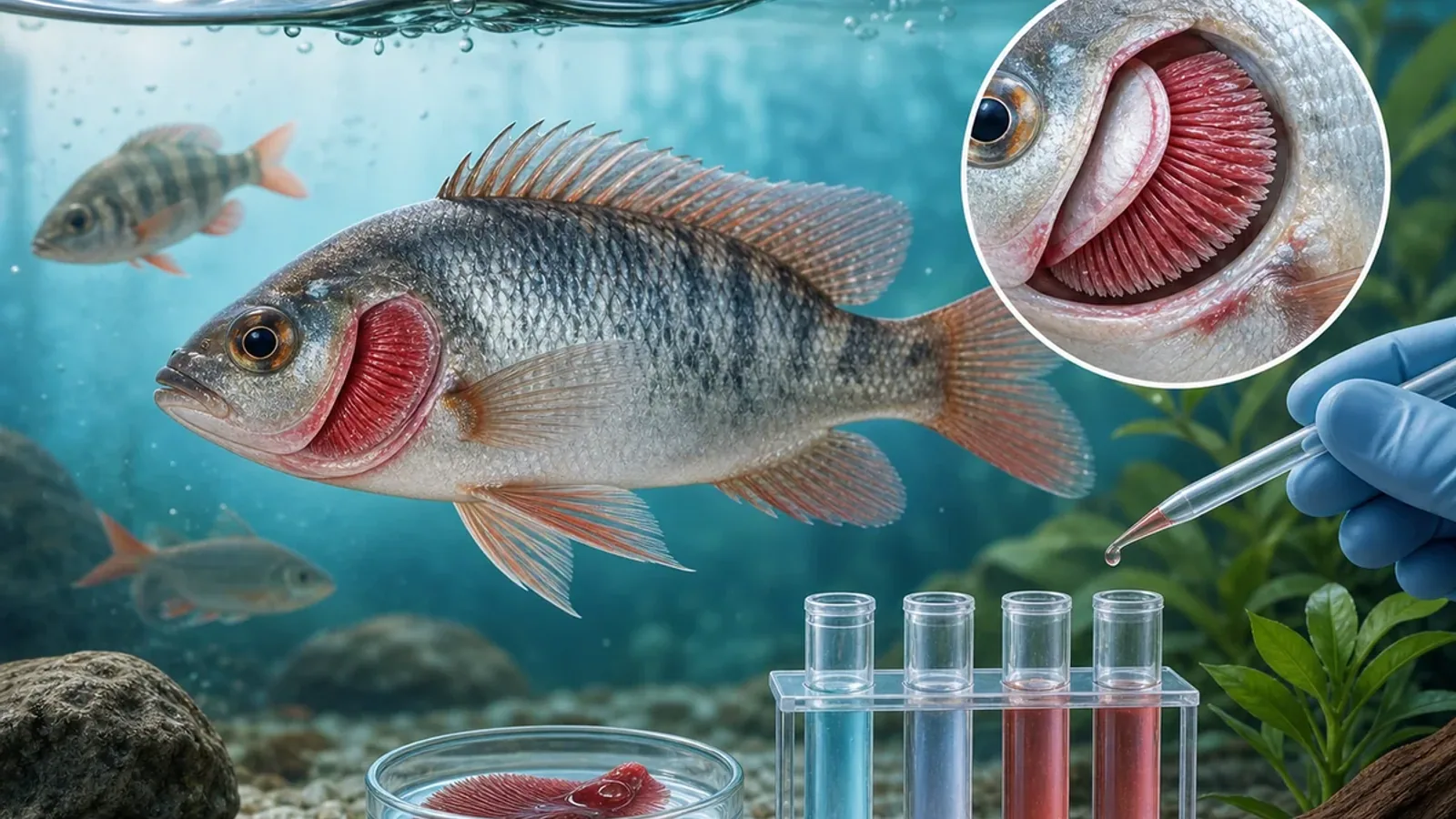
Why is nitrite toxic to freshwater fish?


Nitrite NO2− enters through branchial ion-transport pathways and oxidises haemoglobin to methaemoglobin, which carries oxygen poorly. Fish may breathe rapidly, become lethargic or develop brownish blood, but a lack of signs does not rule out exposure.
Sensitivity varies greatly between species and with exposure duration. Water chloride affects nitrite uptake at the gills, but its protective effect also differs by species. Alkaline pH is not a general explanation for nitrite toxicity, and there is no single maximum suitable for every fish.
What should be done after detection?
Check the test unit—NO2− or NO2-N—and confirm the result. Increase aeration, reduce feeding briefly if fish condition permits, remove waste, check filter flow and carry out a compatible water change. Measure ammonia as well and monitor nitrite until it is no longer detected by the test used.
Chloride addition may form part of a professional response calculated from the species, actual chloride concentration and measured nitrite. A fixed salt dose per litre should not be applied to every aquarium: it may be unnecessary, inadequate or incompatible with the animals and plants present.