

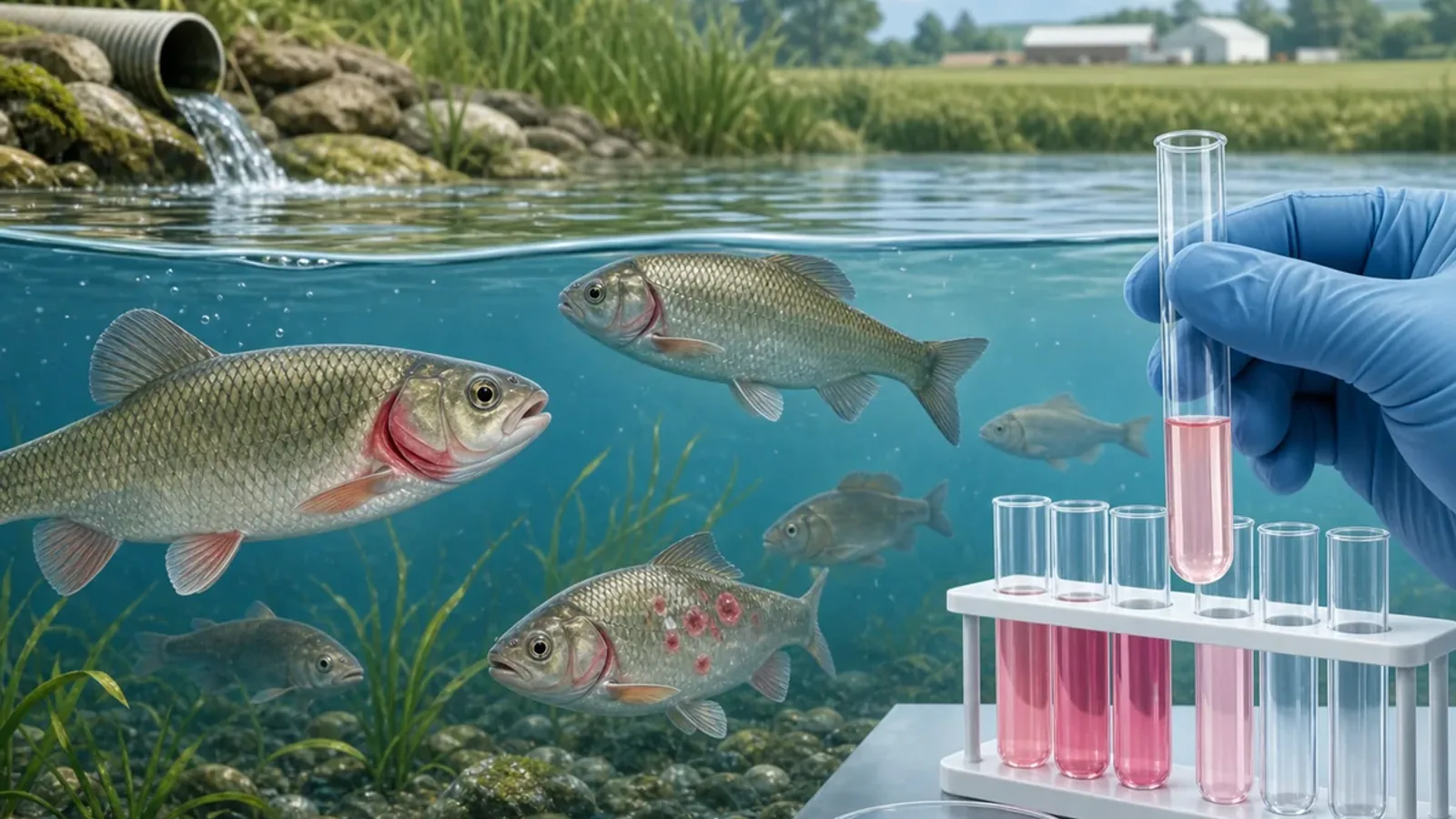
How toxic is nitrate to freshwater fish?


Nitrate NO3− is generally less acutely toxic than ammonia or nitrite, but it is not harmless. Prolonged exposure may affect growth, physiology or survival depending on species, life stage, concentration, duration and water chemistry. No universal threshold separates safe and toxic water for every fish.
Compare results correctly
A laboratory or meter may report nitrate as mg/L NO3− or mg/L NO3-N. Multiply NO3-N by approximately 4.43 to obtain NO3−; divide by 4.43 for the reverse conversion. This difference explains many misleading comparisons.
Nitrate is the usual end product of aerobic nitrification. A conventional biofilter converts ammonia and then nitrite, but does not rapidly remove nitrate. Nitrate does not have to be converted back to nitrite in the filter before it can have chronic effects.
How can nitrate be reduced?
First identify the source: feed load, stocking density, accumulated waste, inadequate water replacement or nitrate-rich source water. Reduce excess inputs and use staged water changes with compatible water. For example, replacing 25% of water at 80 mg/L with water at 20 mg/L gives a theoretical 65 mg/L after mixing; measure the actual result afterwards.
Plants can assimilate some nitrogen and controlled denitrification can be used in selected systems, but neither replaces nitrate monitoring and broader water-quality management.