

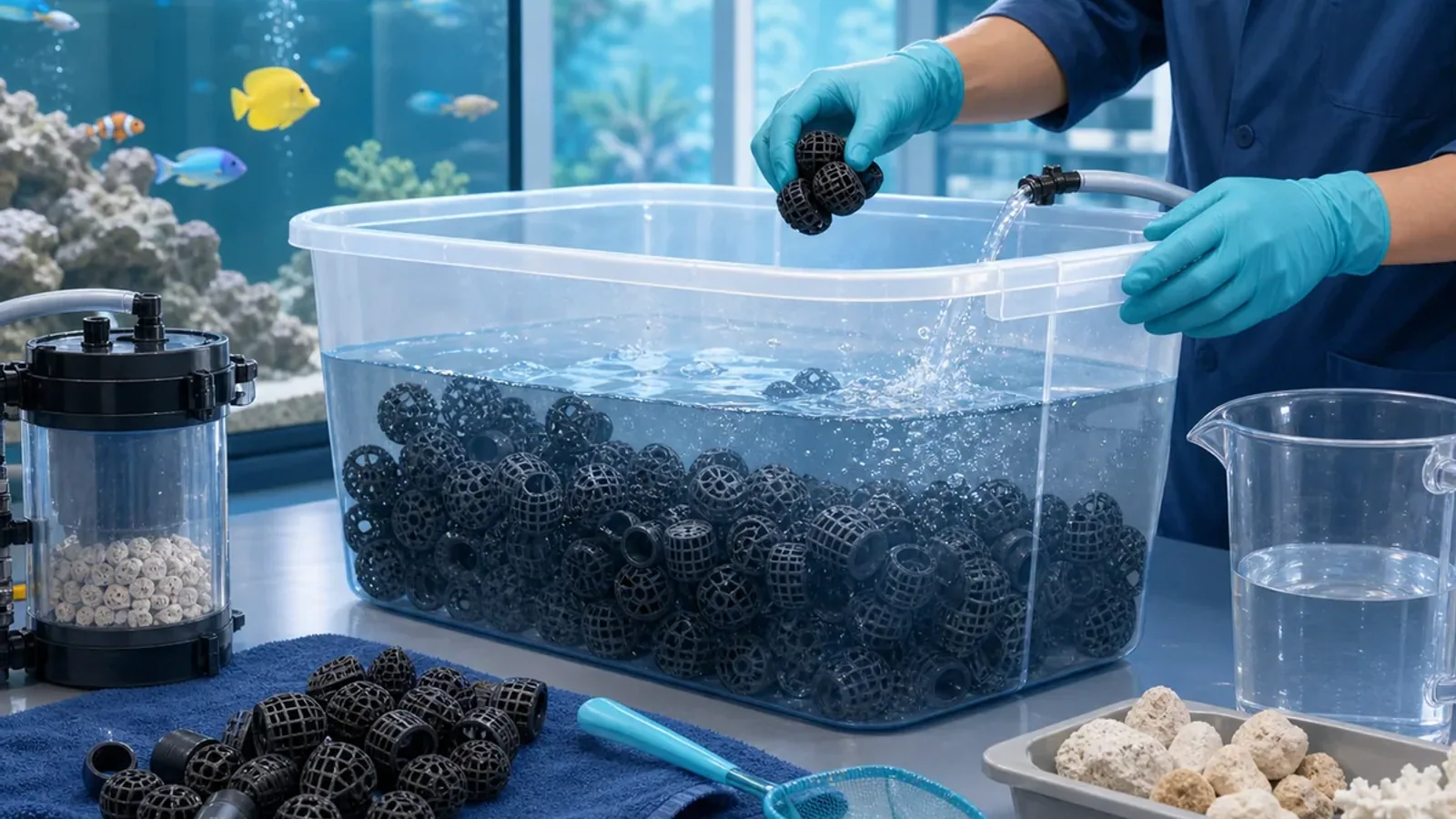
How should new plastic biological filter media be prepared?


New plastic biological media provides colonisation area; it does not yet carry a nitrifying biofilm able to process fish waste. Preparation depends on its form and filter: floating moving-bed elements, fixed media, foam and cartridges are not installed in the same way.
Follow the media and filter instructions
Check compatibility, fill fraction, retention screens and the recommended flow. Moving media require enough air or water movement to mix without jamming or entering the pump. Some manufacturers describe an initial period during which the media floats or moves differently before biofilm develops.
Rinse manufacturing dust as directed, using water compatible with the system. If media will be seeded, avoid chlorinated water that could harm transferred microorganisms. There is no basis for assuming that all plastic media carry wax and require oxidant stripping.
Vetofish permanganate protocol
For bioballs, Kaldnes K1/K3 and Helix media whose manufacturer confirms compatibility, the Vetofish protocol cleans and oxidises the surface film before colonisation:
- fill a plastic container with 100 litres of water;
- dissolve 20 g potassium permanganate (KMnO4);
- immerse the media for 48 hours;
- rinse it thoroughly before placing it in the filter.
Do not use this method for polyethylene-foam “chip” media or plastics of unknown compatibility. Potassium permanganate is an irritating, corrosive oxidant: wear gloves and goggles, work away from animals and follow the safety data sheet. Preparation does not replace biological maturation as described below.
Allow the biofilter to mature
Nitrifying microorganisms convert ammonia to nitrite and then nitrate. This community takes time to establish, and its capacity depends on temperature, pH, alkalinity, oxygen, flow and organic loading. Media starting to sink or change colour does not prove adequate function.
For a new system, use a controlled start, preferably fishless, or a validated professional protocol. In an established system, increase loading gradually and retain some healthy mature media. Measure total ammonia nitrogen and nitrite regularly until both remain controlled under the intended load. Reduce feeding and correct water quality if either rises.
Keep a biofilter wet, oxygenated and supplied during transfer. Do not seed it from a system of unknown health status because the media can also carry unwanted agents.