

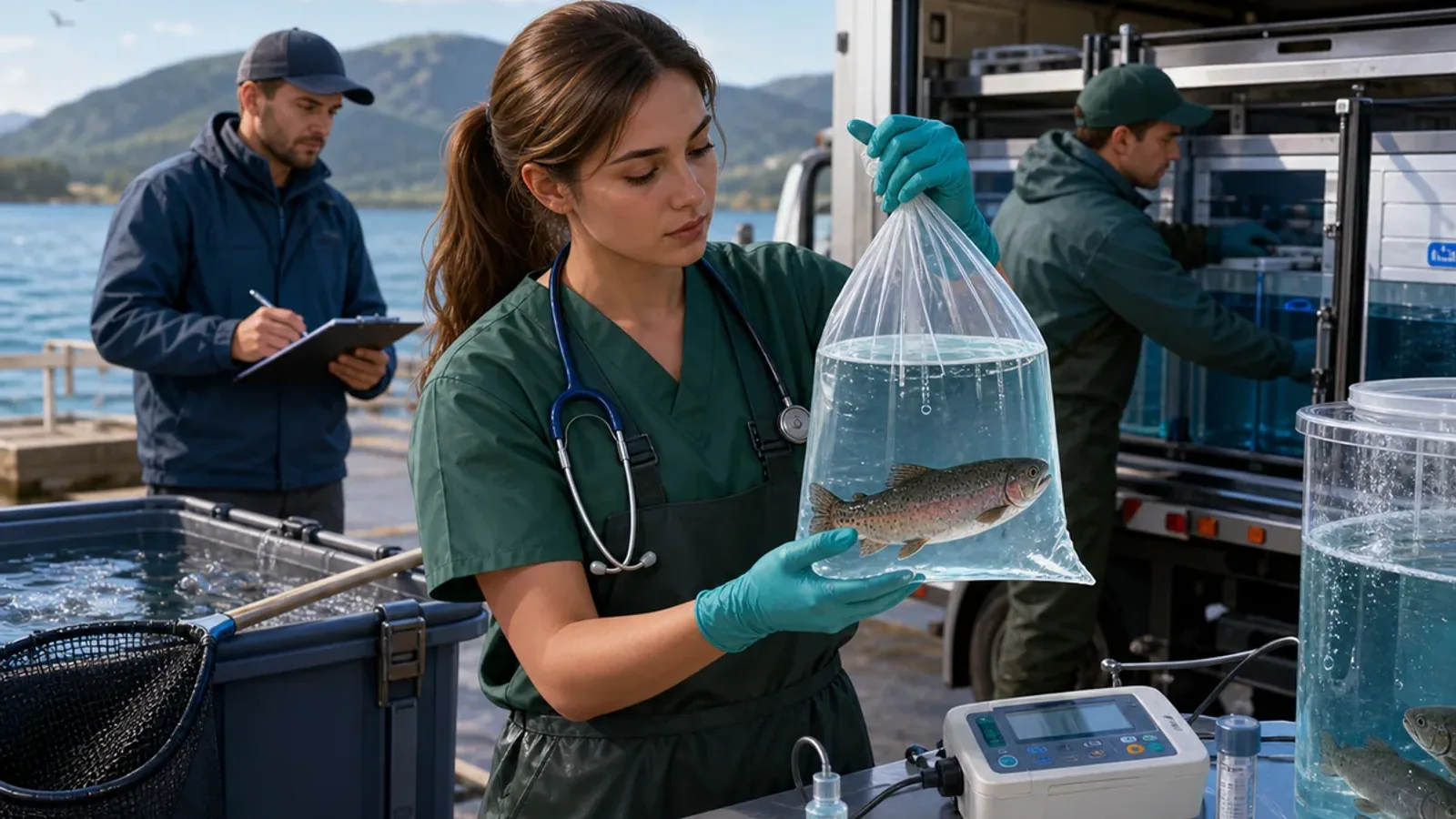
What authorizations are required to transport live fish?
Since January 5, 2008, under EC Regulation No. 1/2005, any person carrying out, on his own behalf or on behalf of a third party, the transport of live vertebrate animals (mammals, birds, fish, etc.…) must hold an authorization.
This authorization is broken down into 3 points:
- The driver must know how to transport animals: he must hold CAPTAV (or TAV training for fish) or have obtained a recognized diploma.
- The means of transport must be approved to be able to transport animals.
- A commitment from the farm.
Scope of application
This Regulations apply to the transport of animals carried out as part of an economic activity. The activity is interpreted in the broad sense and can result from the transport itself or its purpose (sale of animals, various transactions, driving to the slaughterhouse or assembly center).
It does not apply, even if it is carried out as part of an economic activity, if the transport takes place over a distance of less than 65 km.
However, this exemption does not exempt compliance with general principles, particularly concerning the fitness of animals for travel and the conformity of means of transport.
Driver qualification
There are 2 ways to obtain a driver qualification:
A recognized diploma
In accordance with decree of November 12, 2015:
- State diploma of veterinary doctor
- Brevet of higher agricultural technician option “animal productions”
- Brevet of higher agricultural technician “aquaculture productions”
- Brevet of higher agricultural technician option “aquaculture”
- Brevet of technician agricultural, production option, aquaculture specialty
- Professional baccalaureate “aquaculture production”
- Professional baccalaureate “marine cultures” co-signed with the ministries of national education and equipment
- Professional agricultural and maritime certificate “aquaculture production” option
- Professional certificate “aquaculture production”
- Professional certificate “operation manager” maritime aquaculture - continental”
- Brevet of professional agricultural studies “fish farming”
- Brevet of professional agricultural studies “aquaculture work”
- Brevet of professional agricultural studies “aquaculture production” Recognized training “Transport of Live Animals” (species not concerned by the CAPTAV)
Complies with regulations (EC) n°1/2005, and the official list of which is managed by the bergerie nationale de Rambouillet(interactive map). The 12 organizations recognized for providing TAV “aquaculture species” training are as follows (updated on 08/25/2022):
- Amazone Consultants 119 rue de Grenelle, 75007 Paris
- EPLEFPA de Brioude-Bonnefont - CFPPA de Brioude-Bonnefont Bonnefont, 43100 Fontannes
- EPLEFPA de Merdrignac - CFA de Merdrignac 6 rue du Porhoët, 22230 Merdrignac
- EPLEFPA de Saint Joseph - CFPPA de Saint Joseph 24 rue Raphaël Babet, 97480 Saint Joseph
- EPLEFPA de Vire – CFPPA de Vire Les champs de Tracy, route de Caen, 14500 Vire
- EPLEFPA des Combrailles - CFPPA des Combrailles Avenue Jules l’Ecuyer, 63390 Saint Gervais d’Auvergne
- EPLEFPA du Loir-et-Cher – CFPPA de Vendôme Areines BP 106, 41106 Vendôme Cedex
- EPLEFPA du Morvan – CFPPA Château-Chinon Rue Pierre Mendes France, 58120 Château-Chinon
- ISTAV – Scientific and Technical Institute of Animals in the City 85 avenue Pasteur, 93260 Les Lilas
- Repti Conseils & Training 62 Avenue Krüger, 91800 Brunoy
- The dog domain North zone, Pôle Caraïbes airport, 97139 Les Abymes
- Zoopro 58 avenue du Maréchal Foch, 83000 Toulon
Vehicle conformity certificate and commitment
To do with the DDPP of the department
Commitment of the farm
This commitment allows the legal manager of the company (farm, etc.) to certify that he is aware of all the points to be able to transport or have transported the animals on his farm, namely:
- Comply with the regulatory requirements relating to the transport of animals in terms of animal protection and health;
- Return the duly completed travel log, in the case of long-term travel, to the Departmental Directorate of Veterinary Services of the place of departure of the animals within one month after the end of the trip;
- Ensure that at no time, from departure until arrival at destination, the batch of animals transported comes into contact with animals of a different health status from them, and that vehicles are cleaned and disinfected, as soon as possible after use;
- Guarantee, at all times, the qualification of personnel to handle and transport animals, as well as to give, if necessary, appropriate first aid to transported animals.
Reference texts
In France, the legislative and regulatory provisions (decrees and orders) relating to the transport of live animals are based on:
- Council Regulation (EC) No. 1/2005 of 22 December 2004 relating to the protection of animals during transport and related operations, and amending the directives 64/432/EEC and 93/119/EC and Regulation (EC) No 1255/97;
- Corridendum to Council Regulation (EC) No 1/2005 of 22 December 2004 on the protection of animals during transport and related operations and amending Directives 64/432/EEC and 93/119/EC and Regulation (EC) No 99-5 January 6, 1999 relating to dangerous and stray animals and animal protection;
- Decree of November 12, 2015 relating to the authorization or registration of training organizations implementing the training required for people carrying out live animal conveyor functions;
- DGER/SDPFE/2015-1085 memo of December 14, 2015: Specifications for the authorization or registration of training organizations for continuing professional training activities relating to the welfare of animals during their transport by road.