

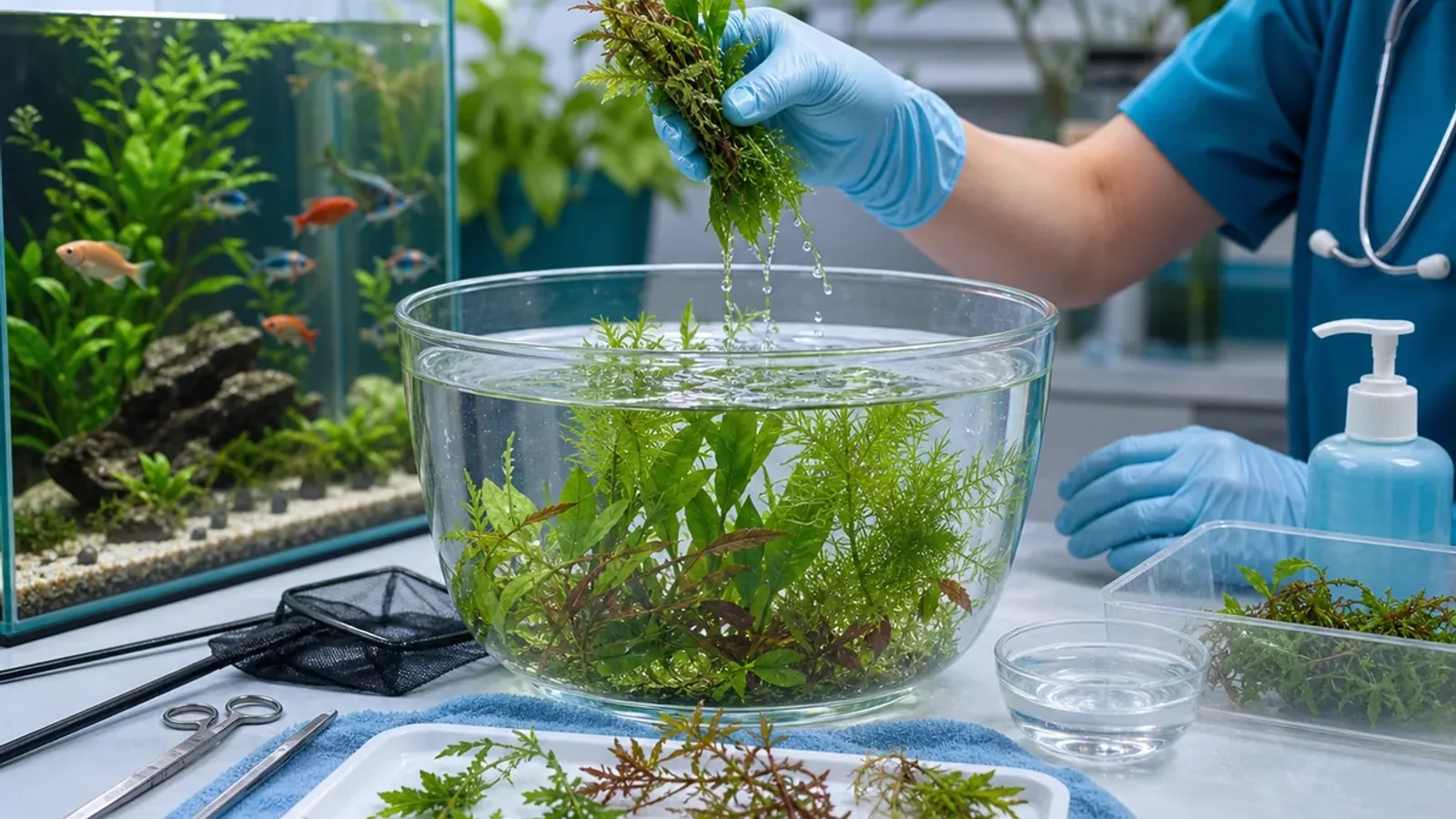
How can unwanted organisms on aquarium plants be reduced?
An aquarium plant can carry water, substrate, eggs, invertebrates, algae and microorganisms. No short dip makes it “sterile” while guaranteeing survival. The safest approach is to choose a suitable source, inspect the plant and observe it in quarantine before placing it with fish.
Reduce risk at purchase
For a highly sensitive aquarium, favour tissue-cultured plants or stock supplied without aquatic animals, while checking the supplier’s conditions. Reject damaged or algae-covered plants and plants from systems containing sick animals. Never release a plant, snail or transport water into the natural environment.
Inspect, rinse and isolate
Remove the pot, wool or gel according to the growing instructions. Examine leaves, stems and roots under good lighting; manually remove visible eggs, invertebrates and damaged parts. Rinse with compatible water, then place the plants in a separate quarantine container or aquarium with dedicated equipment.
Observation time should reflect the target risk and the suspected organism’s biology. Inspect surfaces repeatedly and remove organisms as they emerge. Biosecurity recommendations for aquatic facilities similarly favour quarantining living items until contaminating stages are no longer expected.
Vetofish permanganate protocol
When the objective and plant are compatible with potassium permanganate, use the Vetofish protocol:
- prepare a stock solution with 1 g potassium permanganate in 1 litre of water;
- take 5 mL of this stock and dilute it in 1 litre of water for the dip;
- immerse the plants for no more than 30 minutes;
- rinse thoroughly with compatible water, then keep the plants in quarantine.
Do not use this dip on fragile plants, notably Cabomba spp., Ceratophyllum spp. and Myriophyllum spp. Potassium permanganate is an irritating, corrosive oxidant: wear gloves and goggles, prepare it away from animals and dispose of the solution without releasing it into the natural environment. Keep the stock labelled, closed and protected from light; do not use it if concentration or stability can no longer be assured.
Snails, algae and infectious agents do not all respond in the same way. The dip reduces some risks but guarantees neither egg destruction nor plant sterility.
In a professional setting, identify the hazard first and have the health lead confirm that the protocol is compatible. Keep the plant in quarantine afterward to check tolerance and actual efficacy.
A plant that looks clean is not a health guarantee. For systems holding valuable or vulnerable species, combine controlled sourcing, quarantine, dedicated tools and monitoring instead of relying on a single dip. This freshwater-plant protocol does not apply to flatworms in a marine tank; see the separate guidance on harmful planarians in a reef aquarium.