

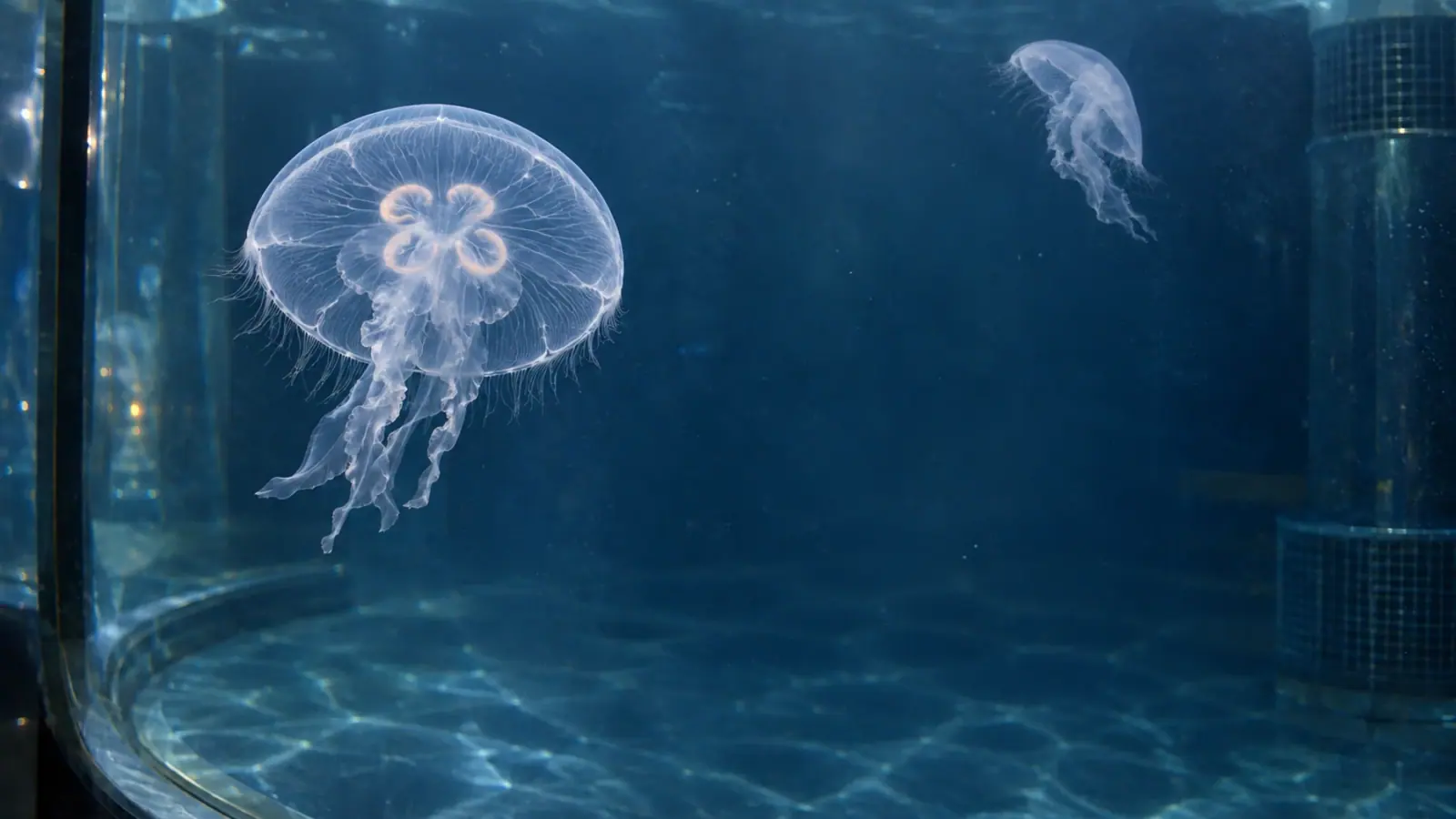
Adult jellyfish: investigate declining condition
An irregular pulse or damaged bell is a reason to investigate, rather than a diagnosis. For adult jellyfish in public aquariums, useful health records connect animal condition with feeding, water movement and recent changes to the exhibit.


- Content type
- Practical guide
- Sector
- Public aquariums
- Animal group
- Corals and invertebrates
Record the change before assigning a diagnosis
An irregular bell margin, reduced pulsation or poor prey capture should trigger a description of what has changed. None of these observations alone identifies an infectious disease. The 2025 AZA care manual brings morphology, movement and feeding together in routine health assessment. For adult jellyfish on display, this means following condition throughout exhibition rather than assuming that successful culture establishes continued health.
Species identity matters. Moon jellyfish in the genus Aurelia illustrate the problem: similar-looking animals can belong to different species. Where identification remains uncertain, the uncertainty should remain visible in the collection record. Performance, growth and thermal requirements cannot be transferred without qualification from another collection or a different geographic origin.
The initial record states when the change appeared, which enclosure is involved and how many animals are affected. One damaged individual presents a different investigation from deterioration spreading through a cohort. Comparable photographs and short videos can help establish progression while avoiding repeated handling merely to obtain another observation.
Look at movement through the enclosure
The manual describes a regular, coordinated contraction around the bell as part of routine assessment, interpreted for the species concerned. It does not establish a universal pulse rate that divides healthy from unhealthy animals. Pulsation also contributes to water movement and feeding, so an assessment of swimming should remain connected to observations made during meals.
An animal carried around by the current may not be swimming effectively. Conversely, a pulsing jellyfish can remain pressed against a surface if enclosure flow prevents it from moving away. Follow its trajectory through the water column: repeated contact, accumulation beside an outlet and recovery after disturbance provide information that a brief view of the bell alone may miss.
For Aurelia, the manual warns that excessive flow may stop pulsation and compromise food collection. Check actual circulation, screen condition and recent maintenance rather than relying only on a pump setting. The setting records one part of the equipment; it does not capture every local water movement experienced by animals within the display.
Establish whether prey are being captured
Food visible in the tank is not proof of ingestion. Where the species and viewing conditions permit, observe prey capture, responses of the tentacles and oral arms, and food within digestive structures. The method must fit the animal’s anatomy and transparency. An observation that works for a moon jellyfish may be unsuitable for another species.
Movement and feeding are closely connected in the AZA manual. Reduced capture can accompany declining condition, but the direction of the relationship needs investigation. A hydraulic disturbance might impair feeding; an already compromised animal might also capture less food. Simply adding more feed without identifying the problem can make system maintenance more difficult without restoring intake.
Keep records of feed origin, distribution changes and observed ingestion. Nutrition cannot be reduced to the amount delivered. Prey size, accessibility and animal responses also matter. A manual covering multiple taxa and facilities cannot establish one feeding regime for every display, and differences between facilities should not be treated as evidence that one routine is universally superior.
Connect tissue condition to enclosure history
Bell, tentacle and oral-arm integrity belong in the assessment. Describe the affected area, extent and progression rather than naming an infectious lesion from appearance alone. Repeated surface contact, transfer-related damage and unsuitable water conditions are among the hypotheses that may need assessment. Their plausibility depends on the case history and the animals involved.
A timeline helps organise the investigation. Compare the onset of changes with cleaning, equipment replacement, introductions, new feed and adjustments to temperature or salinity. Temporal coincidence can identify a useful lead, but cannot establish responsibility by itself. Measurements and repeated observations should help determine whether the proposed connection is supported.
Age is another relevant variable. The manual notes that natural senescence can occur among adult jellyfish, including mixed-age groups. That possibility should not automatically explain collective deterioration. Cohort records are valuable precisely because they allow the team to ask whether a change follows age or affects animals from different origins at the same time.
Prepare veterinary assessment and containment together
Persistent deterioration, involvement of additional animals or a marked loss of normal function warrants discussion between aquarists, technical staff and the veterinarian. Bring observations, water measurements, maintenance records and earlier actions together. Any sampling should address a defined diagnostic question; capture without that purpose may add tissue damage while providing little useful information.
Biosecurity also concerns feeding tools, containers and links between exhibits. The AZA manual recommends preventing cross-contamination through appropriate procedures, including dedicated equipment. Moving an animal to isolation requires a suitable receiving enclosure. An unsuitable container can create another husbandry problem rather than provide an effective health-management response.
AZA recommendations originate from the institutional context of the facilities covered by that framework. They should not be presented as French legal requirements or transferred automatically to another jurisdiction. Local decisions need to account for the animals, installation and applicable rules. The manual does not convert a non-specific observation into a diagnosis or an automatic indication for medication.
Conclusion: measure the response to action
An investigation is useful when it produces an explicit working hypothesis and a follow-up plan. After a suitable correction, compare pulsation, trajectory, ingestion and tissue condition with the earlier record. Preserve observations of no improvement as well as favourable responses. Several simultaneous changes may be necessary during an emergency, but make it harder to attribute a later effect to one intervention.
Adult jellyfish surveillance therefore depends on repeated observation linked to enclosure history. Vetofish can help organise those records and diagnostic questions through our aquatic health expertise. Our support for public aquariums connects husbandry, technical operation and health decisions without promising a diagnosis from a photograph or a single measurement.


