

Antidepressants in rivers: what do fish studies establish?
Laboratory studies show that antidepressants can alter endocrine functions in fish. Interpreting a river signal requires the compound, concentration and exposed life stage to remain attached to the result, alongside the limits of field extrapolation.

- Content type
- Practical guide
- Sector
- Environment
- Animal group
- Fish
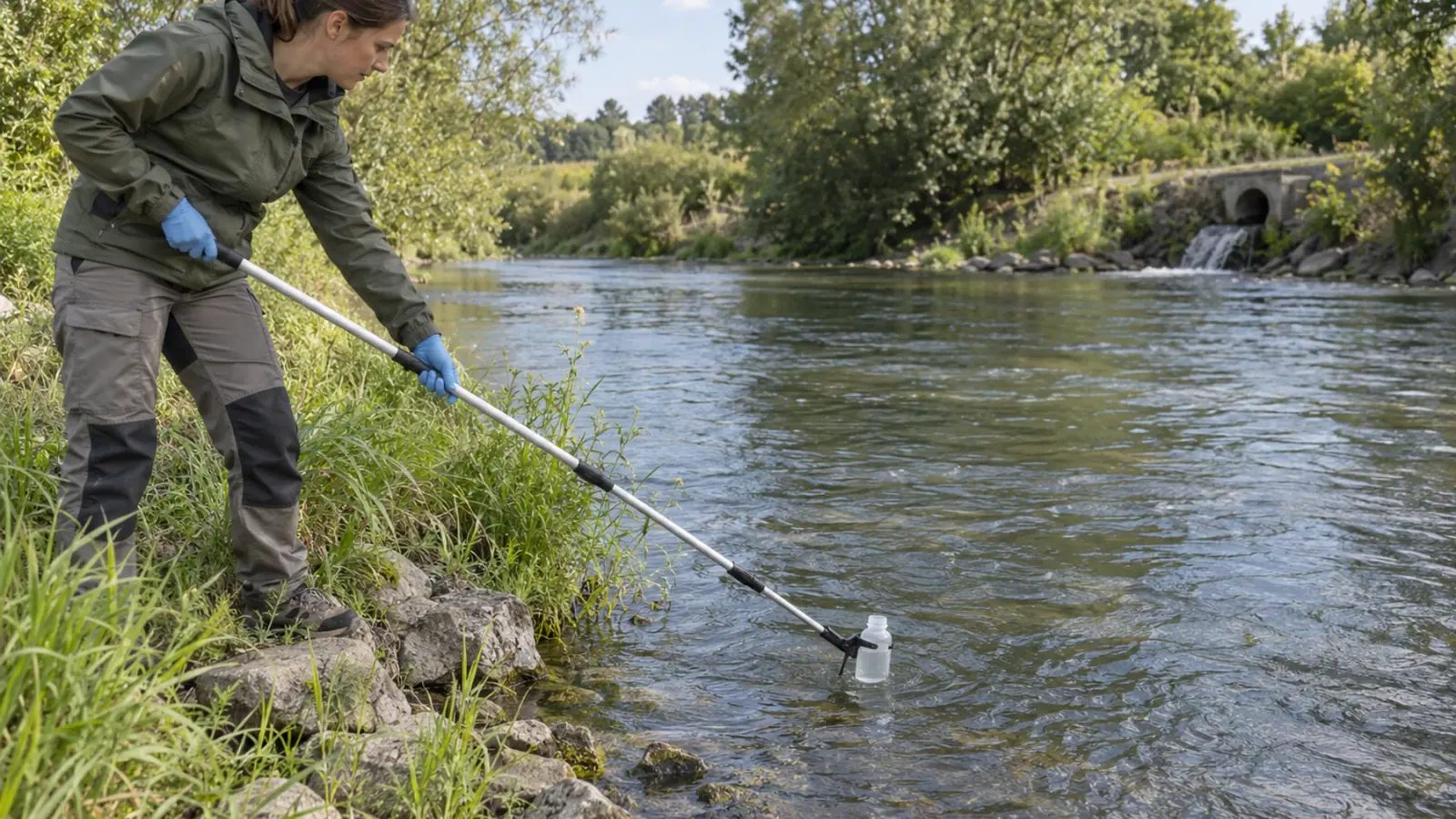
Detecting a medicine in a river and demonstrating an effect in a fish are different stages of investigation. Detection documents possible exposure; biological interpretation requires suitable measurements and a defined question. Environmental managers need to connect those stages without assigning every downstream change to one chemical simply because it is present in the catchment.
Thompson and Vijayan’s 2022 mini-review examines antidepressants as compounds capable of disrupting endocrine functions in fish. A 2019 zebrafish (Danio rerio) experiment by Vera-Chang and colleagues provides a specific example of what laboratory evidence can establish. These older publications support a practical synthesis. They do not describe the current condition of a particular river or establish a local contamination event.
A pharmacological target can matter in environmental assessment
Fluoxetine is a selective serotonin reuptake inhibitor. Monoamine signalling contributes to several vertebrate functions, including endocrine regulation. A compound developed to act on these systems in people may consequently be biologically active in fish. That mechanistic plausibility does not, by itself, predict the outcome of exposure at a given environmental concentration or in every fish species.
The review considers links with stress physiology, growth and reproduction. Findings vary with the compound, species, sex, developmental stage and experimental conditions. Antidepressants should not be treated as a single category with identical toxicological effects. Exposure through water, injection and exposure during early development answer different questions and must remain distinguishable when evidence is summarised for management.
Endocrine disruption here concerns changes in hormonal functions examined by the cited research. Altered activity alone does not identify its mechanism. Associated measurements and alternative explanations are necessary. Ecotoxicology connects contaminant occurrence and fate with biological responses; it cannot be reduced to a striking behavioural observation, nor can a plausible pathway substitute for evidence that the pathway operated in a particular investigation.
Two developmental exposure windows in a laboratory study
Vera-Chang and colleagues exposed zebrafish to fluoxetine during two periods. The first began three hours after fertilisation and ended at fifteen days post-fertilisation. The second ran from fifteen to forty-two days post-fertilisation. Nominal concentrations were 0.54 and 54 micrograms per litre, with controls not exposed to fluoxetine. Those details define the experiment being discussed.
The tested concentrations are not river safety thresholds. Nominal concentration refers to the prepared exposure and must not be confused with a contemporaneous measurement in every container. The exposure windows also differed in length. The authors acknowledge that duration may contribute to differences associated with developmental timing. A summary that attributes every difference solely to life stage would therefore overstate the design.
In adulthood, the researchers measured whole-body cortisol and behaviour during a novel-tank exploration test. They reported hormonal and behavioural changes that depended on sex and exposure window. Responses were not identical in every group. Describing the work as a uniform reduction in the activity of all exposed fish would remove a central feature of the findings.
Lower cortisol is not automatically a welfare benefit
Cortisol contributes to physiological responses to challenges. A lower value after chemical exposure may reflect an altered response rather than improved welfare. The 2019 study considered endocrine measurements alongside exploratory behaviour and discussed disruption of the stress axis. It does not support adding fluoxetine to fish environments as a way to improve their conditions or reduce ordinary husbandry stress.
Novel-tank behaviour is a test outcome. It does not directly measure survival, reproductive success or wild population abundance. A change in exploration can raise an ecological question, but answering that question requires additional evidence. Keep the studied mechanism, the individual response and possible population consequences separate, so that an implication is not reported as an outcome that was already measured.
Whole-body cortisol is also distinct from cortisol measured in holding water or plasma. The matrix, sampling time, handling and analytical method belong with the result. Comparing numbers across different matrices without validation can create a misleading signal. Recognising those differences helps teams choose a suitable measurement; it does not make the available methods interchangeable or rank them without reference to the question.
A wastewater discharge comes with a wider exposure context
River fish encounter mixtures and changing environmental conditions. Temperature, oxygen, flow, habitat and other contaminants can influence their state. A downstream observation needs to be interpreted within that history. A nearby wastewater treatment works does not prove that fluoxetine caused an observed behaviour or abnormality. Location can inform an investigation without establishing the causal explanation in advance.
Laboratory evidence helps formulate a hypothesis and identify potentially informative measures. It does not estimate risk for every local species. Record which compounds were actually investigated, their concentrations, analytical limits and sampling periods. A non-detection cannot exclude all exposure when the sampling design or method was unable to capture the relevant substance, period or concentration.
An investigation can combine chemical analysis, animal observations and habitat information through complementary expertise. Comparable stations and repeated observations help examine alternative explanations. The design must address the actual question. A generic panel of tests cannot guarantee that a later finding will be attributable to one compound, particularly where several exposures and environmental changes occur together.
Define what the monitoring programme needs to establish
Before sampling, specify whether the purpose is to detect exposure, investigate a mechanism or follow ecological condition. Samples and endpoints may differ across those aims. Reports should separate direct observations, analytical findings, hypotheses and unresolved uncertainty. A plausible mechanism remains a hypothesis for the site until evidence supports its involvement under the conditions being investigated.
The cited work supports attention to chronic effects and sensitive developmental periods. It does not establish a local legal requirement, discharge standard or universal corrective treatment. Management responses need site-specific assessment and the appropriate environmental and health expertise. They should not follow automatically from a zebrafish experiment conducted under a different exposure regime and for a different research purpose.
Conclusion and Vetofish support
Retaining experimental conditions makes the evidence useful without turning it into a diagnosis of a river. Our advice and support service can help aquatic environment stakeholders connect animal observations with health hypotheses and work with environmental specialists to define monitoring that answers a clear, proportionate question.


