

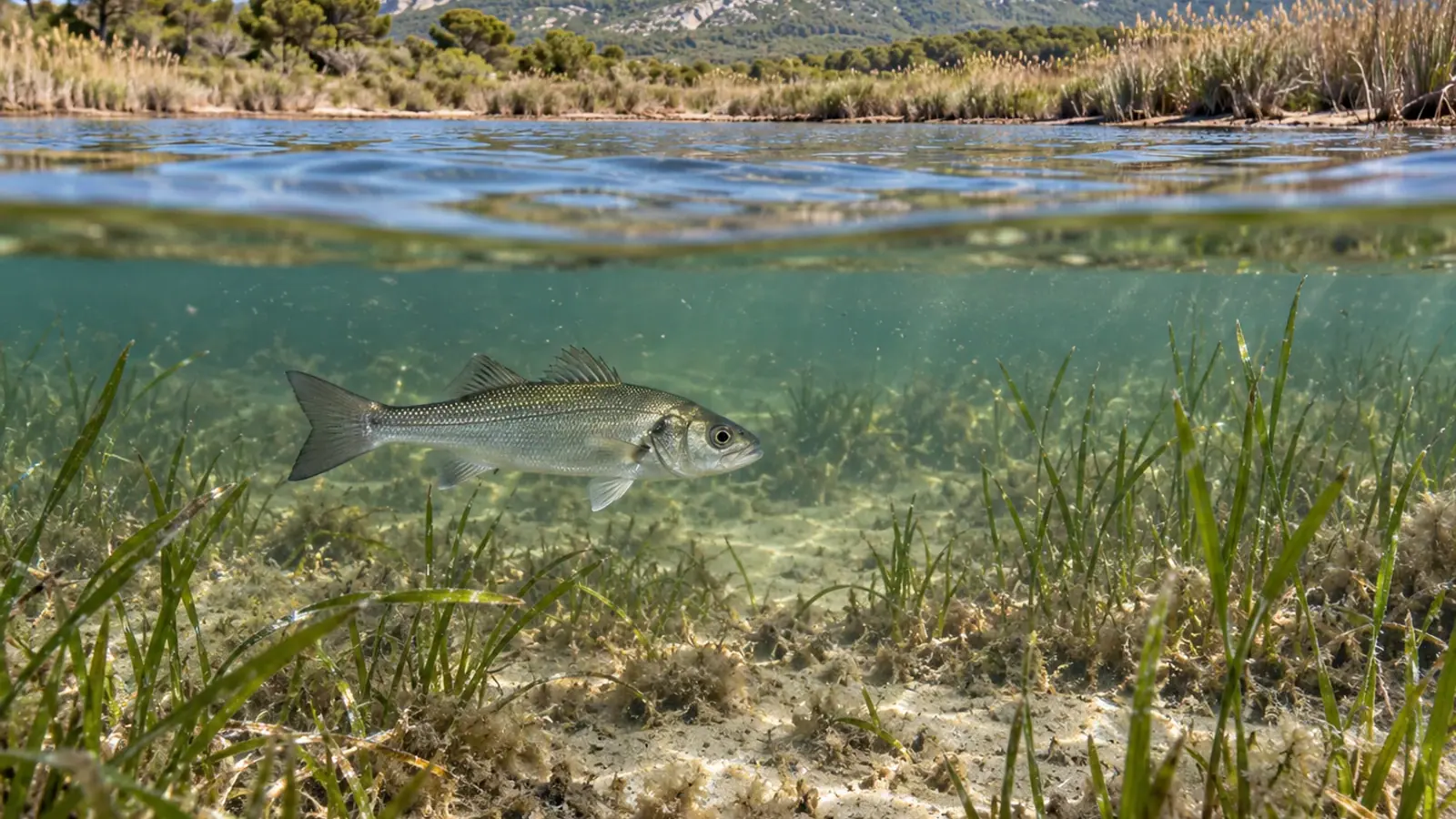
Étang de Berre: good bathing water, healthy fish?
A good bathing-water classification at Étang de Berre describes a microbiological risk to swimmers. Fish also depend on oxygen, salinity, habitat and conditions below the surface.


- Content type
- Practical guide
- Sector
- Environment
- Animal group
- Fish
- Keywords
- OxygenTemperaturepHEcotoxicology
One lagoon, two different assessments
GIPREB reports that the 2025 results confirmed excellent bathing-water quality for Étang de Berre under the regional health authority’s assessment. That is useful public information. It answers a defined question, however: what microbiological health risk has been assessed for people swimming at monitored sites? It is not a health certificate for every fish, depth or season across the lagoon.
The EU Bathing Water Directive, 2006/7/EC, classifies bathing sites using microbiological indicators, chiefly intestinal enterococci and Escherichia coli. It also provides for site profiles and management when pollution occurs. The bacteria are relevant indicators of faecal contamination for swimmers. They do not directly measure oxygen at the bottom, habitat availability or the effects of all contaminants on aquatic animals. An excellent bathing-water classification and a separate need for ecological monitoring can therefore coexist without contradiction.
Understand what a bathing grade means
The classification is not a live sensor certifying the water at every moment. The directive uses a series of samples and a statistical assessment, generally covering several bathing seasons. GIPREB notes that, even in 2026, there is no way to know the precise sanitary quality of the water instantly and with certainty as a person enters the lagoon. Rainfall, a discharge or a local incident may require temporary communication or restrictions without making the longer-term classification meaningless.
Whenever a grade is reported, retain the monitored site, assessment period and microbiological purpose. “The beaches are well classified” should not become “all water throughout the lagoon is safe at all times.” The reverse distinction also matters: an ecological concern cannot be used to declare a beach unsafe for swimming without the health authority’s data and decisions. The two monitoring systems are designed for different uses.
Look at the water available to fish
For fish, exposure changes with depth, time of day and season. Temperature influences metabolic demand; dissolved oxygen governs respiration. Salinity, freshwater inputs, nutrient loading and layering of the water can change which parts of the lagoon remain usable. Shallow seagrass offers a different habitat from a deeper layer short of oxygen. A fish near a beach does not demonstrate that the whole lagoon is suitable, and clear water cannot show everything below the surface.
GIPREB’s 2025 environmental report examines these issues separately. Its summary describes higher salinity and better transparency during the period studied, associated in part with the application of the seasonal pause in discharges from the power scheme. It also reports less eutrophication and avoidance of bottom-water asphyxia in that period, along with an increase in seagrass area. These are ecological observations tied to a particular year. They cannot be inferred from bacterial counts at bathing beaches.
Improvement does not mean complete recovery
GIPREB calls the environmental picture encouraging but qualified. Its report summary says that deeper benthic invertebrate communities remain fragile and are diversifying only slowly. Invasive species remain established. Better transparency or expanding seagrass consequently does not show that every ecological function and community has recovered to a desired state. Freshwater and sediment inputs, water exchange and weather continue to shape the lagoon’s trajectory.
For fish, a programme that notices only mass mortality would respond late. Managers can connect depth profiles of oxygen and salinity with temperature, available habitat, fish assemblages and hydrological events. Measurements need locations and timestamps. A near-surface reading at midday may not describe deeper water overnight. A change in the number of fish seen can also reflect movement; it does not alone prove mortality or population recovery.
The choice of sampling sites matters as much as the choice of variables. A beach monitoring point is selected to describe exposure during bathing. An ecological survey also needs locations that represent deeper water, sheltered coves and connections to incoming flows when those areas address the management question. Reusing only the convenient beach stations would leave some fish habitats unexamined, even if every measurement at those stations were accurate.
Put the datasets side by side without merging their meanings
Health and ecological results can be shown on the same map or timeline if their separate methods remain visible. A municipality or community group can direct readers to the official bathing-water classification and, independently, to the lagoon observatory’s findings. Explaining which variables concern human users and which describe aquatic habitat supports action without creating a false health alarm or a false sense of ecological security.
The 2025 results are also time-bound. A wetter or hotter season, or different inputs, may alter oxygen and communities. The Bathing Water Directive does not replace programmes for monitoring aquatic ecosystems, while an environmental report does not replace official advice on whether a beach is open. Each body of evidence supports a different decision. Their value increases when changes in one dataset trigger a properly framed question for the other, rather than an unsupported conclusion.
For those planning fish monitoring, our advisory service can help define the sampling questions, sites and limits of each indicator. Our environment work aims to make the evidence traceable without turning a good bathing grade into a verdict on the entire lagoon.


