

Aquarium breeding failure: where to look for the cause
No spawning, failed fertilisation and embryonic losses call for different investigations. Public aquarium teams can locate the failing stage and review husbandry before prioritising health examinations.
- Content type
- Practical guide
- Sector
- Public aquariums
- Animal group
- Fish
- Keywords
- ReproductionTemperatureStress
Identify the stage that is failing
Reports that a group of fish has stopped breeding can describe very different events. Staff may have seen no courtship, no spawning, unfertilised eggs, interrupted embryonic development or a failure to rear surviving young. These observations lead to different questions. In a public aquarium, identifying the point where the reproductive sequence breaks down is more informative than assigning one label to every unsuccessful outcome.
The review by Mylonas, Fostier and Zanuy separates gamete development, final maturation and release in captive fish. This framework explains why apparently well-maintained adults do not necessarily produce offspring. It does not make an absence of spawning evidence of infection, and it does not establish that every reproductive difficulty requires treatment.
Reconstruct the broodstock history
Start with the animals and their records: origin, identification, known or estimated age, group composition, previous breeding and changes in housing. An earlier spawning event does not prove that the same individuals remain in the group or are at the same reproductive stage. Uncertain identification should remain visible in the assessment.
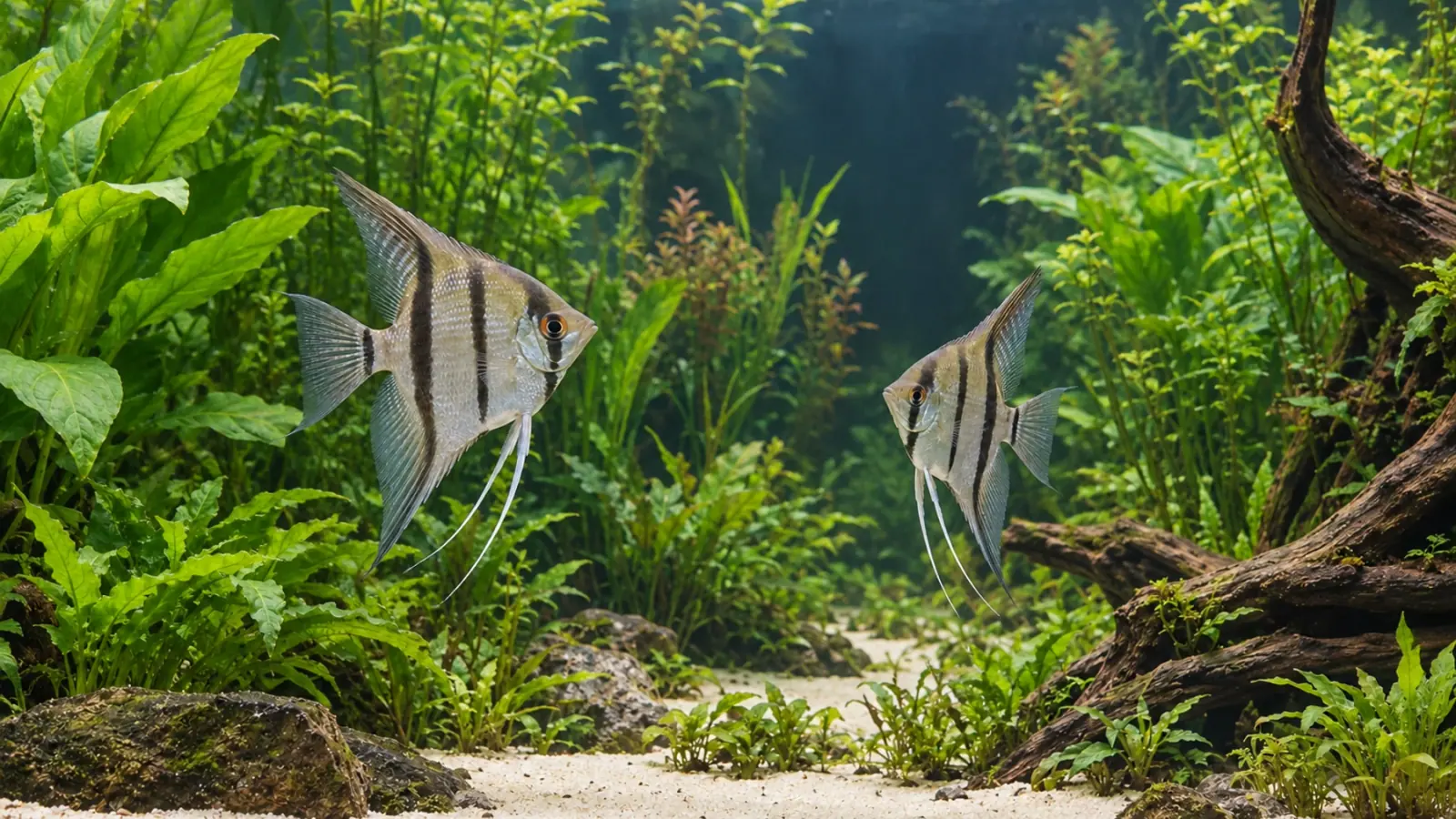
Smith’s review of fish welfare in public aquariums stresses species-specific environmental requirements. It notes, for example, that hard water can prevent freshwater angelfish from spawning. The useful lesson is to check whether the environment suits the species and reproductive stage. This example does not provide a water chemistry target for every freshwater fish.
Temperature records, lighting schedules, water analyses, feeding changes and recent interventions can be assembled before any new manipulation is considered. Photoperiod and temperature are among the environmental signals involved in reproduction. Their interpretation requires the conditions actually experienced by the fish, including periods when the aquarium is closed to visitors.
Differences between intended and actual conditions are particularly relevant. A lighting programme written in a protocol may not describe additional room lighting. A tank-wide feeding record may not show whether all breeding individuals obtained food. These are questions for the local investigation, rather than evidence that either factor caused the failure.
Separate maturation, spawning and fertilisation
Gametogenesis describes the formation and development of gametes. Final maturation prepares them for release and fertilisation. These stages can become uncoupled in captivity. Consequently, failure to observe spawning does not demonstrate that no gametes developed, or that the fish are permanently infertile.
Mylonas and colleagues describe maturation and spawning difficulties in several farmed species. Although their review also addresses hormonal interventions, it does not justify treating every failed breeding attempt in a public collection. Species biology, gonadal status and husbandry conditions need to inform veterinary assessment before an intervention is selected.
Once eggs have been released, the investigation changes. Fertilisation failure, embryonic losses and problems rearing young should be recorded separately. Counting the juveniles that eventually survive merges all these stages into a single outcome. In a mixed-species display, egg identity and access by other animals may also be uncertain. Those limitations belong in the records.
Decide when health investigation becomes more urgent
A reproductive problem on its own does not establish infectious disease. A concurrent decline in appetite, altered body condition, lesions, unusual behaviour or losses increases the need for veterinary assessment. These observations help set priorities; they should not be used to select a cause before the evidence has been examined.
Nutrition, social access and health need to be considered together. Fish prevented from reaching food may remain in a group while experiencing conditions quite different from their neighbours. Feed delivered to a tank is not proof of ingestion by each broodfish. Where individuals can be recognised, their observations should be linked to the group-level husbandry records.
The veterinarian selects examinations according to the hypotheses and animals available. Staff can prepare identification records, comparable photographs, previous test results and a timeline of changes. Each handling or examination should answer a useful question while accounting for welfare and risk. Repeated intervention without a clear purpose can add disturbance and make the history harder to interpret.
Make husbandry changes interpretable
A shared timeline helps aquarists and the veterinary team distinguish an observed spawning event from one inferred from indirect evidence. Record gaps in observation as well. Failure to see spawning is not necessarily proof that it did not occur, particularly in complex exhibits or outside routine observation hours.
Where several plausible factors are identified, changing all of them together prevents a clear explanation of any improvement. A documented, progressive strategy is preferable when the animals’ condition allows it. Urgent action needed for their health takes priority, but its timing and reason should remain part of the record.
Define the intended outcome before follow-up begins. Courtship, identified spawning, fertilisation and embryonic survival answer different questions. One successful event should be interpreted alongside the wider history, including previous failures. It should not erase uncertainty about which change was responsible.
Limits of this framework
The Mylonas review principally concerns aquaculture species. Applying its reproductive framework to public aquarium collections is a reasoned adaptation, not validation for every displayed species. Smith provides a broader husbandry and welfare context, rather than a universal diagnostic algorithm. Neither source establishes a single period after which an absence of spawning becomes pathological.
Conclusion and Vetofish support
Failure to produce offspring first requires a clear description of the failing stage. Health hypotheses can then be assessed alongside environmental conditions and animal observations. This avoids confusing larval rearing problems, fertilisation failure and disease in breeding adults.
Our testing and diagnostic service can help prioritise hypotheses and examinations using the evidence available. Through our public aquarium expertise, Vetofish can support a structured review of broodstock history, husbandry and reproductive outcomes.


