

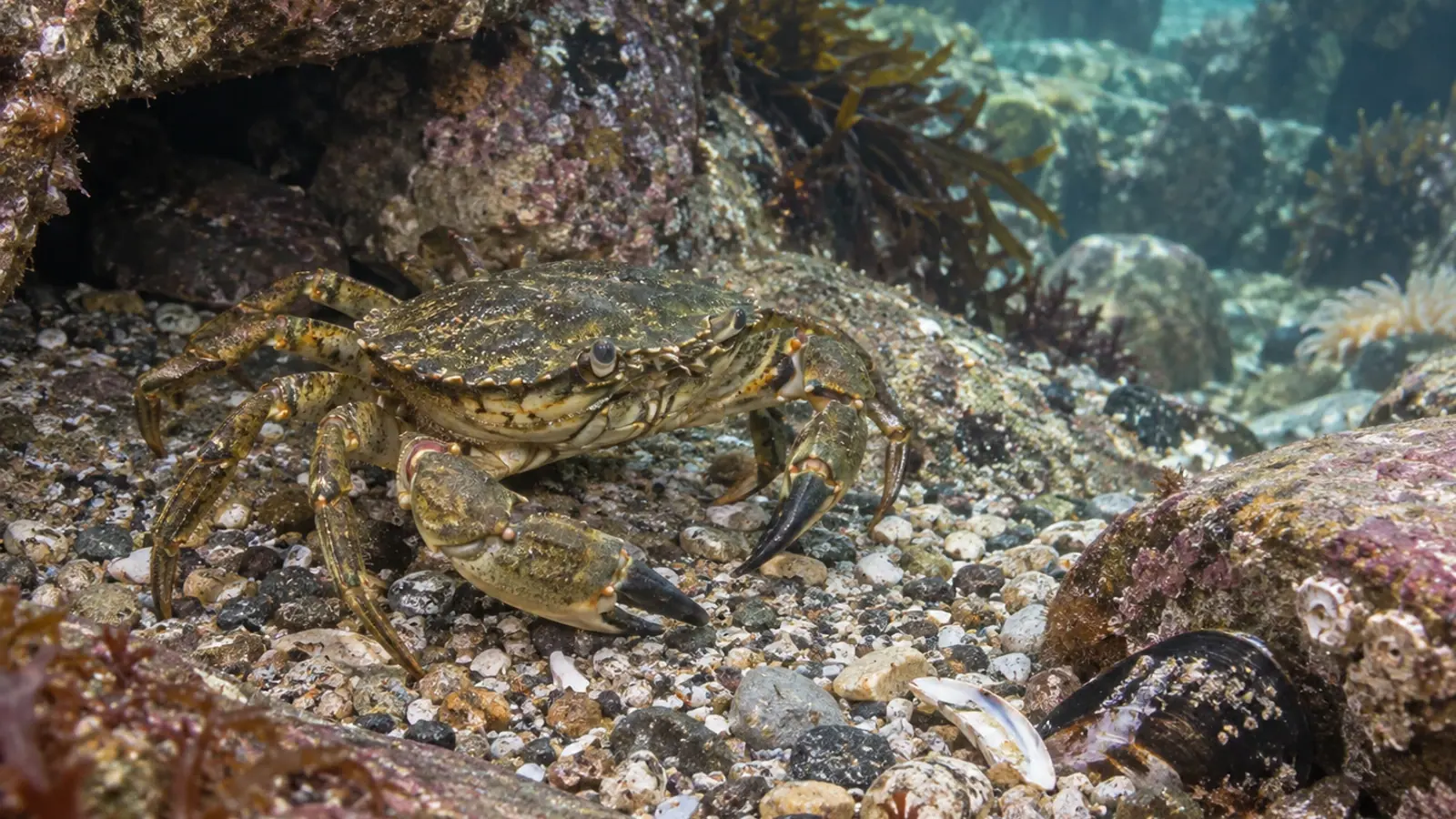
Aquarium crustaceans: monitor recovery after handling
Survival after capture or transfer does not establish that a crab or lobster has recovered. Repeated observations should connect physical condition, behaviour and water conditions without relying on a universal welfare marker.
- Content type
- Practical guide
- Sector
- Public aquariums
- Animal group
- Crustaceans
Establish a reference before the event
A crustacean returned to its tank may survive while still showing altered condition or behaviour. Public aquariums need to assess recovery after a specific event, such as necessary capture, relocation or intervention. This is a different question from the everyday suitability of the enclosure. Staff need a reference against which to compare the animal and a route for seeking veterinary assessment when something changes.
Decapods differ substantially in biology and behaviour. A crab, lobster and shrimp should not receive an identical assessment simply because they belong to the same broad group. For a planned intervention, identify the species and individual or group, describe the context and retain observations of usual behaviour. The process proposed here is a practical monitoring framework, not a recovery protocol validated across all crustaceans.
What physiological evidence can show
Conneely and Coates’ meta-analysis, published in the 2024 volume of Fish and Fisheries, includes 59 studies examining haemolymph responses to physical stressors. L-lactate emerged as a promising physiological marker, ahead of measures including urea and glucose. The authors propose its use alongside condition or vigour indices; the analysis does not establish a universal welfare threshold.
A 2025 review of commercial practices also describes risks from handling, emersion and transport, together with possible physical injury. Much of this evidence comes from fisheries and farming. Applying it to public aquariums therefore requires an explicit qualification: it supports monitoring after an intervention, rather than providing a standard recovery period for every animal.
A biological result may document a stress response without establishing its cause, clinical importance or the animal’s overall welfare. For an individual crustacean, the circumstances of handling and its subsequent environment remain essential to interpretation. The value of a measurement depends on the decision it can reasonably inform.
Record what actually happened
A useful handling record explains why capture was needed, how it proceeded, changes in environment and any incident. Distinguish handling time, any exposure to air and the journey instead of combining them into one total. This makes it possible to identify the part of the process that could be changed next time.
Water conditions before and after transfer belong in the same record. Dissolved oxygen, temperature and salinity need interpretation for the species and system. A reading taken hours later may not represent the animal’s exposure during the move. Time-stamping observations helps prevent a later satisfactory reading from obscuring an earlier problem.
Staff receiving the animal need to know about deviations and incidents. Handover matters especially when the team conducting the capture is different from the team monitoring recovery. A short record that is completed consistently is more useful than a detailed form with the important fields left blank. The aim is to preserve enough context to explain subsequent observations.
Observe without creating another stressor
Initial checks concern visible integrity of the body and appendages, posture and the ability to move normally within the enclosure. Follow-up observations assess change over time rather than the presence of an immediate response alone. Refuge use, interactions and resumption of feeding can be informative when compared with what is usual for the species.
Behavioural measures must be described precisely enough for different keepers to recognise them. Low activity during daytime has a different meaning in a nocturnal species than a sudden change in an individual normally visible at that time. Record moult stage when it is known; do not assume moulting to explain every abnormal observation.
Remote observation can avoid unnecessary recapture. This guide proposes no provocative test or painful stimulus. The monitoring schedule should reflect the species, event and observed risk. The cited literature does not justify the same recovery window of a few hours for all crustaceans. An agreed schedule should also identify what happens when the animal cannot be observed reliably.
Sampling needs a defined purpose
Taking haemolymph is itself an additional intervention. Its value should be discussed with the veterinarian in relation to a specific question, feasibility and expected benefit. Having a meter or assay available does not establish that sampling is appropriate. A result without an interpretable reference can generate concern or false reassurance without improving care.
The meta-analysis highlights heterogeneous evidence. Moult status was poorly documented in a substantial share of the literature, limiting some interpretations. A non-significant association in the analysis does not demonstrate that the factor is irrelevant for every animal. A physiological stress marker must also be distinguished from a diagnosis of pain or disease.
For routine surveillance, the proposed priority is consistent observation with sufficient context. Additional examinations belong where they can address a clinical question or assess a recovery hypothesis under suitable conditions. Decisions should consider the burden of obtaining the measurement as well as the information it might supply.
Agree escalation before it is needed
Teams can identify in advance the changes that trigger veterinary contact and who is responsible for making that contact. A new lesion, persistent abnormal posture or deterioration from the reference condition warrants assessment without waiting for mortality to confirm a problem. Subsequent action depends on diagnosis and the animal’s needs.
Reviewing the planned procedure against actual observations can lead to changes in capture, movement or reception conditions. The practical conclusion is that no single marker summarises recovery. A documented sequence allows physical condition, behaviour, survival and environment to be interpreted together and makes future handling decisions easier to review.
Planning monitoring with Vetofish
Vetofish can help keepers define reference observations, organise handling records and choose criteria for veterinary contact. Our animal welfare support works with public aquariums to improve surveillance while avoiding unnecessary additional interventions.


