

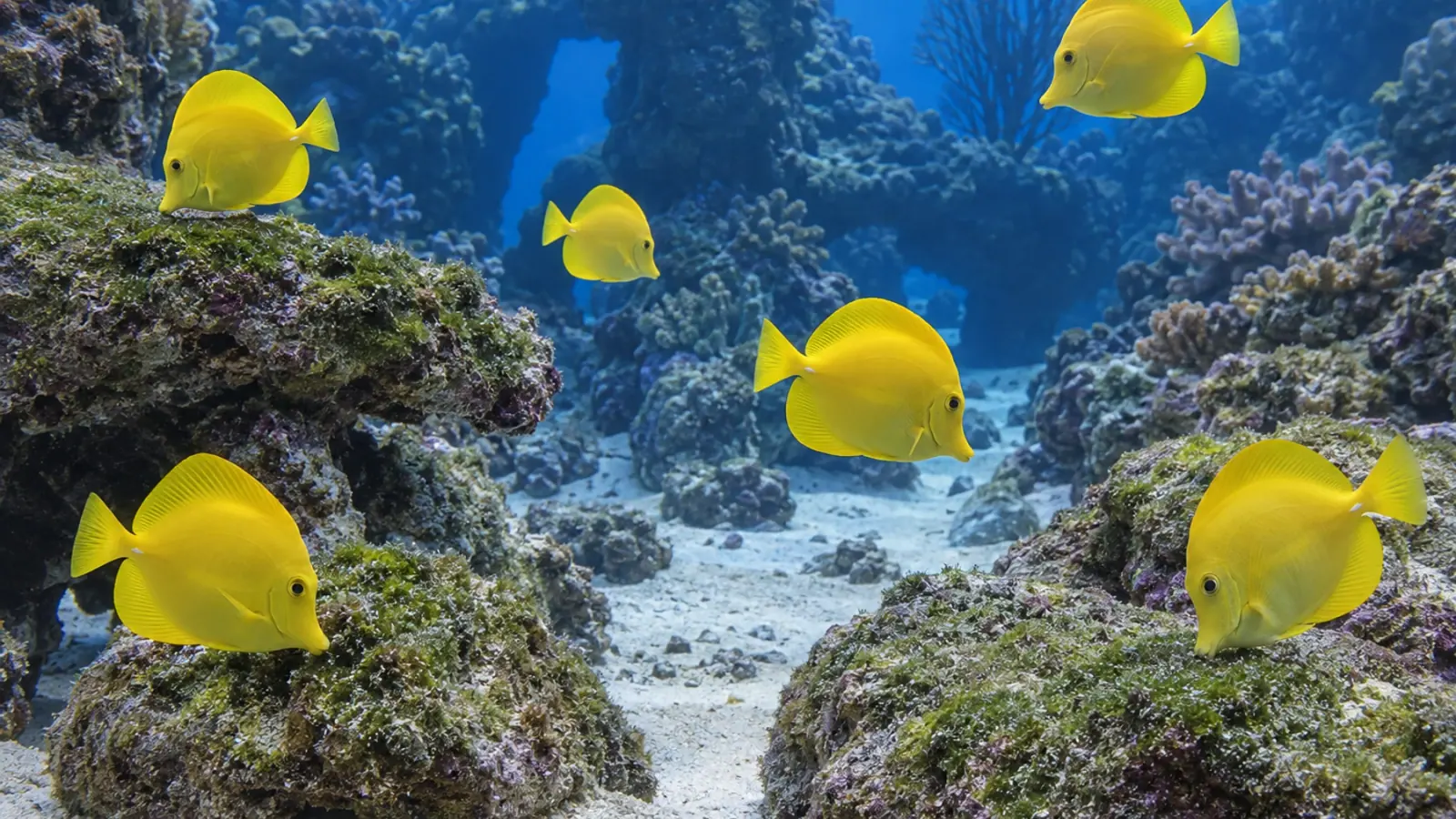
Feeding enrichment: which fish get their share?
In public aquariums, a longer feeding opportunity is useful only if fish obtain enough food without excessive competition or accumulating leftovers. Assess access, behaviour and water conditions together.
- Content type
- Practical guide
- Sector
- Public aquariums
- Animal group
- Fish
- Keywords
- EnrichmentEthogramStressOxygen
A busy feeding session can conceal fish that obtain very little food. Fast or dominant individuals may take most of the ration while others remain near cover or at a different depth. The care team needs to establish whether the intended fish actually eat, alongside any interest they show in an enrichment device.
This evergreen guide draws on Stephen A. Smith’s 2023 review of fish welfare in zoological collections. The approach below is a practical framework for observation and adjustment. It is neither a new experiment nor a feeding schedule intended for every species.
Match the feeding opportunity to the animal
Natural feeding ecology helps explain which resources a fish recognises and how it uses them. Grazing herbivores, prey-catching carnivores and fish that forage within the substrate may need different presentations. Mouth structure, body size, life stage and feeding behaviour all affect whether a particular arrangement is usable.
Smith notes that detailed nutritional requirements remain unknown for many species displayed in public aquariums. A commercial diet formulated for a familiar aquaculture species is not automatically suitable for a diverse collection. Making food more engaging cannot correct an inappropriate nutritional composition.
Recognition and access are also separate issues. A fish may be physically able to reach an item without accepting it as food. For a new arrival, confirming that it eats before introduction to an established collection helps distinguish acceptance from later competition. Additional feeding stations cannot solve a failure to recognise the diet on their own.
State the intended change before introducing a device
Environmental enrichment should provide opportunities suited to the species. Feeding enrichment can change the location, presentation or duration of food availability. Set a specific aim: enabling grazing, improving access for less conspicuous fish or allowing food searching in several parts of the exhibit.
“Making the fish more active” is too broad to judge success. Increased movement may represent exploration, competition or avoidance. A short behavioural record, or ethogram, can separate food searching, ingestion, chasing, withdrawal and waiting. Its categories should describe actions that the care team can recognise consistently.
The enrichment food belongs within the overall feeding programme. Count it towards the total ration rather than treating it as an unrecorded extra. Otherwise, an apparently modest activity may increase intake in some fish and the amount of waste entering the life-support system.
Follow the fish away from the main feeding group
Watching only the most visible gathering misses animals at the edges of the event. Observe fish near shelters, smaller individuals and species using other depths or feeding surfaces. Where individuals cannot be identified reliably, record the species, approximate size classes and areas involved.
Actual ingestion provides more information than proximity to the food. Look for items taken and spat out, interrupted attempts and fish that wait until the resource has been depleted. Body condition and injury records help interpret the longer-term pattern. One feeding session cannot establish that access and intake remain adequate over time.
Several feeding locations may be worth testing when a resource is monopolised. Their number is not a universal solution. Territories, exhibit geometry and water movement may allow the same fish to control several locations, or carry food away from the intended recipient. Observe the result rather than assuming that additional stations have made access equitable.
Include uneaten food in the assessment
Smith’s review explains that rejected food may decompose, impair water quality or be consumed excessively by other species. Record what remains and where it collects, alongside the quantity offered. A resource disappearing from view does not necessarily mean that the intended fish ate it.
Any structure retaining fragments needs to be accessible for inspection and cleaning. Food lodged beyond the animals’ reach is not evidence that useful foraging time has increased. Plan how to remove the device and recover leftovers before adding it to the exhibit.
Water monitoring must remain appropriate to the species and system, including dissolved oxygen and relevant nitrogen compounds. There is no single limit suitable for every aquarium. Interpret a deterioration with stock load, feeding input, filtration performance and the timing of husbandry activities. An enrichment assessment should not displace the facility’s normal water-quality surveillance.
Keep a baseline and change one feature at a time
Describe the existing feeding arrangement and observe several comparable sessions before introducing a change. Keep observation timing and conditions as similar as practical afterwards. If the diet, feeding location and daily schedule all change together, the contribution of the enrichment device becomes difficult to distinguish.
A useful record combines access, ingestion, fish interactions, leftovers and the additional maintenance required. Agree on reasons to withdraw or revise the device, including injuries, increased competition, repeated exclusion of a group from feeding or deterioration of water conditions. Staff should be able to return to an established presentation promptly.
These steps are practical recommendations for a local assessment, not an experimental protocol validated across aquarium species. Findings from one exhibit describe that exhibit first. A single behavioural change cannot establish an improvement in overall welfare.
What this guide can and cannot establish
Smith’s paper is a review of welfare and husbandry principles. It does not compare every feeding enrichment method or provide a universal ration, frequency or device specification. A collection’s decisions still require knowledge of its species, life stages and operating constraints.
Nor should enrichment be judged solely by how engaging a session looks to visitors. The assessment needs to retain the animals that are less conspicuous, the food they obtain and any unwanted effects. Nutritional adequacy and opportunities for species-appropriate behaviour belong in the same decision.
Conclusion and Vetofish support
Useful feeding enrichment preserves adequate intake while offering appropriate opportunities to search for or obtain food. Check access, ingestion, injuries, leftovers and water conditions together before deciding to retain a change.
Vetofish can help develop an observation framework and review unwanted effects through its animal welfare service, with specialist support for public aquariums.


