

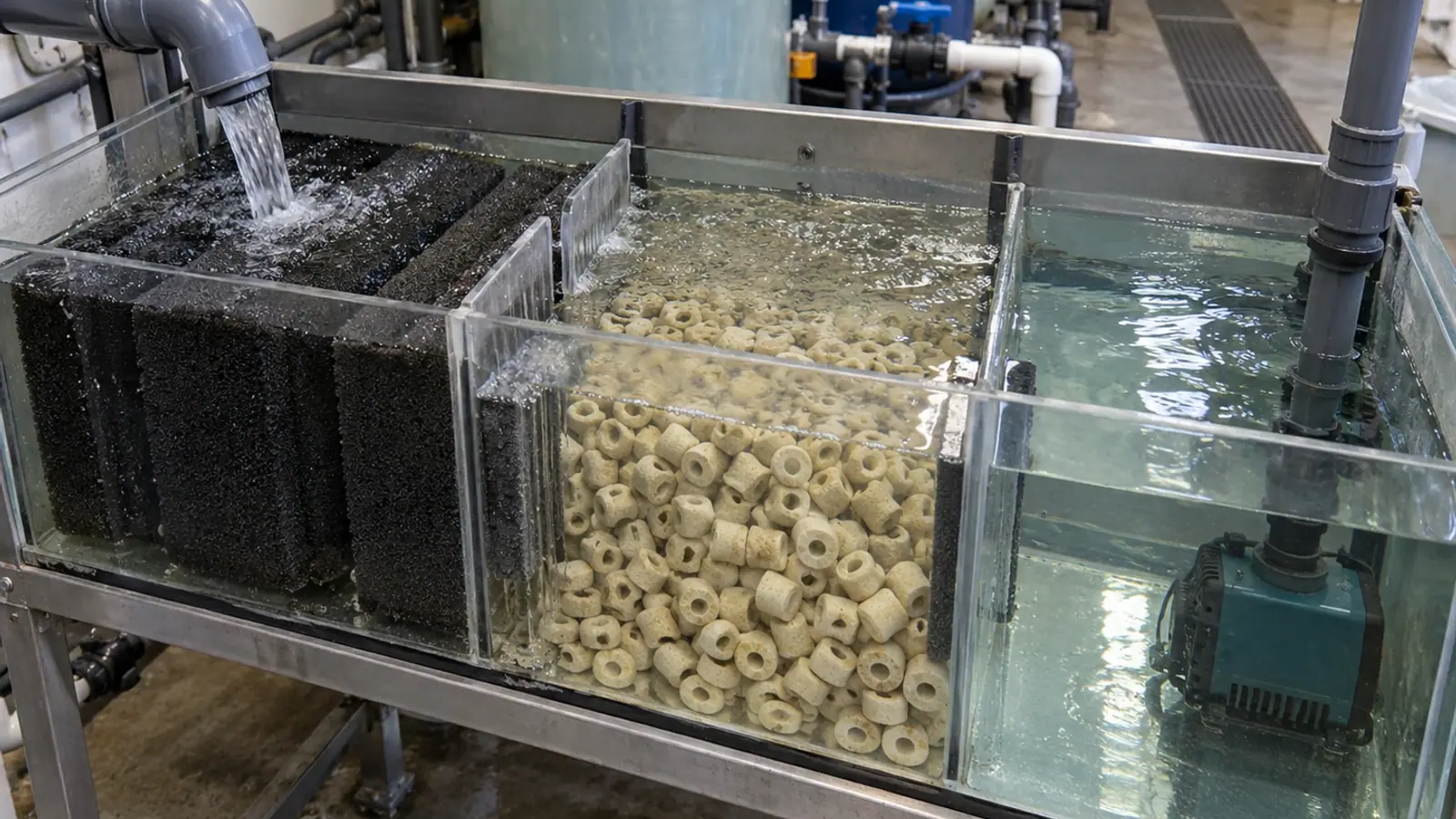
Aquarium filters: keep sampled compartments distinct
Water, sponge and ceramic carriers do not describe the same microbial community. Open research helps public aquariums plan distinct samples without equating environmental detection with infection in fish.
- Content type
- Practical guide
- Sector
- Public aquariums
- Animal group
- Fish
- Keywords
- MicrobiomePCRBiosecurityOxygen
An aquarium-water result does not necessarily describe the organisms attached to a filter sponge, ceramic carrier or substrate. These compartments offer different surfaces, flows and resources. When a public aquarium investigates a change in system performance or an animal-health problem, sampling location therefore belongs in the diagnostic question. It should be recorded as carefully as the name of the requested test.
A biofilter contains more than one community
A biofilm is a surface-associated community held within a matrix produced by its microorganisms. Its presence is not itself evidence of disease. Within a biological filter, some organisms contribute to nitrification, converting ammonia to nitrite and then nitrate. Others perform different functions or use the resources available on the carrier. A functioning filter cannot be understood simply as a container of one beneficial bacterial species.
In a study published in 2025, McKnight and colleagues followed three newly established home freshwater aquariums for twelve weeks. They collected water, ceramic beads and sponge pieces separately, monitored nitrogen compounds and used molecular methods to examine the carrier communities and ammonia-oxidising groups. This design retained information about both the aquarium and the material sampled.
Community profiles differed between aquariums and between materials. Complete ammonia-oxidising Nitrospira were prominent in the sampled carriers towards the end of monitoring. The findings do not establish which filter is best for every collection. They support a narrower point: combining distinct supports under a single label can conceal useful information about the microbial compartment being examined.
Detection is not equivalent to disease
A carrier’s microbiota includes organisms whose function and effect on animals cannot be inferred from a genus name alone. The aquarium study detected sequences assigned to Mycobacterium, for example. This does not demonstrate a particular pathogenic species or mycobacterial disease in the fish. The project was not a transmission experiment or a clinical investigation of infection.
McMurtrie and colleagues’ 2025 review provides complementary context for the skin and gill interface. Microbial communities on these surfaces interact with the environment while also responding to host characteristics and exposure conditions. Composition and function are different questions. A changed profile may have several explanations and does not automatically identify the cause of a lesion.
For a public aquarium, an environmental finding needs to be interpreted alongside the organism’s identity, the analytical method and the animals’ condition. A molecular assay detects a defined target. Depending on its design, it can identify a sequence without establishing that the organism is alive, infectious or responsible for the observed signs. The interpretation should state these limits explicitly rather than leaving them implicit in a laboratory label.
Agree the question before collecting more samples
Before sampling, specify whether the investigation concerns a named agent, differences between compartments or a change in biological function. Broad sequencing and a targeted diagnostic assay serve different purposes. The laboratory needs the history of the event and an explanation of which practical decisions may depend on its findings.
When carriers are compared, keep samples separate and record location, material, quantity collected, date, recent maintenance and storage conditions. Combining water, gravel and sponge in one tube removes the ability to locate a signal. The sampled volume or surface should suit the validated method rather than merely filling an available container. Discussing these details before collection avoids samples that cannot answer the intended question.
Gravel can be considered as a separate compartment in a site-specific investigation, but the central study did not directly characterise gravel as one of its sampled filter supports. Its inclusion must therefore be justified by the installation and the organism of interest. Results obtained from ceramic beads or sponges should not be transferred to gravel as though it had been examined in the same way.
Connect the profile to the system’s history
A carrier installed yesterday has a different history from a mature filter. Introductions, treatments, cleaning, changes in feeding and hydraulic work should accompany the analytical record. Without them, a genuine difference between dates may remain unexplained. Where clinical urgency permits, collecting relevant samples before an intervention can preserve evidence that the intervention would otherwise remove.
Dissolved oxygen and nitrogen compounds help describe system performance without turning every chemical change into microbiological proof. Clear water does not guarantee stable nitrogen conversion. Equally, a different microbial profile does not establish that filtration capacity has fallen. Animal observations, chemistry, equipment records and microbiology answer related but distinct questions and should be read together.
Preserve useful biological function during intervention
An environmental signal should not automatically trigger whole-system disinfection. Such an intervention may require animal relocation, affect biological treatment and demand a controlled restart. The veterinarian, technical team and laboratory should define the objective, affected areas and criteria for assessing whether the intervention achieved its purpose.
If cleaning or carrier replacement is necessary, record the portion treated and monitor the circuit after recommissioning. This helps distinguish sanitary progress from a technical disturbance. Decisions must remain appropriate to the species and actual installation. The home-aquarium study provides no disinfectant concentration, fallow period or treatment rule for a public aquarium.
Limitations, conclusion and support
Three freshwater home aquariums cannot represent marine exhibits, large collections or quarantine facilities. Stocking, feeding and maintenance were not uniform. The findings can inform how a sampling question is structured, but they do not validate a universal health-surveillance method or rank filter materials for professional use.
The practical priority is to retain each compartment’s identity and ask what the analysis actually demonstrates. A filter is both equipment and a biological environment; its microbial presence needs interpretation before intervention. Our diagnostic and laboratory service supports public aquariums in planning relevant samples and reviewing them alongside collection and system records.


