

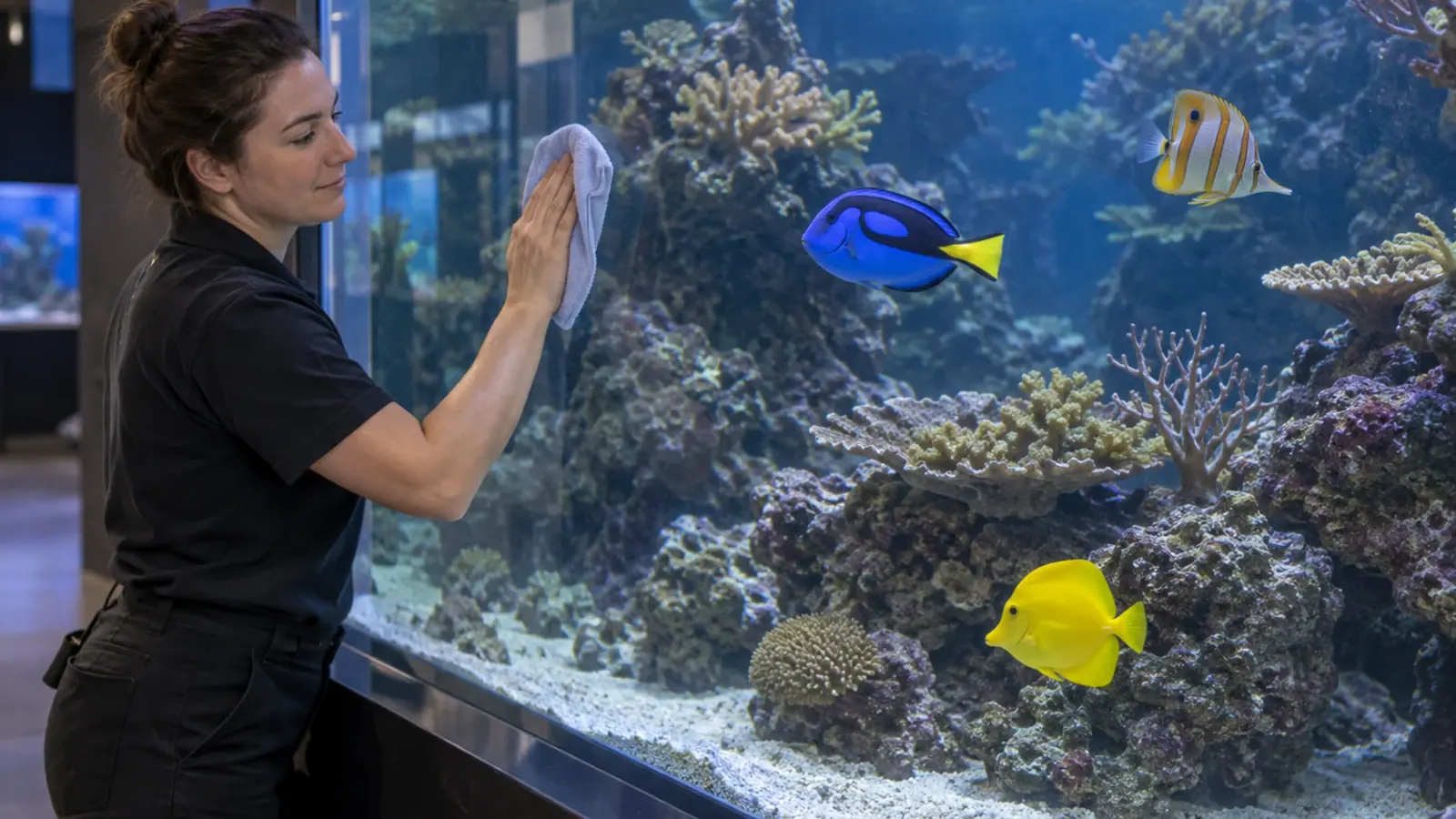
Glass cleaning: observe how exhibit fish respond
Glass cleaning supports husbandry and viewing, but its effect on fish cannot be assumed. A simple before, during and after observation can show whether a particular routine warrants adjustment.

- Content type
- Practical guide
- Sector
- Public aquariums
- Animal group
- Fish
A necessary task with an unknown local effect
Clean exhibit windows make fish easier to examine and easier for visitors to see. They also bring people, tools and repeated movements close to the animals. Whether that activity changes fish behaviour depends on the species, tank design, cleaning method and prior experience. A quiet exhibit is not automatically unaffected, and a brief movement away from the glass does not by itself establish poor welfare.
There is little directly applicable published evidence on glass cleaning in public aquariums. This guide therefore offers a way for an institution to evaluate its own procedure. It does not claim that cleaning always disturbs fish or prescribe a universal recovery period. Smith’s review of fish welfare in public aquariums supports a broader assessment involving behaviour, physical condition and environmental conditions, rather than one response in isolation.
Describe the procedure before measuring it
“Glass cleaning” covers different operations. Wiping the outside of a viewing panel, using a magnetic cleaner and sending a worker into an exhibit differ in proximity, sound, movement and potential effects on the water. The maintenance record should specify which surface was cleaned, the equipment used, the duration, the staff present and any other work performed at the same time.
This detail matters when interpreting a response. A fish may react to a person entering the water, a changed water flow or a moved object rather than to the glass tool itself. Record feeding, visitor numbers and technical work near the exhibit. If several things change at once, observations can still guide care, but they cannot confidently identify a single cause.
Map the locations fish normally use before observation begins. A front window can conceal a rear refuge or deeper area. A simple tank sketch and a record of camera blind spots help staff decide which individuals and behaviours they can assess reliably.
Keep observation from becoming another intervention
Observers may alter what they intend to measure. Cryan and colleagues compared remote and hand-held video at 13 cleaner wrasse stations in French Polynesia. Several cleaner–client interactions were more frequent in remote footage. These were wild reef fish responding to a diver, not exhibit fish undergoing window maintenance. The result supports one methodological precaution: where a nearby observer could affect behaviour, use a fixed camera or a consistent observation position.
Choose a small set of actions that different staff members can recognise: movement to shelter or deeper water, grouping, rapid withdrawal, feeding and return to usual areas. Count or time them in the same manner before, during and after maintenance. A record of “ten fish entered the rear shelter” is more reproducible than a judgement that the tank looked stressed.
Video can allow staff to review the same intervals and check whether an apparent absence reflects a blind spot. Set a baseline and follow-up period appropriate to the local routine. That period is an observation choice, not a biological threshold. Footage should follow the institution’s rules and make the monitored individuals or groups identifiable enough for comparison.
Look for patterns rather than one dramatic moment
Repeat the observations across several routine cleaning sessions. Similar times of day and consistent criteria make the recordings easier to compare. Days without cleaning may be useful comparators if feeding, visitor activity and other husbandry tasks are sufficiently similar. Where they are not, document the difference rather than treating the videos as a controlled experiment.
Group averages may conceal one individual’s problem. Watch for animals that remain hidden, stop using a preferred area or fail to feed after repeated sessions. A short-lived response still matters if it recurs frequently or prevents important activity. Conversely, a fish that does not visibly flee may still require assessment through other indicators. Behaviour is a clue, not a complete welfare diagnosis.
If a repeated adverse response is apparent, alter one feasible aspect of the routine at a time: timing, approach path, tool movement or the worker’s position. Observe again after the change. Hygiene, staff safety and tank operation remain necessary, so an adjustment should solve a practical problem rather than merely make a graph look better.
Limits and conclusion
A camera captures visible behaviour; it does not directly measure physiological state or replace examinations and water-quality records. Cryan’s study demonstrates observer effects in a different setting, while Smith’s review provides a general welfare framework. Neither validates a single cleaning protocol for all exhibits. Conclusions should stay attached to the species and conditions actually observed.
The useful decision is whether a defined routine repeatedly changes the behaviour of particular animals, and whether a feasible adjustment improves the situation. A clear maintenance record and consistent observation give aquarists a way to revisit that decision as animals, staffing and exhibit conditions change.
Vetofish support
Vetofish can help teams select observable indicators, set up a monitoring record and interpret the findings with husbandry staff. Our animal welfare support can be tailored to the needs of public aquariums and their individual exhibits.


