

Aquarium equipment noise: measure before changing
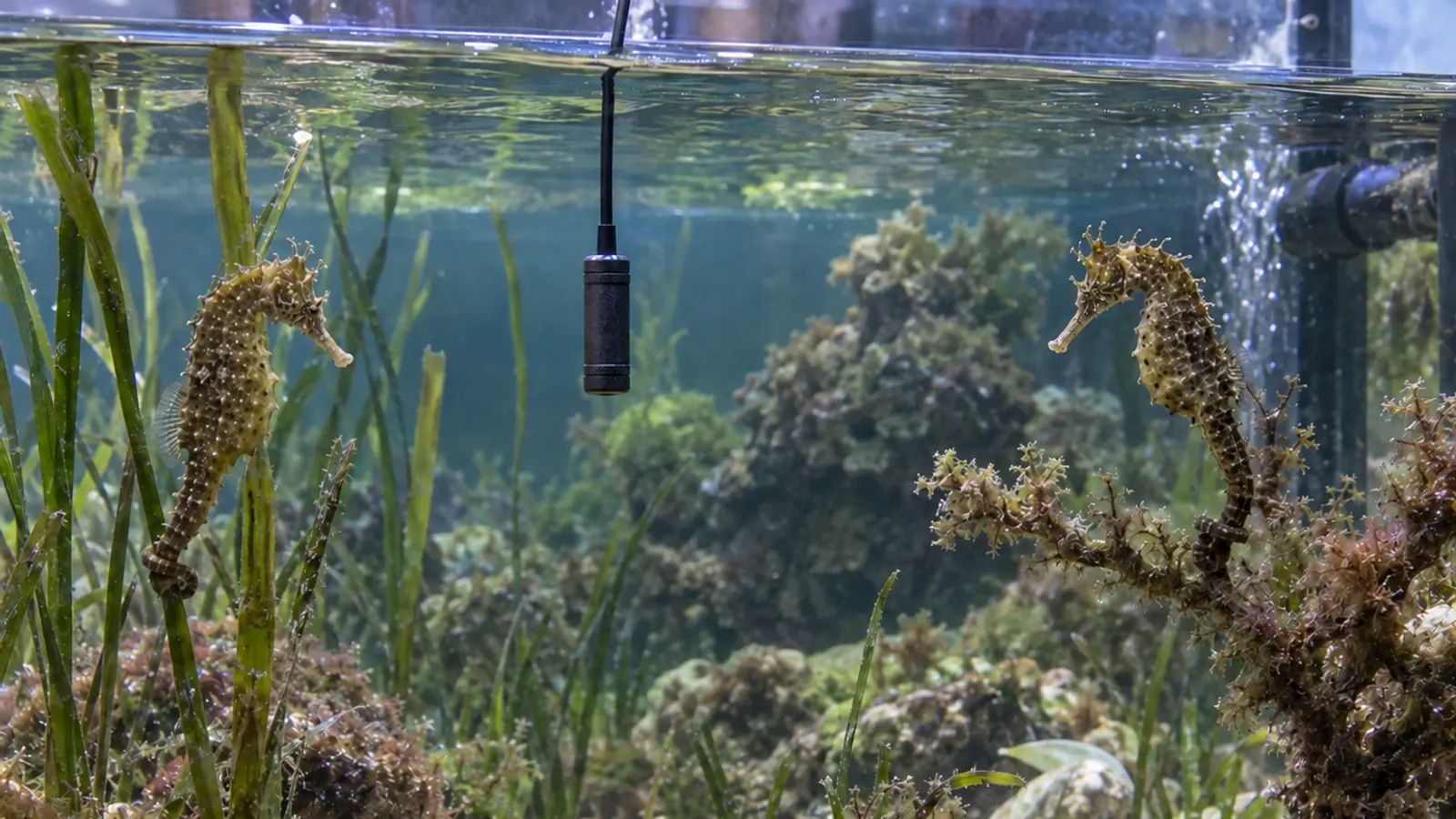
Pumps, water returns and construction shape the sound environment of aquarium fish. A survey across nine public aquariums found substantial variation. Useful decisions require underwater measurements, frequency information and animal observations taken under comparable conditions.

- Content type
- Practical guide
- Sector
- Public aquariums
- Animal group
- SyngnathidsFish
- Keywords
- StressEthogramEnrichment
Replacing a pump can change a tank’s acoustic environment without producing any visible change in water clarity. A connection that transfers vibration to the support, or a relocated water return, can also alter what fish experience. Public aquarium teams first need to describe the change before assigning an animal response to it.
This guide combines Anderson’s survey of tanks housing seahorses with the methodological review by Clark and Dunn. Neither supplies a universal noise limit for aquarium collections. Together they support an investigation linking recordings, equipment operation and animal observations. The question should be precise enough to guide a modification and assess its consequences.
What the seahorse survey demonstrates
The 2013 study involved nine public aquariums in the United States. Aquarists recorded underwater sound and supplied information on tank design. Overall sound pressure levels ranged from 116.3 to 142.9 dB referenced to 1 µPa. These values describe the installations surveyed; they are not a recommended exposure range for seahorses.
The findings showed substantial variation and associations with some construction features. They did not demonstrate that wall material alone caused a health problem. This was an acoustic survey, rather than a clinical assessment of every population or a controlled test establishing the benefit of a particular modification.
Aquarium staff can use this approach to characterise tank sound. An exhibit that seems quiet in the visitor gallery may have a different underwater environment. Conversely, a sound annoying to visitors does not directly describe the exposure experienced by fish. An investigation needs measurements in the relevant medium.
Specify the component being measured
A microphone in the room and a submerged hydrophone measure different environments. Fish can detect the particle motion associated with sound, and sound pressure does not fully describe that component. Where particle motion has not been measured, the report should state the limitation instead of claiming a complete exposure assessment.
Clark and Dunn’s guide places recordings within a soundscape: frequencies, duration, sources and context all contribute. An average level can conceal pulses or intermittent equipment. Checking a pump, comparing tank locations and assessing nearby construction require different recording plans because they ask different questions.
Retain the units, acoustic reference, frequency band, instrument settings and equipment limitations. Airborne and underwater decibel values cannot be directly compared. A phone application used in the gallery is not a substitute for measuring aquatic exposure. The first purchase decision should therefore follow the measurement question, with specialist advice where the required component exceeds available expertise.
Map the installation while protecting its functions
Before recording, assemble a plan of pumps, pipework, water returns and supports. Record operating settings, maintenance periods and nearby works. This inventory connects technical events to recordings; it does not classify every source as harmful merely because it is audible or measurable.
Measurement positions should represent areas the animals actually use. Document depth and distance from tank walls so the arrangement can be repeated. Tank geometry influences the acoustic field, and one recording in the centre may not characterise all occupied areas. Repeat measurements become more interpretable when position remains explicit.
Turning off equipment for a test requires prior technical agreement. Filtration, oxygenation and animal safety must remain assured. Where this cannot be achieved, use a simpler comparison of normal operating periods rather than an experiment that compromises essential functions. A useful investigation should fit the installation’s operational constraints.
Record the precise change under evaluation and who implements it. Keeping an equipment log prevents a later comparison from overlooking a simultaneous adjustment to flow, cleaning or maintenance. It also gives future teams enough information to repeat the assessment rather than relying on recollection.
Observe animals under comparable conditions
An ethogram defines the behaviours to record, such as space use, feeding, resting, sudden responses and social interactions. For seahorses, the availability and use of holdfasts may be part of the account. Interpretation depends on the species and its established conditions rather than a behaviour assumed to be normal for all fish.
Changed activity is not automatically evidence of noise-induced stress. Temperature, lighting, feeding, care and visitor activity may change at the same time. Logging those factors helps assess competing explanations. Repeated observations provide a better basis than an impression taken immediately after a pump has been replaced.
Unchanged behaviour does not prove absence of an effect either. The selected indicators may be insensitive, or observations may cover too short a period. A negative finding should be bounded by the behaviours and duration examined, with unmeasured outcomes identified. That wording preserves the difference between a local observation and a general safety claim.
Evaluate a modification before extending it
Technical assessment may identify a pump mounting, vibration-transmitting connection or water return worth examining. Changes should be agreed with installation specialists and remain compatible with hydraulics, maintenance and the animals’ environment. Reducing a recorded sound while degrading another condition is not an established welfare improvement.
Before-and-after comparisons need the same recording positions, settings and observation periods. Several simultaneous changes make individual contributions harder to distinguish. Retain raw recordings and an intervention log so conclusions can be reviewed, especially when responsibility passes to another team.
Habitat enrichment and equipment isolation remain different interventions. Adding furnishings without measurement does not demonstrate reduced acoustic exposure. The response should address the identified mechanism and then be checked using comparable data. A satisfactory result in one exhibit does not establish effectiveness across tanks with different geometry or inhabitants.
Conclusion: connect sound, equipment and animal records
A useful audit brings together an acoustic record, a technical record and animal monitoring. It states what was measured, under which conditions and with which limitations. Current evidence does not justify one threshold for all species, but it does support a documented comparison of feasible local solutions.
Working with Vetofish
Vetofish can help define animal indicators and connect husbandry observations with technical monitoring, working with an acoustics specialist when required. Our animal welfare service supports public aquarium teams. Installation plans, recent equipment changes and dated observations provide a practical starting point for designing the assessment.


