

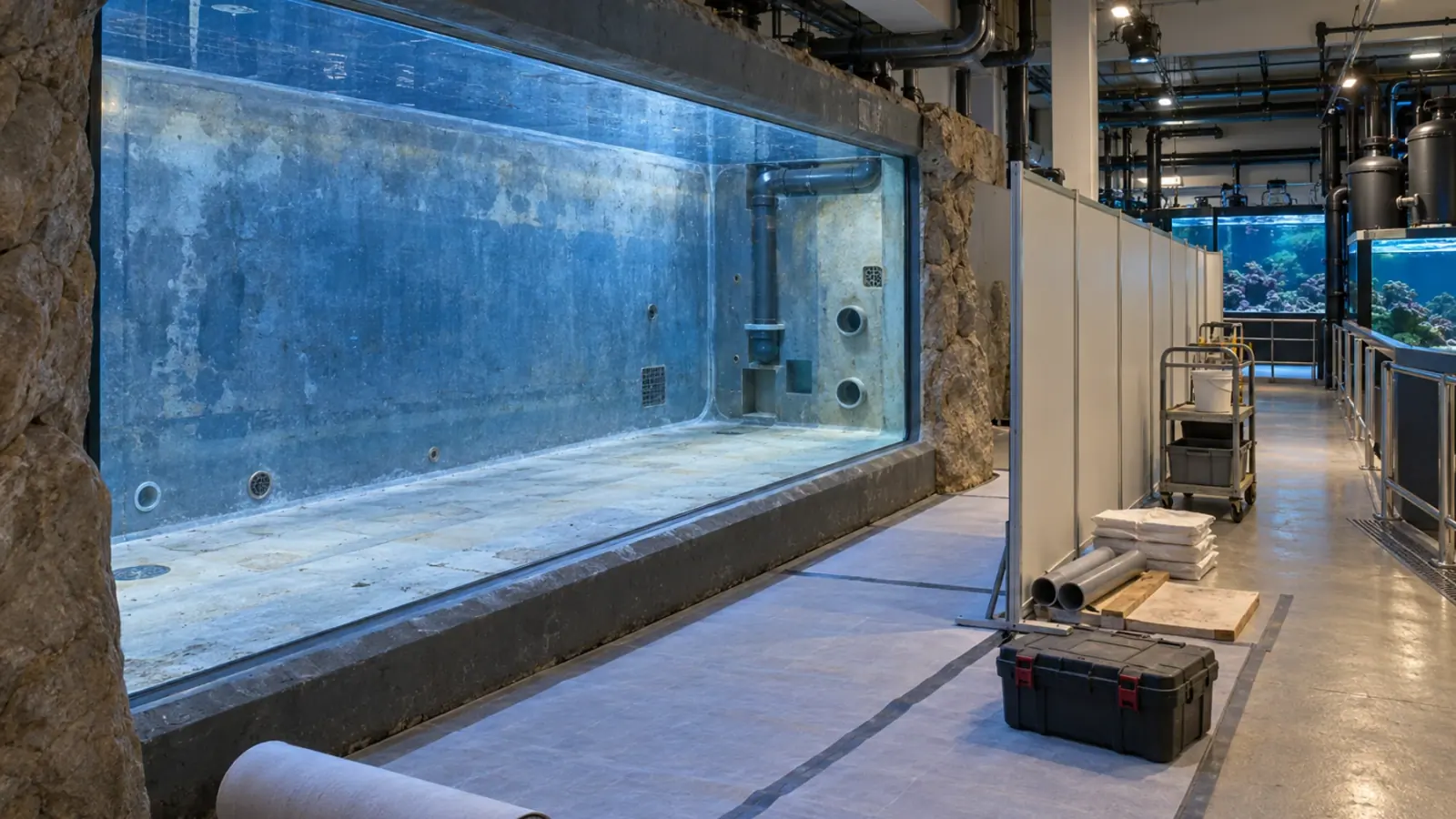
Aquarium renovation: prepare for recommissioning
A tank under renovation can remain connected to the collection through water, tools or temporary installations. Planning boundaries, fish accommodation and acceptance criteria keeps recommissioning tied to verified conditions rather than clear water and a deadline.


- Content type
- Practical guide
- Sector
- Public aquariums
- Animal group
- Fish
A tank under renovation can remain connected to the collection through water, equipment, staff movements or temporary installations. Risk therefore extends beyond the immediate work area. Before draining, moving fish or refilling, a public aquarium needs to describe what still circulates and which barriers will change during the project.
The 2024 EAZA standards address animal environments, hygiene, equipment and collection health management. Smith’s 2023 review describes fish biology and the diversity of requirements in public aquariums. These frameworks can inform preparation, but they are not an experimentally validated renovation protocol or a new list of French legal requirements. EAZA standards are association standards whose scope should remain explicit.
Define the health-management boundary
Biosecurity aims to reduce the introduction and spread of pathogens. Building work can change routes that normally support it: separate access points, trolley movements, storage arrangements or temporary pipe connections. Those changes need assessment before the institution assumes that its ordinary boundaries remain effective throughout the project.
The plan should distinguish the affected tank, connected technical circuits, storage locations and routes towards other animals. A visible physical barrier is insufficient if wet equipment or water bypasses it. Conversely, an unnecessarily broad boundary may obstruct care without controlling a real transfer route. The boundary should follow the identified risk rather than the contractor’s working area alone.
Physical and chemical hazards also differ from infectious risks. Debris, residues and sharp surfaces do not require the same response as a pathogen. Materials, products and their compatibility with the aquatic environment need examination with technical staff before animals could be exposed. A sanitary plan should preserve these distinctions rather than treat every concern as a disinfection problem.
Prepare temporary housing before moving fish
Receiving accommodation needs to support the relevant species and life stage for the expected period, with allowance for delays. Apparent volume alone cannot establish capacity: water treatment, feeding, social conditions and access for observation also matter. Smith’s review emphasises precisely this diversity in fish requirements.
Quarantine has a defined health-management purpose. A temporary holding tank does not become quarantine accommodation merely because it is in another room. Animal status, water connections, equipment and monitoring arrangements determine the precautions needed. Movement records should retain group origin and recent observations rather than lose that history when the fish change location.
The destination after renovation should be considered from the start. If several groups share temporary facilities, their separation and return should not be improvised during recommissioning. Changed arrangements can create contacts that did not previously exist. An absence of visible clinical signs is insufficient evidence that these new contacts carry no risk.
Organise equipment, waste and interventions
EAZA standards call for hygiene and biosecurity protocols covering matters including waste, access and animal movements. Applying those principles during construction means specifying dedicated equipment, conditions for equipment leaving the area and the people authorised to change circuits. These are organisational proposals to adapt to the institution, rather than procedures tested in a renovation trial.
Disinfection seeks a level of inactivation appropriate to the hazard and surface. It does not replace cleaning or materials assessment. A product suitable for a dry external surface cannot automatically be considered appropriate for a system that will house fish. Selection and use depend on health assessment, product conditions and the intended return to service.
Construction waste and water also need agreed destinations. Temporary drainage should not be connected without assessment to a circuit still serving the collection. Intervention records need to identify what was opened, replaced or treated, particularly when different contractors or internal teams work on the same installation in succession.
Preserve the functions that must remain operational
Biological filtration relies on microbial activity supported by the circuit’s operating conditions. Renovating a container and interrupting its biological treatment are separate events. The project record should identify which components remain operational, which stop and how their fitness for return to service will be assessed afterwards.
Other animals may depend on equipment near the work area. A shared pipe, relocated sensor or obstructed access can affect their care even when their tanks are untouched. EAZA standards emphasise protection from installation-related hazards. Temporary connections should consequently be assessed as changes to the actual operating system, rather than peripheral building arrangements.
An identified person should be able to stop work when agreed conditions no longer hold. This responsibility complements the construction schedule: a delivery deadline is not evidence that the collection can safely operate through the next phase. Changes affecting care should reach the relevant teams before they are implemented.
Base the return decision on observable criteria
Clear water and a repaired tank are insufficient grounds for reintroduction. Acceptance can examine surface integrity, completion of interventions, suitable water and the operation of affected equipment. The specific checks depend on the work. No universal refill or waiting period establishes fitness for every system, species or project.
Results, deviations and corrective actions should remain available before the return decision. If an essential function is uncertain, temporary holding arrangements need reassessment rather than indefinite extension or termination solely to meet a deadline. Following reintroduction, animal observations complement technical measurements and help identify an unexpected course.
Conclusion and Vetofish support
Renovation planning means managing a temporarily different installation and then checking its return to service. Our animal-health expertise can help public aquariums examine flows, prepare movements and define the evidence needed for reintroduction. EAZA association standards provide a framework; the decision remains specific to the work, animals and institution.


