

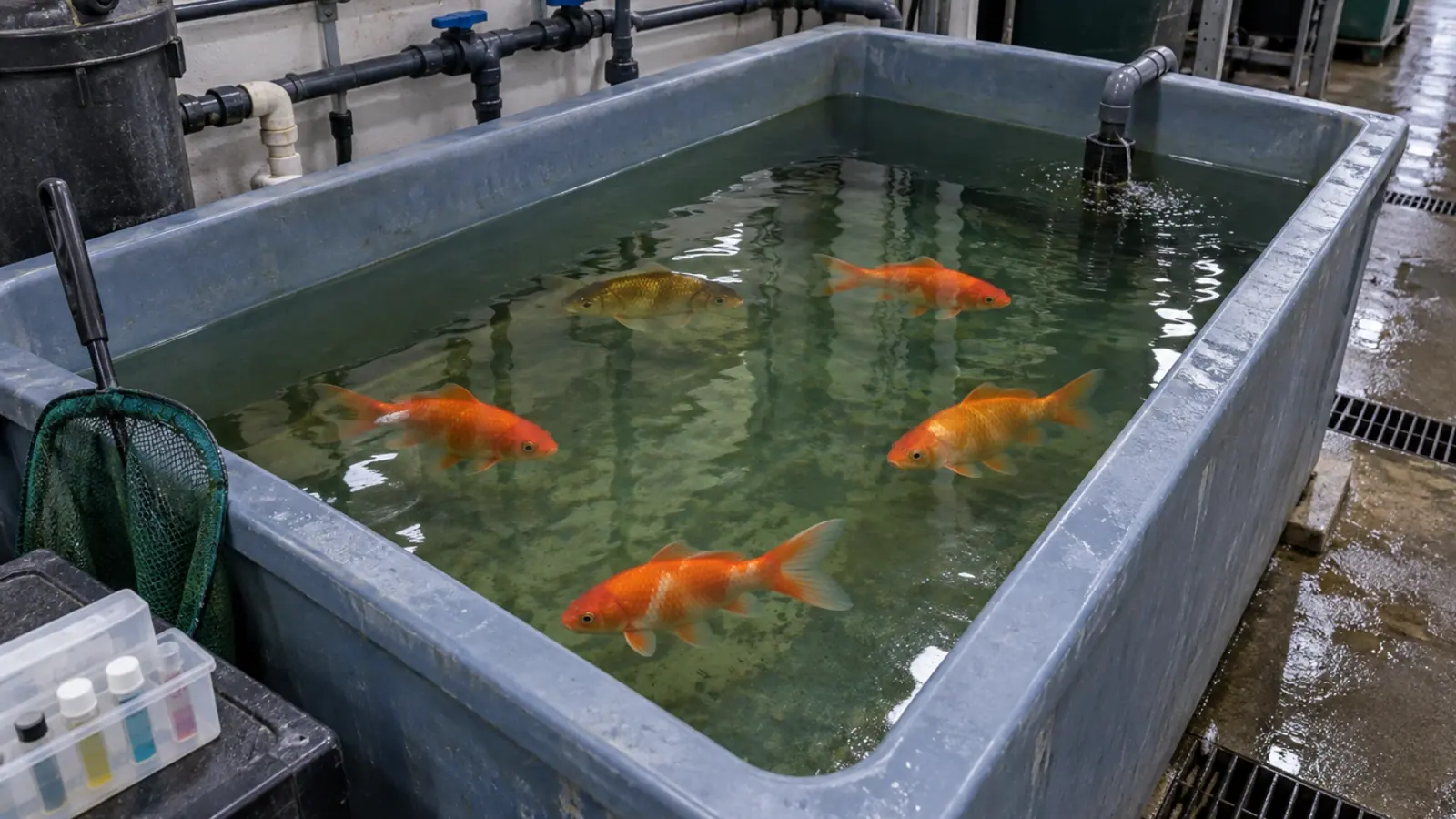
Confiscated fish: assess aquarium receiving capacity
Receiving confiscated fish requires separate decisions on immediate care, quarantine and permanent placement. IUCN guidance helps public aquariums assess identity, resources and risks before animals join an existing collection.


- Content type
- Practical guide
- Sector
- Public aquariums
- Animal group
- Fish
Emergency care does not decide permanent placement
A public aquarium asked to hold confiscated fish faces two decisions: how to meet the animals’ immediate needs, and whether it can provide longer-term care without compromising its existing collection. An empty tank does not answer the second question. Separation, husbandry capacity and access to clinical support need assessment before an arrival creates commitments that are difficult to reverse.
The International Union for Conservation of Nature’s 2019 guidelines place immediate care, identification and assessment of placement options at the centre of confiscated-organism management. Their scope extends across many taxa rather than supplying a fish-specific health protocol. For aquariums, they offer a decision framework for animals whose origin and previous care may be poorly documented.
Keep identification and provenance uncertainties visible
Identification determines the water conditions, diet and facilities an animal requires. Similar-looking fish can have different husbandry needs or conservation implications. A provisional identification should remain clearly marked until it is confirmed, with photographs and the supporting information retained. Uncertainty is part of the case record, not a gap to fill by assuming the most familiar species.
The IUCN guidelines also distinguish the country of shipment from the organisms’ actual origin. For an aquatic consignment, a dispatch address says little about previous water sources, contact with other species or intermediate transport stages. Missing history should be treated as uncertainty in the health and placement assessment. It cannot establish either a safe origin or a specific disease exposure.
An arrival record can bring together animal numbers, proposed species, sizes, apparent condition, transport containers, known dates and information supplied by the responsible authority. Staff should distinguish information received from observations made at the aquarium. That separation allows a conclusion to be reconsidered when identification improves or further records become available.
Stabilisation and long-term decisions need different criteria
The guidelines prioritise safety and provision for essential needs. In fish, this means suitable water conditions, observation and an organised care response. Urgency does not make an unsuitable display tank an appropriate receiving environment. The facility must be able to meet the likely requirements while uncertainty is being resolved.
Quarantine requires effective separation appropriate to the species and circumstances. A separate tank connected to the collection’s water circuit provides a different barrier from an independent installation. Water, equipment and staff activities all need consideration, together with the ability to maintain the arrangement for as long as the assessment requires.
The IUCN document does not provide a universal quarantine period for confiscated organisms. Release from quarantine should follow a documented assessment of observations and relevant examinations. Elapsed time alone cannot resolve uncertain identity, persistent clinical signs or an unanswered health question. The team needs to know which evidence will support its next decision.
Check capacity before making an open-ended commitment
Tank volume is only one part of receiving capacity. Water management, suitable food, dedicated equipment, staff availability and veterinary expertise also matter. Animals that are difficult to feed or observe can require considerably more support than the spare space suggests. Planning needs to account for those demands during routine staffing as well as the first response.
For example, a technically suitable tank may already serve another health-management purpose. Committing it to an urgent intake can remove the aquarium’s normal isolation capacity. That trade-off should be explicit, with an alternative arrangement or a defined limit to the commitment. Otherwise, the consequence may emerge only when another animal requires separation.
The receiving agreement should identify contacts, practical responsibilities, outstanding information and circumstances requiring referral elsewhere. Legal placement decisions remain with the competent authorities. IUCN guidance is international advice, not a French permit to hold or transfer animals. An aquarium operating in France must therefore distinguish its veterinary and husbandry assessment from the decisions and documentation required by those authorities.
Assess health without assuming infection
Uncertain provenance does not mean every fish is infected. It does reduce the assurance that can be drawn from an incomplete history. Risk assessment should connect plausible hazards, routes of transmission and consequences for incoming animals, the collection, people and potentially the external environment. It should also identify which uncertainties can realistically be reduced.
Examinations need to answer the questions raised by the particular consignment. A negative screening result does not certify freedom from every agent: sample type, timing, test performance and the animals examined all affect its meaning. Biosecurity arrangements should remain proportionate to residual uncertainty even when the incoming fish appear to be recovering.
Incoming animals’ welfare matters alongside protection of the resident collection. An isolation arrangement that persistently prevents feeding or fails to meet species needs requires reassessment. The response may involve changes to the installation or referral to a better-equipped facility, coordinated with the responsible parties. Separation is a means of managing risk, not a complete husbandry outcome.
Review destination options as evidence improves
Permanent display is only one possible outcome. The IUCN framework calls for assessing captive placement and other options against their resources, risks and suitability. Release into the wild requires a separate evaluation. Unknown origin or unresolved disease risk cannot be bypassed by treating release as an obvious rescue endpoint.
For the aquarium, a useful conclusion is a revisable decision: temporary holding with conditions, integration after assessment, or an organised transfer to an appropriate facility. Identification, animal needs and available resources must support that decision. A commitment made during the emergency should be revisited as those facts become clearer, with the reasons recorded for the next team responsible.
Prepare receiving arrangements with Vetofish
Vetofish can help assess receiving facilities, organise the health record and define reassessment criteria. Our aquatic health expertise supports public aquarium teams in planning proportionate care while keeping urgent stabilisation separate from approval for collection entry.


