

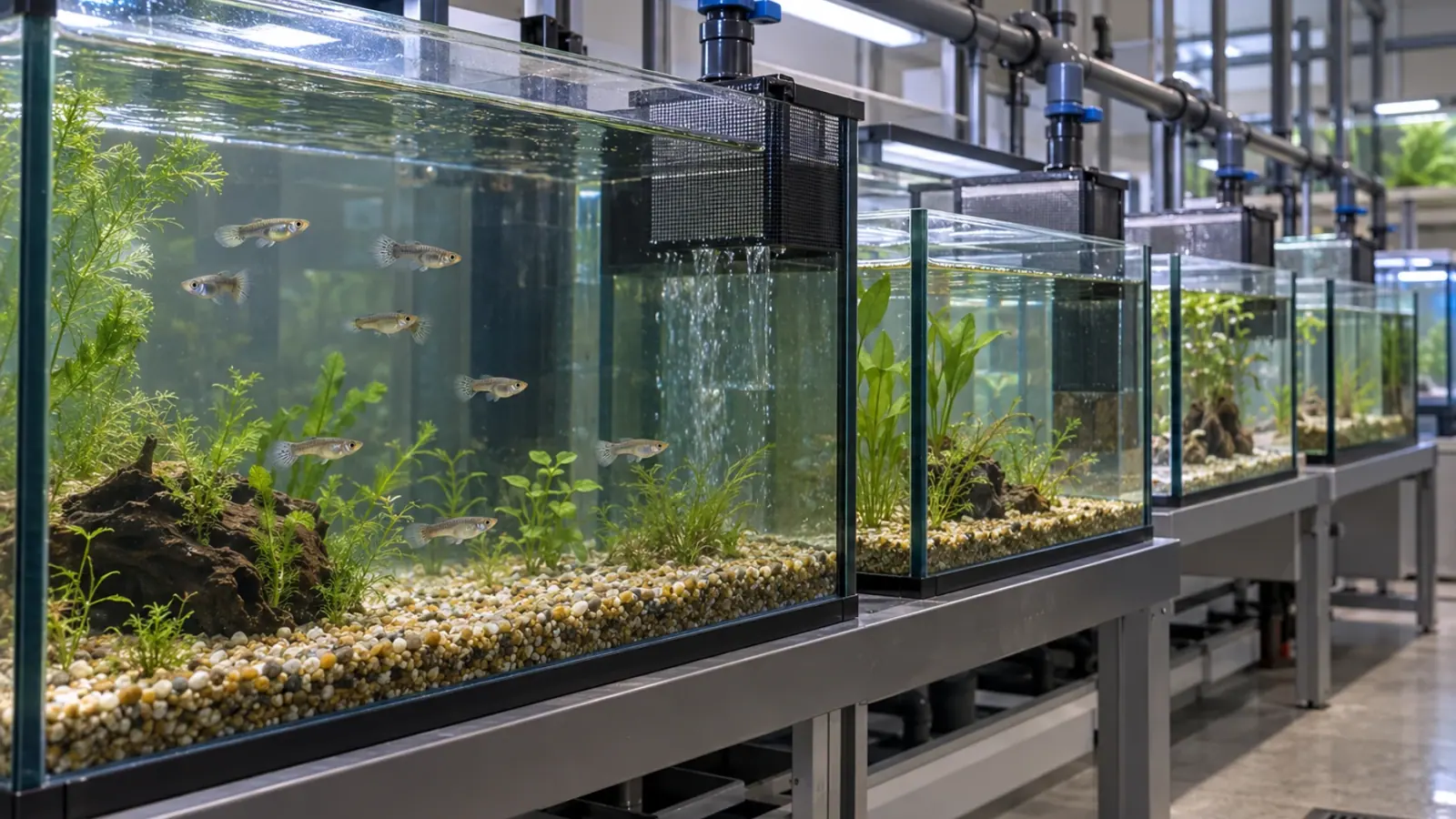
Aquarium offspring: plan capacity at every life stage
Eggs or young fish may appear before a destination is agreed. Public aquariums can prepare by connecting each life stage’s needs to sustainable resources and a clearly stated collection purpose, without assuming every birth is a conservation benefit.


- Content type
- Practical guide
- Sector
- Public aquariums
- Animal group
- Fish
- Keywords
- ReproductionBiosecurityTransport
Eggs appear within an exhibit, or young fish suddenly become visible among an established collection. By that point, the team needs more than a spare nursery tank. It needs to know which cohorts it can support, how their requirements will change and where the animals could eventually be housed. Initial space is useful only when it connects to a credible plan for later growth.
This guide considers decisions made before unplanned breeding. It draws on Smith’s 2023 review of fish welfare in public aquariums and the IUCN’s 2014 guidance on ex situ management for conservation. These sources provide complementary frameworks rather than a single procedure for controlling reproduction or managing every unexpected cohort.
Establish what the collection might produce
Reproduction includes the production and development of offspring, rather than egg release alone. Preparation begins with the species present, their known reproductive biology, adult life stages and the team’s observations. In mixed exhibits, the origin of eggs may be uncertain. That uncertainty should remain in the record until identification is established.
A species-level planning sheet can bring together expected seasonality, previous observations, early-life requirements and available expertise. Its purpose is to expose what the institution can prepare for, not to predict an exact number of offspring. Missing information should direct documentary work and exchanges with other institutions rather than be replaced by unsupported estimates.
Smith’s review emphasises the diversity of fish biology and the need for species-appropriate environments. Reproduction can provide information about one biological function, but breeding alone cannot establish good welfare throughout a collection. Social, nutritional or environmental problems may still affect animals in an exhibit where offspring are produced.
Assess capacity through successive life stages
A larva is not simply a smaller adult. Swimming ability, feeding and the suitability of water inlets or outlets can differ substantially from those of displayed fish. Receiving larvae therefore requires assessment of the container, accessible food, water movement and observation needs for the species concerned. A nursery arrangement suitable for one taxon may fail for another.
Juveniles subsequently grow without necessarily being sexually mature. Capacity assessment needs to extend beyond the first few weeks. A cohort may fit into several small containers initially and later exceed the institution’s ability to separate, filter or observe it adequately. Temporary nursery space and sustainable long-term housing are different resources, even when the same tanks appear in both plans.
Teams can examine several scenarios: few surviving young, a larger cohort, or a delayed move to another institution. Each scenario should identify usable tanks, staff time, food, consumables and the period for which these resources are available. This is an organisational proposal. The cited sources do not provide numbers or holding periods applicable to every aquarium.
Name the purpose before invoking conservation
The IUCN’s 2014 guidance addresses ex situ management used for defined conservation objectives. It calls for a clear programme role, the population characteristics needed to fulfil it, and an assessment of resources, feasibility and risks. It does not classify every birth in a public aquarium as a conservation achievement.
Where a conservation programme exists, breeding decisions may depend on relatedness, demographic composition and the managed population’s genetic objectives. Producing the greatest possible number of animals is not automatically the priority. A cohort’s contribution should be assessed with the programme coordinators rather than inferred solely from the species’ threatened status.
An aquarium maintaining a species outside such a programme still has responsibilities for animal care and collection management. It can apply careful resource planning while accurately describing its purpose. Education or replacement of collection animals may be legitimate institutional aims; neither label, by itself, demonstrates a measured benefit to wild populations. Future release requires a separate assessment and cannot be treated as a default destination for surplus animals.
Agree decisions and responsibilities in advance
Before offspring appear, establish who confirms identity, who authorises continued rearing and who contacts potential partners. A cohort record can connect presumed origin, observation date, developmental stage, estimated numbers and uncertainties. Subsequent container changes and losses should remain linked to that record so the team can reconstruct what happened.
A prospective partner’s available space needs confirmation for the species, life stage and relevant period. Health information, biosecurity requirements, accepted diets and receiving conditions should be discussed before movement. A possible transfer is not a guaranteed destination, and another institution’s capacity should not be counted without its agreement and a workable receiving plan.
Changes intended to prevent breeding also require species-specific assessment. Separating individuals can alter social conditions, while changing the environment may affect other exhibit occupants. The general frameworks cited here do not justify hormonal interventions, abrupt changes in water conditions or methods for eliminating a cohort. Such decisions require their own assessment rather than being improvised from a collection-planning guide.
Use unexpected births to improve the plan
An unplanned cohort can reveal useful information about breeding conditions, the stage at which offspring become detectable, feeding capacity and actual workload. The review should distinguish information available before the event from discoveries made afterwards. A single successful cohort can improve preparation without proving that the same result will be reproducible.
An effective plan prevents a later housing impasse. Existing animals, new cohorts and staff depend on shared resources. If rearing occupies a tank needed for another essential function, that opportunity cost belongs in the decision. A list of possible destinations is insufficient without confirmed resources and commitments.
Conclusion and Vetofish support
Anticipating offspring means connecting reproductive biology, capacity at each stage and a credible destination to a clearly stated purpose. Our advisory support can help public aquariums develop cohort records, assess housing capacity and coordinate decisions across teams and partner institutions. The plan should remain open to revision when observations or available resources change.


