

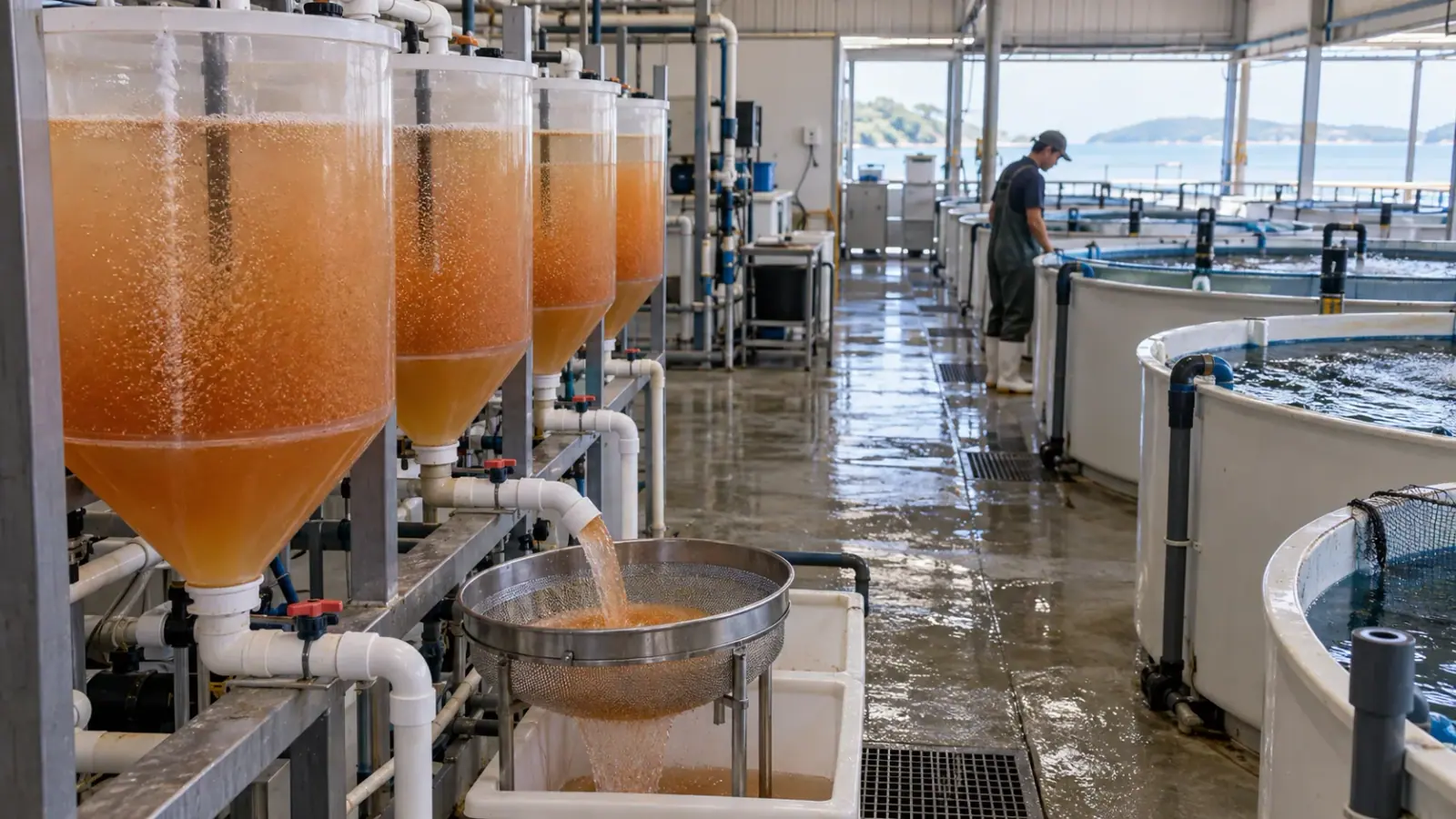
Artemia in hatcheries: hatching is only the beginning
A live nauplius is not automatically a suitable meal. Hatcheries need to control the age, size, nutrient content and microbial load of Artemia all the way to the larval tank.
- Content type
- Practical guide
- Sector
- Aquaculture
- Animal group
- Fish
- Keywords
- SalinityMicrobiomeBiosecurity
Artemia is a practical live feed for many hatcheries, yet a high hatch rate says little about what a fish larva actually eats. The FAO live feed manual separates production methods from prey size, nutritional properties and feeding practice. Cyst hatching, naupliar harvest and enrichment answer different questions and need separate checks. These are separate control points. A hatchery should follow a cyst batch through to ingestion rather than regard the contents of a hatching vessel as a finished diet.
Start with the fish larva
The feeding plan starts with the cultured fish species, developmental stage, mouth gape and hunting behaviour. A prey item may be alive and abundant but too large to swallow. Conversely, very small prey may require an impractical density before larvae encounter enough of them. Observations in the tank, including larval gut contents after a meal, are more informative than a target concentration recorded only at the harvesting bench.
Newly hatched nauplii do not remain unchanged. As they develop, their dimensions and composition alter. A mixture of ages makes feed delivery less predictable. Recording hatching time, harvest time and the delay to feeding helps staff compare batches. Rotifers or other prey may still be necessary before the switch to Artemia for a particular species. The transition should be guided by demonstrated ingestion, not a calendar date borrowed from another hatchery.
Separate hatch performance from harvest quality
A batch record identifies cyst origin, date opened, storage conditions and the hatch performance observed on site. Incubation water and aeration need to suit the validated local method. A published procedure is a starting point for testing, not a universal setting for every strain and vessel. Salinity is relevant both to the culture and to the change in water conditions when prey are transferred to a larval tank.
Harvesting should separate live nauplii from unhatched cysts and empty shells as effectively as the facility allows. Otherwise an apparently generous ration may contain a substantial inert fraction, while debris adds to tank maintenance. Appropriate rinsing reduces the transfer of culture water. Staff should record live yield, prey condition and age instead of judging a batch solely by the volume of a concentrated harvest.
Cyst decapsulation is a distinct operation with its own operator safety and quality requirements. It should not be improvised next to the larval tanks or added routinely when the hatchery cannot verify its outcome. Where it is used, the chosen procedure must be validated for the local equipment and protect both staff and animals.
Enrich for a defined nutritional purpose
Freshly harvested Artemia can be alive without providing the fatty acid profile required by the fish species under culture. Enrichment gives nauplii access to a suitable preparation before feeding. The FAO treats this as a nutritional stage in its own right. Product choice, exposure period, prey density and aeration belong in a documented procedure. The label on an enrichment product does not measure what each fish larva has consumed.
Enrichment cannot compensate for unsuitable prey size, a late harvest or a feeding pattern that carries prey away from the larvae. Extra material can also increase organic loading in the culture. Checks should therefore cover prey viability, culture condition, ingestion and subsequent larval performance. Where feasible, analysis of samples actually fed to larvae provides stronger evidence of nutrient delivery than a record showing that the procedure was followed.
Treat live feed as a biological input
Live prey carry microbes and culture water. Detecting a bacterium along that pathway does not prove it caused disease in the fish, but it does make traceability important during a hatchery investigation. Tanks, enrichment batches, rinsing steps, tools and cyst lots should be identifiable. Ageing culture water, shared containers and prolonged holding of harvested nauplii can undermine a ration that looked adequate by number.
Biosecurity requires a clear flow between cyst storage, prey culture, larval rearing and waste handling. Staff need agreed checks and responses when hatching is poor, prey die, or water quality drifts. A suspect batch should be held back while its condition is assessed. No single microbial or nutritional threshold applies to every species and every hatchery: the decision rules must fit the system and the tests available.
Observe feeding in the tank
The final assessment happens where the larvae are. Samples from different places and times can reveal whether prey remain accessible, accumulate in a dead zone or disappear before feeding. Uneaten prey contribute to organic loading. Automatically increasing the ration in response to slow growth may worsen the water conditions that contributed to the problem.
A useful daily record links larval stage, cyst lot, hatch and harvest times, enrichment, prey supplied, consumption observed and water condition. That makes it possible to compare periods and identify a specific change rather than concluding vaguely that Artemia has stopped working. The value of live feed is ultimately measured through the larvae, their survival and development, and the practical constraints of the installation.
For aquaculture operations, our advice and support service can help define workable checkpoints across live feed production and larval feeding.


