

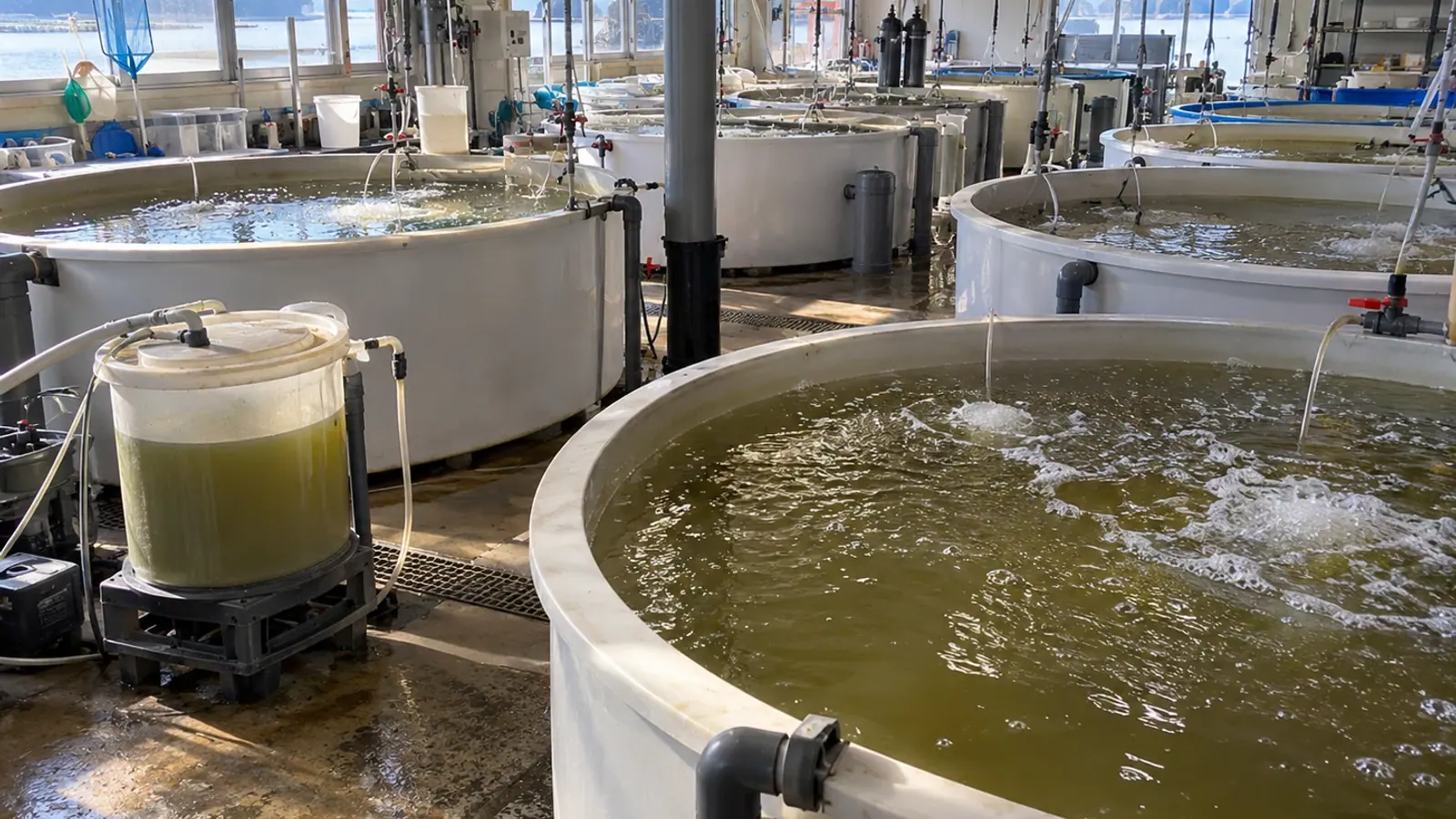
Hatchery rotifers: check the batch before feeding
High rotifer numbers do not establish that a batch is suitable for larvae. Prey size, recent feeding, enrichment and the route through the hatchery all need checking before delivery.
- Content type
- Practical guide
- Sector
- Aquaculture
- Animal group
- Fish
- Theme
- NutritionBiosecurity
A count answers only part of the question
Rotifers provide live prey during the early feeding stages of many marine fish. Their usefulness depends on whether larvae can capture them and on what the prey actually delivers. Counting organisms establishes production output. Accepting a batch for feeding also requires information about size, condition, recent diet and its route through the facility.
The FAO manual on live food production explains the connection between culture and nutrition. Published in 1996, it is a foundational technical reference, rather than current approval of every product or treatment it describes. Its biological principles provide a basis for the checking process proposed here. Numerical acceptance criteria must be chosen for the strain, fish stage and production system involved.
Match the prey to the larvae
Prey size should suit the feeding capabilities of the larval stage. A culture’s trade name does not establish its size distribution. Microscopic examination of a representative sample can distinguish expected rotifers from debris or unwanted organisms and provide an opportunity to assess activity.
A working batch record should identify the strain, origin, restart date, production tank and intended larval tank. Changing the strain deserves reassessment even when the new culture produces a familiar concentration. Increasing the ration does not make an unsuitable prey size useful to larvae with a limited mouth opening.
Sampling and observation are easier to interpret when operators use the same method. Repeated examinations and illustrated descriptions of acceptance criteria can make a phrase such as “culture satisfactory” less subjective. These are proposed process controls, not a diagnostic test that rules out every infectious agent. Findings still need to be interpreted alongside the history of the culture and the performance of the larvae receiving it.
Check the culture before increasing feed
Salinity, temperature, aeration and culture feed affect production. The FAO describes responses that vary with strain and conditions. A single setting should therefore not be treated as suitable for every hatchery. A successful pilot tank may behave differently when volume, diet or organic loading changes.
Time-stamped measurements help staff relate a change in growth to a change in the culture environment. Dissolved oxygen should be checked under the conditions that place the greatest demand on the system, rather than only at the start of a shift. Visible bubbles alone do not demonstrate that aeration meets the needs of the culture.
Before increasing feed, check that counts are comparable, water conditions remain appropriate and the diet has been prepared as intended. More feed may not correct a declining culture and could distract from the actual problem. The operational task is to distinguish measurement error, environmental change and a change in routine. A decision record makes the reasoning available to the next shift and provides a reference when the culture is assessed again.
Production and enrichment are separate objectives
A productive culture can yield prey with an unsuitable nutritional composition. Rotifer diet and enrichment affect fatty acid provision, including EPA and DHA. The manual’s nutritional chapters explain why producing large numbers and preparing nutritionally useful prey should be assessed separately.
The local protocol needs to identify the feed, preparation method, enrichment sequence and interval before delivery. Historical examples of commercial products are not current recommendations. Any formulation in use should be assessed against its documentation and the results obtained in the specific hatchery.
Assessment should continue beyond the harvest point. Holding, waiting and delivery conditions can alter what larvae ultimately receive. Reviewing a feeding event therefore means reconstructing the whole sequence: collection, preparation, any rinsing, holding, movement within the facility and introduction into the larval tank. Record the intervals without inventing a universal maximum holding time. A batch that passed its initial check still needs a clear link to the feed that reached the animals.
Follow the water and equipment as well as the prey
Live feeds carry a microbiota and culture water. Biosecurity assessment should follow actual transfers between starter cultures, multiplication tanks, enrichment, harvesting and feeding equipment. Unnecessary contact between starter cultures and equipment used in larval tanks creates an avoidable connection between circuits.
Identifying equipment by circuit and documenting the intended cleaning process is a practical starting point. Transfers between tanks should be recorded explicitly. When a batch is rejected because of an anomaly, keeping its identity and identifying the larval tanks previously supplied makes investigation more focused. Rinsing does not establish sterility, and a satisfactory microscopic appearance does not replace a justified microbiological investigation.
Older manuals include treatments or products whose safety and legal conditions of use require a current assessment. They are not reproduced here as instructions. Any health intervention needs veterinary evaluation of its purpose and consequences for animals and water systems. Historical technical usefulness should never be confused with permission to use a substance today.
Make acceptance criteria useful in practice
An acceptance record can bring together batch identity, prey observations, counts, water conditions, nutritional preparation and any anomaly. Rules for feeding, holding or rejection should be agreed before a problem occurs. Their usefulness can then be reviewed against observations in the larval tanks, without automatically attributing every poor outcome to live feed.
The practical conclusion is to connect production output to the meal actually received. Concentration remains essential, but establishes neither nutritional suitability nor health security. Usable traceability helps staff understand a change in performance and correct the relevant step rather than changing several unrelated settings at once.
Reviewing the process with Vetofish
Vetofish can review culture circuits, batch records and acceptance criteria, then help design a health investigation matched to the observed problem. Our aquatic health expertise supports aquaculture facilities in connecting live prey quality, larval observations and production decisions.


