

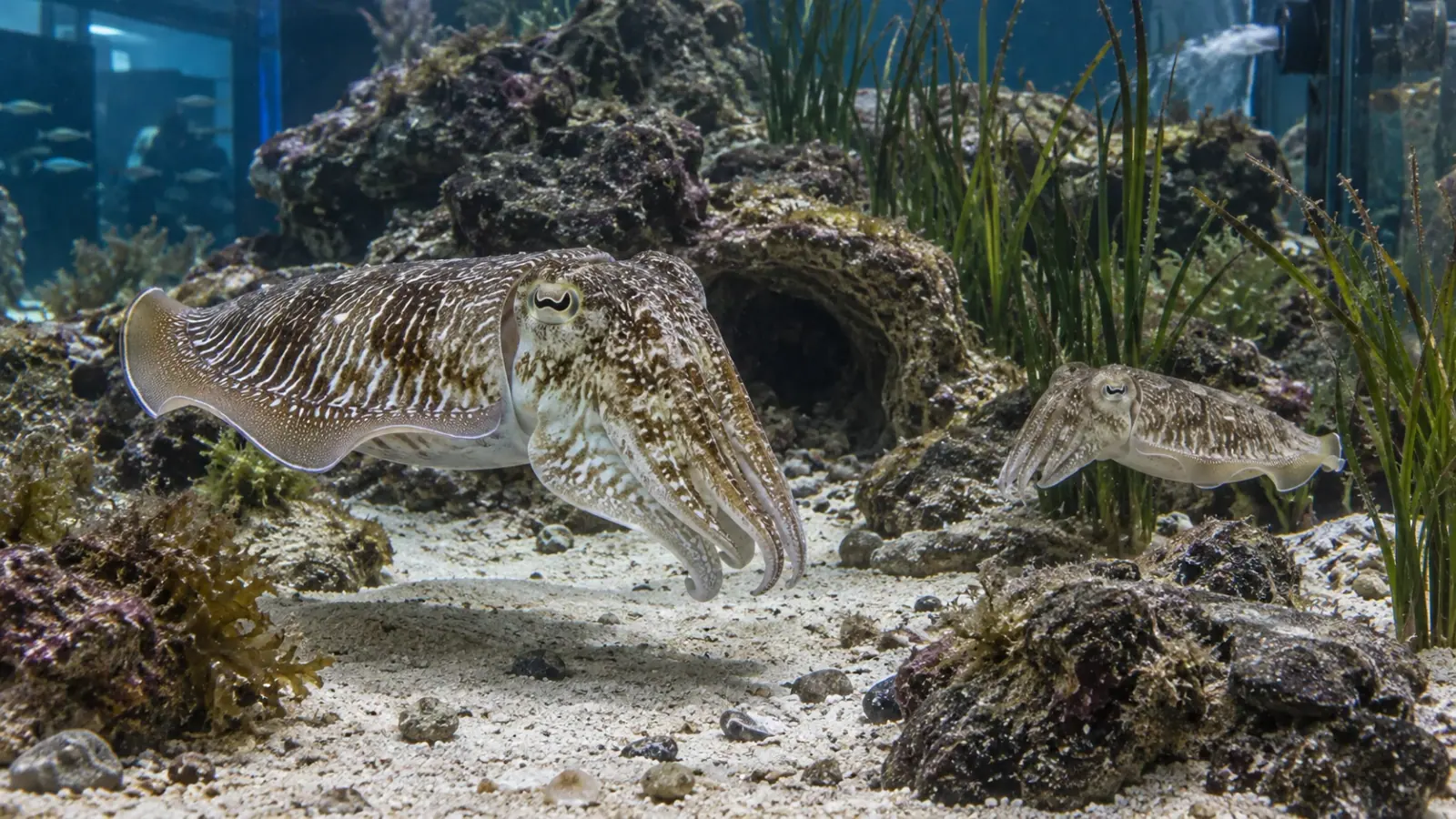
Cephalopod care: prevent problems before lesions appear
A collision, escape attempt or colour change may be preceded by subtle signals in cephalopods, so monitoring must reflect the species and its context.

- Content type
- Practical guide
- Sector
- Public aquariums
- Animal group
- Cephalopods
Cephalopods are not a uniform husbandry group. A benthic cuttlefish, an exploratory octopus, an open-water squid and a nautilus use space and shelter in very different ways. Applying a generic exhibit design or observation checklist can therefore hide a problem until abrasion, food refusal or a collision becomes visible.
Some evidence comes from research facilities, but welfare tools have also been tested in zoological collections and public aquariums. The consistent message is that environment, appearance and behaviour must be read together against a reference appropriate to the species and the individual.
Prepare the exhibit before arrival
Acclimation begins with exhibit design. Water parameters, flow, resting areas, substrate, visual contrast, shelter and escape prevention should follow the natural history of the species. A lid is not simply present or absent: hose passages, overflows and narrow gaps may all provide an exit route for an octopus.
International cephalopod guidance emphasises stable temperature and salinity. Rapid changes can be poorly tolerated, while high respiratory demand makes continuous flow and oxygenation important. Alarms must cover unstaffed periods and trigger a practical response to pump or life-support failure.
Lighting, vibration and activity around the exhibit also belong in the plan. A retreat allows the animal to control exposure. For a species that normally uses a den or shelter, that resource should be available on arrival rather than added after avoidance behaviour develops.
Acclimation records should include transport duration, water differences, transfer method, the first voluntary feeding and the time taken to resume species-typical activity. A fixed number of days does not prove adaptation. The endpoint should be a set of observable criteria, and the exhibit should remain separable from other systems while health status is being assessed.
Record defined behaviours
“Stressed” is an interpretation, not an observation. A useful record describes feeding, exploration, shelter use, respiration, posture, locomotion, repeated wall contact, body-pattern changes, inking, response to keepers and recovery time after management procedures.
Colour is informative but does not function as a universal code. Patterns change with camouflage, communication, hunting, rest and context. An unusual display becomes more meaningful when linked to posture, location, duration and a specific event. Short video clips collected under comparable conditions improve agreement among keepers.
Narshi and colleagues adapted an Animal Welfare Assessment Grid for invertebrates monitored at a zoo and a public aquarium. The tool grouped factors related to health, environment, psychological state and procedures. Its value is not a magical score. It is the ability to visualise accumulated events and test whether a management change improves the animal’s trajectory.
Reduce collision risk in cuttlefish
An experimental study in common cuttlefish, Sepia officinalis, assessed housing conditions, simulated husbandry disturbance, shelters and enrichment. Juveniles may strike tank walls when startled, and resulting damage can compromise growth and survival.
The researchers found that some environments, shelters and visual features reduced negative behaviour. This does not mean that a substrate photograph or one refuge design suits every cephalopod. The transferable lesson is methodological: define the unwanted behaviour, test one precise change and check its effect without introducing a new hazard.
In a display exhibit, visitors, reflections and movement along the front panel differ from research settings. The facility should therefore evaluate the system under real operating conditions, including peak attendance, cleaning and lighting transitions.
Separate enrichment from novelty
Enrichment serves a function: hiding, exploring, manipulating, hunting or choosing between microhabitats. A merely novel object may instead provoke avoidance, injury, ingestion or obstruction. Materials should be non-toxic, stable, cleanable and free of sharp edges or trapping spaces.
Assessment begins before introduction and continues during and after exposure, with a predetermined stopping rule. Frequency of use is not always sufficient. Staff should confirm that the resource does not interfere with feeding, rest or tank maintenance. Individual preferences may change with age, reproductive state and health.
Respond to early departures from baseline
Reduced feeding, altered respiration, abrasion, unusual posture or repeated wall contact should trigger a structured check of water quality, flow, temperature, noise, lighting, social interactions, shelter access and recent changes. Clinical examination and sampling are then tailored to species and risk without repeated capture that would add another stressor.
Senescence must also be distinguished from treatable disease. Its expression varies among taxa and individuals. A predictable life history does not justify assigning every change to age; feeding history, lesions, behaviour and veterinary findings remain necessary.
Daily records gain value when they can be reviewed on a common timeline. Maintenance work, visitor density, feeding, water alarms and clinical observations should use compatible timestamps. This makes it possible to investigate repeated departures from baseline and distinguish coincidence from a pattern worth testing.
Teams also need an incident plan for escapes, prolonged inking, life-support failure and traumatic contact. It should assign roles, identify safe containment equipment and define when veterinary input is required. Practising the human sequence without using an animal can reveal missing tools and ambiguous responsibilities.
Vetofish can help public aquariums translate natural history into observable criteria, audit exhibits and procedures, train teams and define escalation thresholds. For cephalopods, prevention depends less on a universal recipe than on a controllable environment and observations precise enough to prompt action before injury.
To move from evidence to action, explore our animal welfare service and our expertise for public aquariums.


