

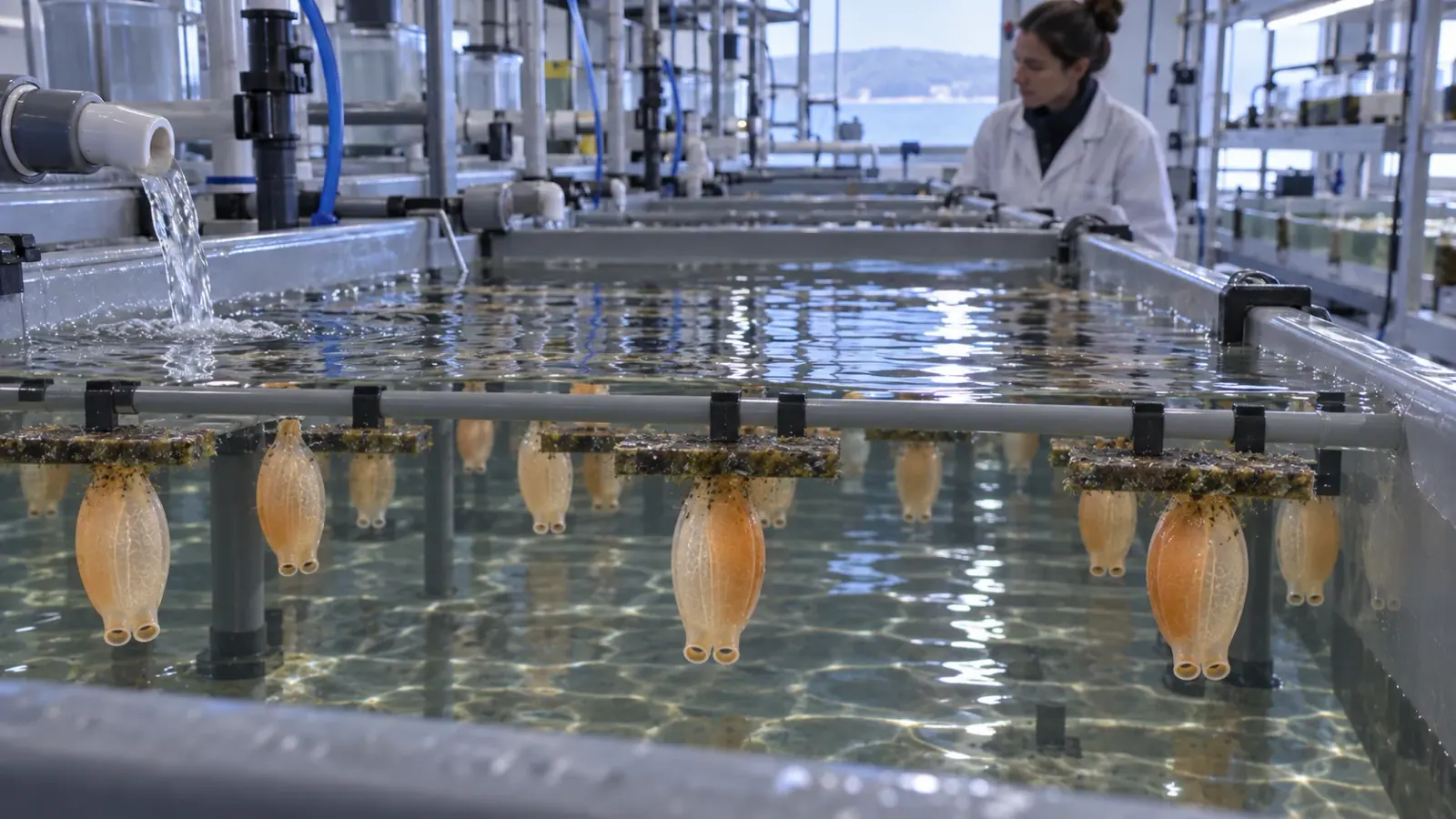
Ciona robusta: a simple chordate with demanding culture
The sea squirt Ciona robusta offers accessible embryos and powerful genetic tools, but reproducibility still depends on adult culture.
- Content type
- Species profile
- Sector
- Research
- Animal group
- Corals and invertebrates
Ciona robusta is a solitary marine ascidian: an invertebrate, but also a chordate. Its larva possesses a notochord and body plan that help researchers investigate the origins of features shared with vertebrates. Embryogenesis is rapid, cell lineages are well described and genetic manipulation is accessible. Experimental simplicity does not remove husbandry from the equation. Adult size, nutrition and maturation determine the availability and quality of gametes.
A model close to the vertebrate branch
Tunicates belong to the chordates. The swimming Ciona larva carries a notochord, dorsal nerve cord and tail, then settles and metamorphoses into a filter-feeding adult. This transition makes development, differentiation and tissue remodelling visible across strikingly different life stages.
A compact genome and transgenic or CRISPR tools allow investigators to examine conserved genes without some of the redundancy found in vertebrates. A 2026 study of the adult heart combined single-cell sequencing, transgenic lines and targeted perturbation to investigate cardiac progenitor proliferation. It demonstrates the model’s power; it does not make an ascidian heart equivalent to a mammalian one.
Resolve taxonomic identity
Older literature often used Ciona intestinalis for animals now assigned to C. robusta, formerly “type A”. Names, provenance and identification method must therefore remain in the record. Species confusion can alter interpretation of temperature tolerance, reproduction, ecology and crosses.
Traceability should include supplier or collection site, date, cohort and any transgenic line. Because C. robusta is non-native in some regions, collection, transport, containment and disposal must prevent release to the environment.
Maintain an active filter feeder
The attached adult draws water through one siphon, retains particles in the branchial basket and expels water through another. Feeding, flow, particle load, microbial quality and condition are therefore tightly linked. Clear water is not necessarily an adequate ration, and particle-rich water is not necessarily stable or safe.
Mathiesen and colleagues compared controlled culture conditions for C. robusta and C. intestinalis. Body length closely tracked somatic and sexual maturation, and the authors used size selection to retain reproductively fit animals at low density. This is a defined experimental protocol, not a universal recipe for every strain and facility.
Track growth before scheduling crosses
Egg and sperm availability reflects adult history. Body size, estimated age, ration, temperature, salinity, density and maturation date should accompany each production event. Selecting only the largest animals may support a protocol but can also bias a study concerned with growth variation.
Crosses should preserve parental identity. Many embryos from one pair do not represent the same number of independent biological replicates. Designs need to distinguish parents, fertilisation batches, culture vessels and technical observations.
Use the embryo without overlooking metamorphosis
External fertilisation exposes cleavage, gastrulation, larval formation and attachment to observation. Stage should be defined by morphology under a documented temperature, not elapsed time alone. Embryo density, water renewal, settlement surface and contamination can all affect outcome.
Metamorphosis profoundly reorganises the animal after attachment. A larval result cannot automatically describe juvenile or adult physiology. Conversely, the condition of a gamete-producing adult may generate parental effects that disappear from view when cohorts are pooled.
An immunity and microbiome model
C. robusta also supports work on innate immunity and gut microbial interactions. Liberti and colleagues review mucus organisation, immune effectors, cultured microbial collections and short-term germ-free methods. These tools enable controlled experiments, but an altered microbial community cannot be interpreted independently of food and water.
As a filter feeder, the ascidian can concentrate particles and is relevant to ecotoxicology. That property requires water controls, exposure characterisation and strict prevention of cross-contamination.
Link health, metadata and reproducibility
Daily surveillance can record siphon opening, filtration, retraction, tunic appearance, attachment, growth and mortality. Observations belong beside water measurements and interventions. A change in colour or shape should not be assigned a diagnosis without appropriate investigation.
Useful metadata include species, line, origin, temperature, salinity, diet, density, size, reproductive status and the version of genomic resources. Standardisation supports comparison among laboratories and helps separate biology from culture effects.
Keep the organism within the experimental unit
The simplest analytical error is to count images, cells or embryos as if each came from an independent adult. Biological replication must follow the level at which the treatment was allocated. Randomisation, blinded scoring and archived raw images strengthen a design, but they cannot replace independent parents or cultures.
Health events also belong in reporting. Unexplained mortality, a change in filtration or a contamination episode may affect cohorts even when the intended molecular endpoint appears technically sound. Excluding those observations after seeing the result risks hiding a husbandry-related bias.
Vetofish can support marine facilities with system design, animal surveillance, biosecurity and breeding procedures. With C. robusta, reliable genetics begins with documented adult culture.
To move from evidence to action, explore our advice and support service and our expertise for research facilities.


