

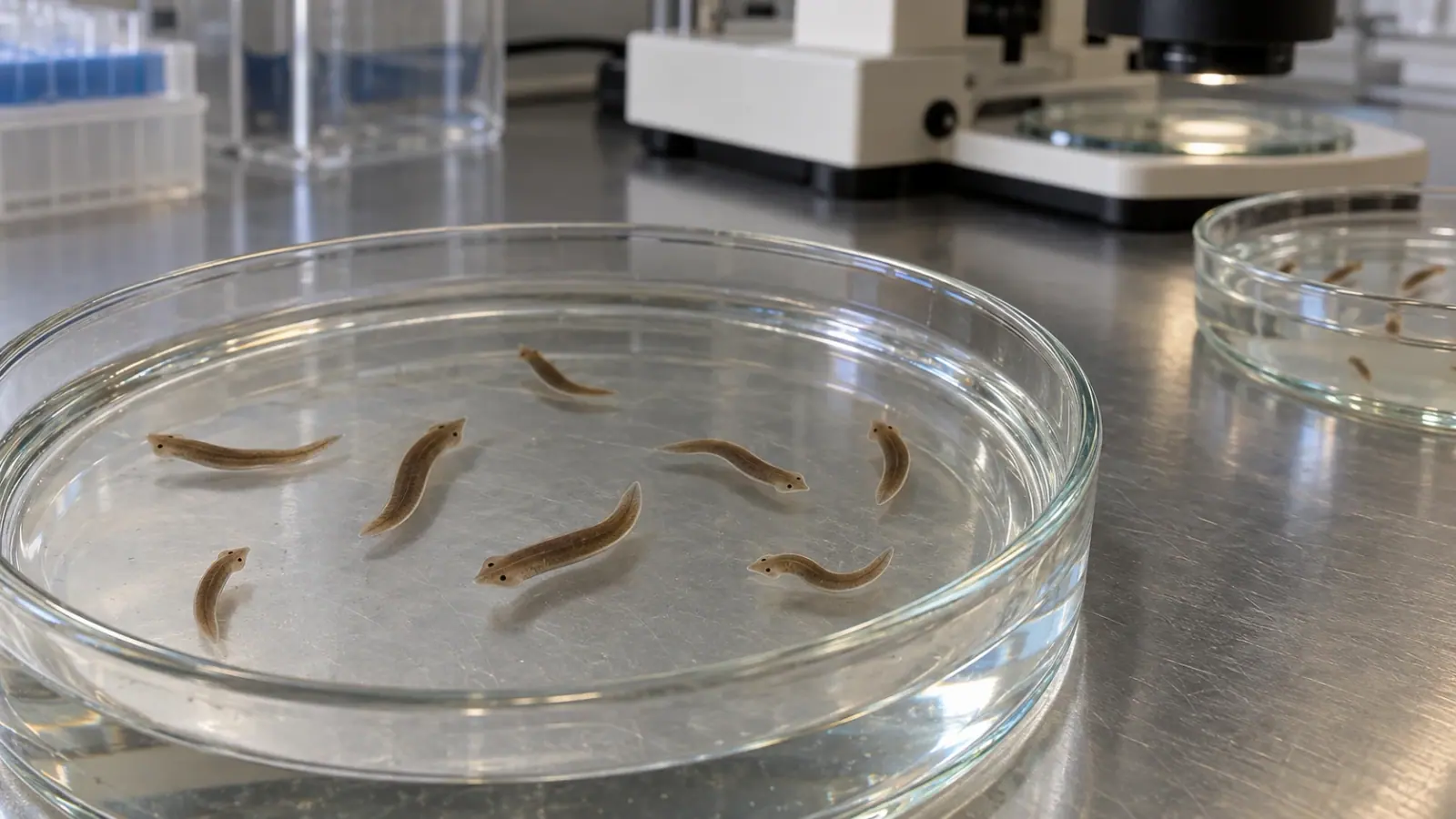
Schmidtea mediterranea: husbandry is part of the model
The remarkable regenerative capacity of Schmidtea mediterranea makes it a powerful model, provided that strain, water, temperature, feeding and fasting are documented.
- Content type
- Species profile
- Sector
- Research facilities
- Animal group
- Corals and invertebrates
- Keywords
- ReproductionTemperatureStress
A planarian only a few millimetres long can rebuild missing body parts after amputation. In Schmidtea mediterranea, this capacity relies on abundant adult stem cells, the neoblasts, and coordinated restoration of body axes, tissues and organs. The model therefore supports research on regeneration, homeostasis, differentiation and cellular plasticity in a whole animal.
Its experimental power can obscure a more ordinary fact: results depend on the colony. Strain, reproductive mode, water composition, temperature, feeding, pre-experimental fasting and handling history all shape the starting state. Stable husbandry is not a background service; it is part of the scientific model.
Sexual and asexual lines are not interchangeable
Laboratory S. mediterranea includes sexual and asexual lines. Asexual animals reproduce by fission and can be maintained as clonal populations. Sexual lines produce cocoons and enable reproductive studies, but add variables related to maturity and reproductive state.
The choice should be explicit in protocols and publications. “Planarian” is inadequate, and even the species name is incomplete when line origin affects genotype and culture history. Transfers between laboratories should preserve strain identity, arrival date, relevant passages or fission cycles and unusual colony events.
Small size does not remove the need for health monitoring. Changes in locomotion, feeding response, epidermal integrity, shape or fission frequency may signal drift in the environment or colony. Observations should be compared with an internal baseline rather than a generic image of the model.
Culture water is an experimental medium
The open protocol by Sousa and Adell describes an artificial medium prepared from salt stocks, maintenance near 20°C and dark conditions. Concentrated medium and calcium solutions are stored separately to avoid precipitation, then diluted before use. The practical lesson is broader: composition, preparation, storage time and containers all require traceability.
A dedicated room or incubator limits thermal and light variation. Vessels should remain easy to handle because overly heavy containers increase the risk of abrupt movement and batch mixing. Walls, mucus and feed residues are monitored; cleaning should remove organic accumulation without injuring animals.
Local modifications are possible when validated, recorded and applied consistently. Quietly combining recipes from several laboratories, however, makes interpretation harder. For replication, the exact formulation is more useful than labels such as “Montjuïc water” or “planarian medium.”
Water-change schedules should distinguish routine exchange from corrective action after feeding or an incident. Source-water lot, preparation date, conductivity or other locally validated checks can help identify drift. Separate utensils for colonies reduce accidental transfer of animals, food residues and microorganisms.
Feeding and fasting alter the starting state
The maintenance protocol uses small liver pieces that remain in the vessel for several hours before removal and water replacement. Quantity, frequency, food origin and exposure time affect growth and organic load. Excess feed also supplies the microbial environment, while incomplete removal can quickly degrade conditions.
Pre-experimental fasting must be defined. Many studies use it to reduce variability related to digestion or nutritional state, but duration is not biologically neutral: planarians grow and degrow as resources change. Time should therefore be calculated from the last feeding and applied identically to compared groups.
Size is another biological variable. Selecting animals within a defined interval, measuring length with a reproducible method and balancing individuals among groups helps avoid confounding treatment with initial condition.
Population expansion by fission also requires planning. Cutting at a defined anatomical position can increase colony size, but the resulting fragments need a documented recovery period before they enter experiments. Animals collected at different stages of regeneration are not equivalent merely because they have reached a similar length.
Regeneration requires precise timing
An amputation experiment is more than “cut and observe.” Cut position relative to the pharynx and body axes, tool, temperature, time since feeding, time of day and recovery interval define the experiment. Different fragments do not receive identical polarity information or reconstruct the same structures at the same pace.
Observation criteria should be set in advance: wound closure, blastema formation, eye appearance, locomotion, feeding or molecular markers. Standardised imaging with orientation and scale improves comparison. Welfare still matters in an animal with strong regenerative ability; the ability to regrow tissue does not make every procedure inconsequential.
Genomics expands the model but does not replace the animal
The genome assembly published by Grohme and colleagues enabled more reliable analysis of a highly repetitive and polymorphic genome. Together with RNA interference, transcriptomics and single-cell approaches, it helps connect genes, cellular states and tissue reconstruction.
Those resources make husbandry metadata more important, not less. Differences in diet, temperature or strain can alter expression and be mistaken for treatment effects. Depositing sequences and code is insufficient when the biological history of the animals remains vague.
A practical minimum dataset should include strain, reproductive mode, culture medium recipe, temperature range, light regime, vessel and density, feeding schedule, fasting interval, last water change and any manipulation used to expand the colony. Reporting deviations is as important as reporting the intended procedure.
Vetofish can help research facilities write husbandry procedures, analyse critical control points, define daily indicators and harmonise metadata between teams. With S. mediterranea, reproducibility starts well before amputation; it starts in the culture vessel.
To move from evidence to action, explore our advice and support service and our expertise for research facilities.


