

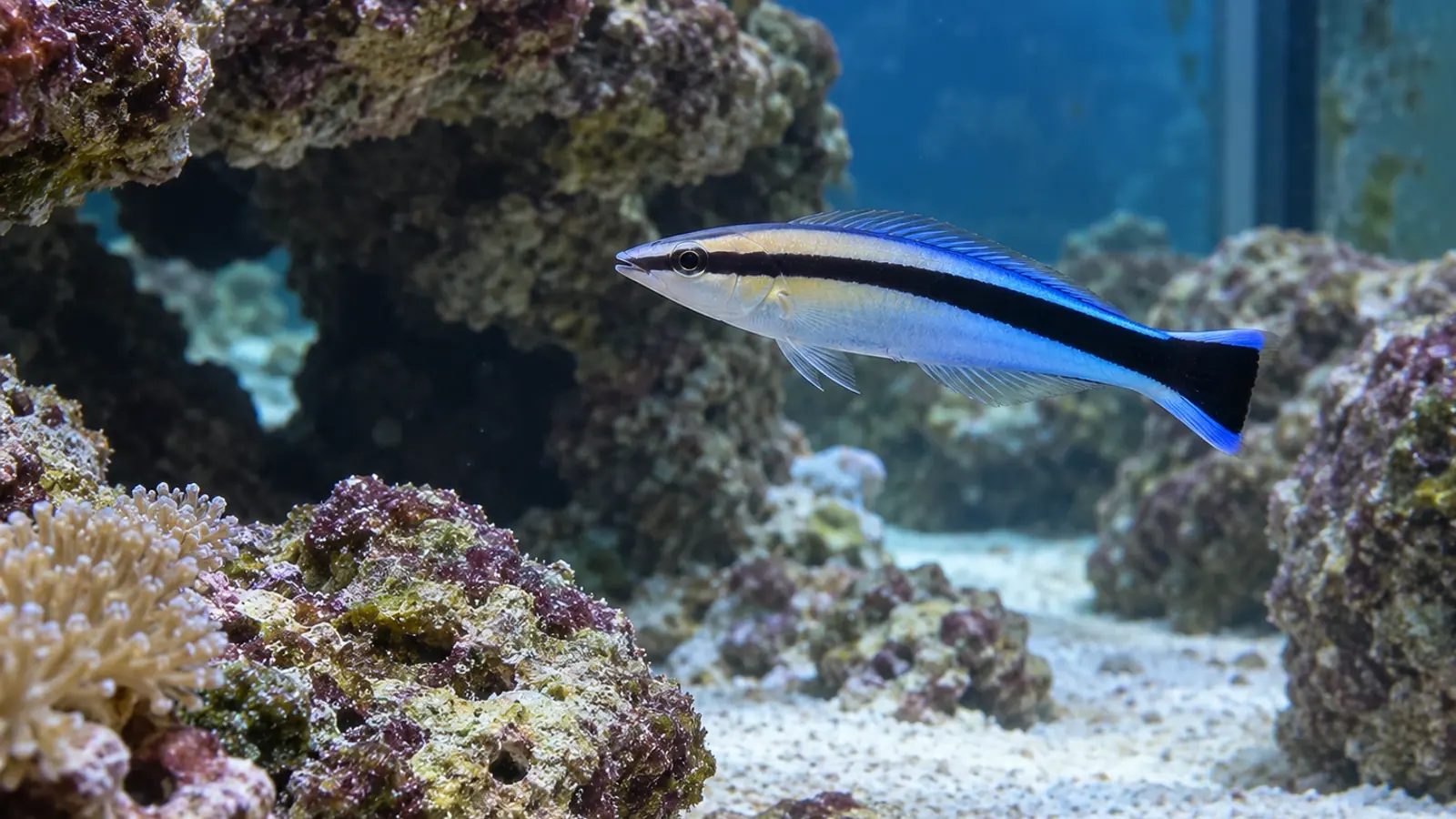
Cleaner wrasse and mirrors: observe before interpreting
Touching glass does not, on its own, identify what a fish is doing. An open 2025 study follows mirror responses in nine cleaner wrasse and interprets their sequence as self-recognition. Public aquariums can also draw a practical lesson from recording what happens before and after an interaction.


- Content type
- Practical guide
- Sector
- Public aquariums
- Animal group
- Fish
- Keywords
- EthogramEnrichmentStress
A study of sequence, rather than a count of glass contacts
The cleaner wrasse Labroides dimidiatus is a small Indo-Pacific fish that feeds on ectoparasites removed from client fishes. That ecology matters when researchers interpret its response to a parasite-like mark. A mark that attracts attention in this species may have a different significance for another fish. Experimental meaning therefore begins with the animal, not simply with the presence of a mirror.
In a study published in November 2025, Shumpei Sogawa and colleagues followed nine cleaner wrasse with no previous mirror experience. A coloured mark was placed on the throat, outside the fish’s direct view, before mirror presentation. The researchers recorded the timing of mirror-directed actions and attempts to remove the mark. This was a cognition experiment, not an evaluation of mirrors as routine enrichment for public aquarium displays.
Six of the nine fish attempted to scrape the marked throat region against a surface within the first two hours. The authors interpret this as evidence of mirror self-recognition. The finding concerns these nine fish in this experimental arrangement. It is not an expected pass rate for an aquarium collection, nor does it establish a general scale of intelligence across fish species.
What happens before and after an action matters
Seven fish initially displayed behaviour classified as aggressive towards the mirror image. Subsequent approaches and body alignments were interpreted as testing the relationship between the fish’s movements and the reflected movements. These actions were not all placed in a single category of interaction with glass. Their order was central to the authors’ interpretation of the experiment.
An ethogram gives observers explicit descriptions for the actions they record. For an aquarium team, an approach, mouth contact or change in orientation is easier to check against video than a label such as playing. Location, duration and the surrounding sequence can then inform interpretation. The behavioural description should remain available even if the interpretation changes after discussion or further observation.
The paper also distinguishes mouth contacts after a mark-removal attempt from the earlier aggressive interactions. Swimming speed and associated movements differed between these periods. Similar-looking contacts can consequently belong to different sequences. A short video clip that omits what preceded the contact may remove information needed to interpret it, even when the contact itself is perfectly visible.
Self-recognition is the interpretation being tested
The authors argue that the rapid responses suggest a capacity for self-recognition already present before mirror exposure. They discuss broader implications for the evolution of self-awareness in vertebrates. Those proposals extend beyond the directly recorded sequence of actions in nine fish. Presenting them accurately requires keeping the observations and the proposed explanation recognisable as different parts of the scientific argument.
A mark test does not provide direct access to an animal’s subjective experience. Interpretation depends on whether the mark is meaningful to the species and whether an observable response is available. A fish that does not scrape cannot automatically be classified as lacking self-recognition. The paper discusses false negatives and the limitations of treating failure on a particular test as evidence about an animal’s entire cognitive capacity.
Self-recognition, welfare and clinical condition are also separate questions. The study does not show that fish responding to the mark have better welfare than fish that do not. It supplies no clinical threshold based on mirror-contact frequency. Slower swimming, considered alone, is neither a physiological stress measurement nor proof of a positive emotional state. Those conclusions would require evidence directed at those questions.
Public aquarium practice does not require repeating the experiment
The practical lesson concerns the quality of behavioural records. If a fish repeatedly approaches a viewing pane, staff can document lighting and visual conditions, nearby animals, feeding context and recent environmental changes. A reflection, another fish or movement in the visitor area should not be assumed to explain the event before observation. Comparison with that individual’s usual behaviour helps define a question worth investigating.
Environmental enrichment should suit the needs of the species. This paper did not assess permanent mirror provision as an enrichment programme. Frequent or intense interaction therefore cannot be treated as a demonstrated benefit. Display arrangements, opportunities to move away and individual responses need their own evaluation. A cognition result can inform discussion without becoming an immediate husbandry recommendation.
The research involved marking fish within an experimental framework. It should not become an improvised demonstration or a routine check on display animals. For day-to-day records, video collected without handling can already help keepers compare descriptions. Persistent unusual behaviour calls for assessment of the animal and its environment, rather than repeated attempts to make the fish pass a test.
Connecting cognition research with care and interpretation
For public aquariums, the study offers a useful example for explaining how behavioural science works. Educators can present the number of animals, the recorded outcome and the authors’ interpretation, then describe the remaining questions. This makes the result accessible without presenting a proposal about self-awareness as a settled statement about every fish.
The same approach strengthens care records. Keep animal identity, date, visibility conditions and observable actions together. Repeated observations document change within an individual; they do not create additional independent fish. Differences between animals should remain visible instead of being hidden behind a collection-wide average number of contacts.
Vetofish supports animal welfare assessment by connecting behaviour, housing conditions and veterinary evaluation where required. Here, the mirror remains a research tool. The wider lesson for aquarium work is to describe actions in context, retain uncertainty and ensure that a behavioural label never replaces observation of the animal.


