

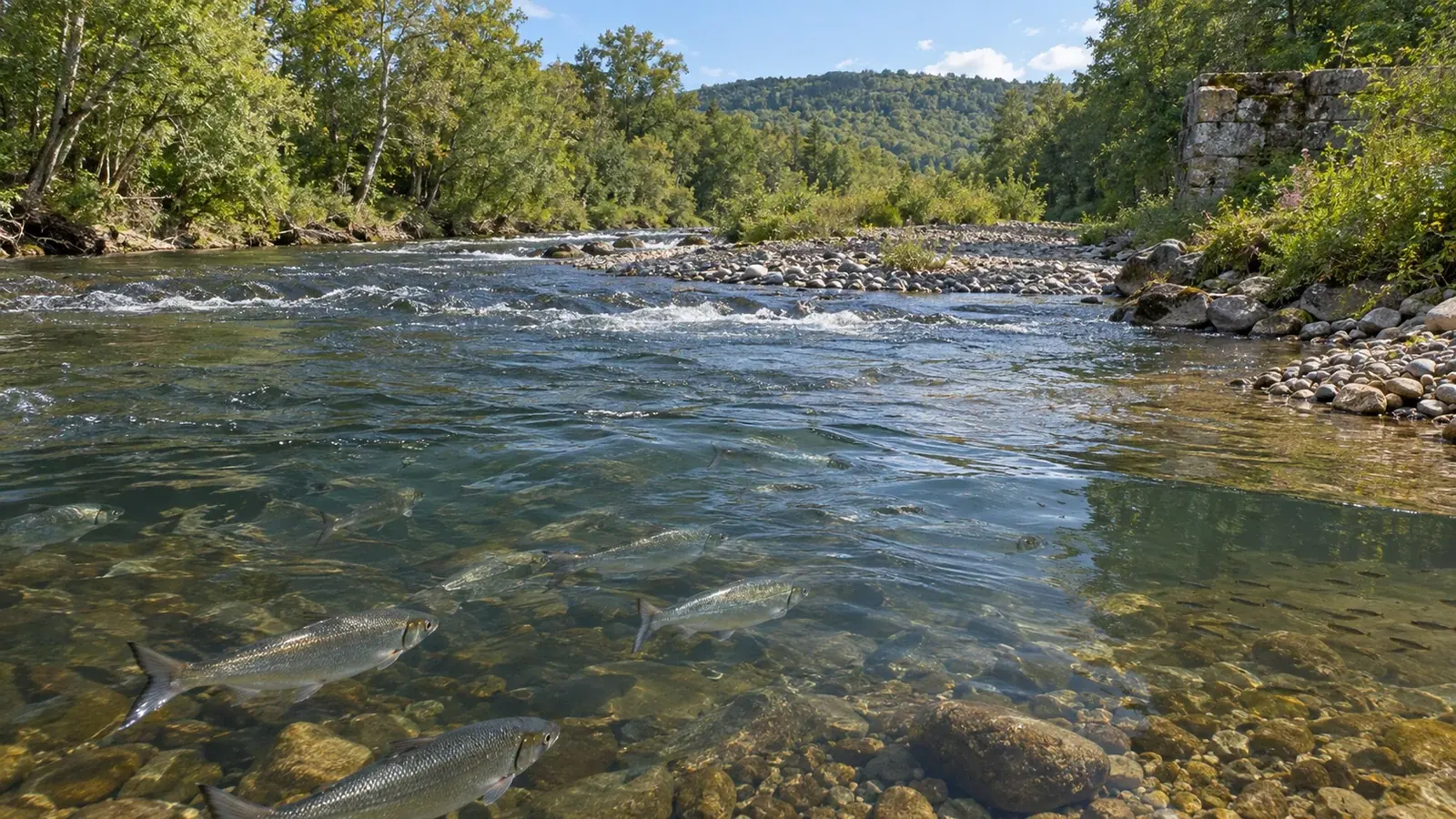
Dam removal outcomes unfold over years
Two years of monitoring would have given an incomplete account of Columbia Dam removal. Physical conditions changed quickly, while biological communities and migratory fish followed different timelines.
- Content type
- Scientific news
- Sector
- Environment
- Animal group
- Fish
Removing a dam restores a route, but the river does not immediately deliver an ecological verdict. On Paulins Kill, a Delaware River tributary in New Jersey, teams monitored Columbia Dam before removal, through work in 2018–2019 and until 2024. Physical conditions responded quickly, while habitats and biological communities followed different paths. An assessment ending after two years would have confused the beginning of recovery with a durable outcome.
Monitoring starts before machinery arrives
A measurement taken after construction describes a condition, not a change. The Paulins Kill programme held data from 2015, three years before removal began. That baseline supported comparisons upstream and downstream and placed post-removal years within variation that had already been observed.
Columbia Dam was about five metres high. It blocked migration and created an impoundment. Removal aimed in part to reopen upstream habitat for migratory fish. The researchers did not reduce success to the presence of one species. They combined temperature, dissolved oxygen, turbidity, channel form, macroinvertebrates and fish.
That breadth protects interpretation. Passage may be restored while sediment is still adjusting. Faster-flowing habitat can appear before organisms recolonise it. Conversely, the return of a migratory fish does not show that every habitat or resident community has reached a stable condition.
Physical change comes first
Loss of an impoundment alters flow, depth and sediment transport. At Paulins Kill, channel and habitat changes were visible soon after removal. Sediment formerly held in the impoundment was mobilised or stabilised differently among reaches. This phase can create temporary turbidity and shift substrates, removing habitat for some organisms while exposing it for others.
Water measurements need to be interpreted with construction timing, rainfall and discharge. A single turbidity value cannot distinguish a work-related pulse, a natural flood and a persistent problem. Temperature and dissolved oxygen also change with season and time of day. Continuous sensors or repeated campaigns provide a stronger comparison than isolated samples taken on different dates.
Station placement matters just as much. Reaches upstream, within the former impoundment and downstream experience different processes. Reference reaches, where available, can help separate the removal effect from an unusual climate year or another change elsewhere in the catchment.
Invertebrates and fish follow different clocks
Macroinvertebrates respond to substrate size, current, organic matter and water quality. Their composition may change as formerly slow habitat becomes more riverine. A community sampled one year after construction, however, still reflects disturbance and local capacity for recolonisation.
Fish add mobility. A species can pass the former barrier quickly without immediately establishing an upstream population. Passage, occupancy, reproduction and recruitment are different outcomes. At Paulins Kill, American shad returning upstream of the site provided an important signal of reconnection. It did not summarise the response of all resident species.
Methods must remain comparable over time. Season, effort, gear, reach length and hydrological conditions all affect catches. Failure to detect a species in one sample does not establish its absence from the river. Where individuals are tagged or tracked, detection probability and tag survival also need to enter the analysis.
Success depends on the question
“Was the dam removed?”, “can fish pass?” and “has the ecosystem recovered?” are separate questions. The first has an immediate engineering answer. The second needs evidence of movement or occurrence beyond the former barrier. The third requires several indicators and enough time to reveal trajectory, variability and possible new equilibria.
A European synthesis of river-habitat restoration found that fish-community responses vary with elapsed time, project scale and catchment context. Restoring one reach does not remove other pressures. Water quality, remaining barriers, discharge, non-native species and availability of spawning habitat may all constrain the response.
The monitoring plan should define criteria before results arrive. It can distinguish completion of work, physical performance, reconnection, biological response and persistence. This structure avoids calling a slow response a failure, while also preventing an early favourable sign from being treated as permanent success.
Fund the timeline and preserve the record
Long-term monitoring needs assigned budgets and responsibilities. Protocols, station coordinates, metadata, calibration records and raw data should survive staff changes. Fixed-point photographs, channel profiles and sensor series become valuable when they remain comparable from one year to the next.
High-frequency sampling around removal captures immediate effects. Less frequent but repeated surveys then show whether the trajectory persists. Monitoring should not end only because one funding period closes; its duration should follow the questions and the expected response rate of each indicator.
Uncertainty should remain visible. Extreme flows, drought, upstream works or changes in sampling can all influence a time series. Recording those events does not weaken the conclusion. It helps identify which changes can reasonably be attributed to removal and which require another explanation.
Vetofish can help river managers define aquatic indicators, design field campaigns and interpret habitat, water and fish data together. Dam removal is not judged by one photograph after construction, but by a series long enough to distinguish disturbance, recolonisation and lasting benefit.
To move from evidence to action, explore our advice and support service and our expertise in aquatic environmental health.


