

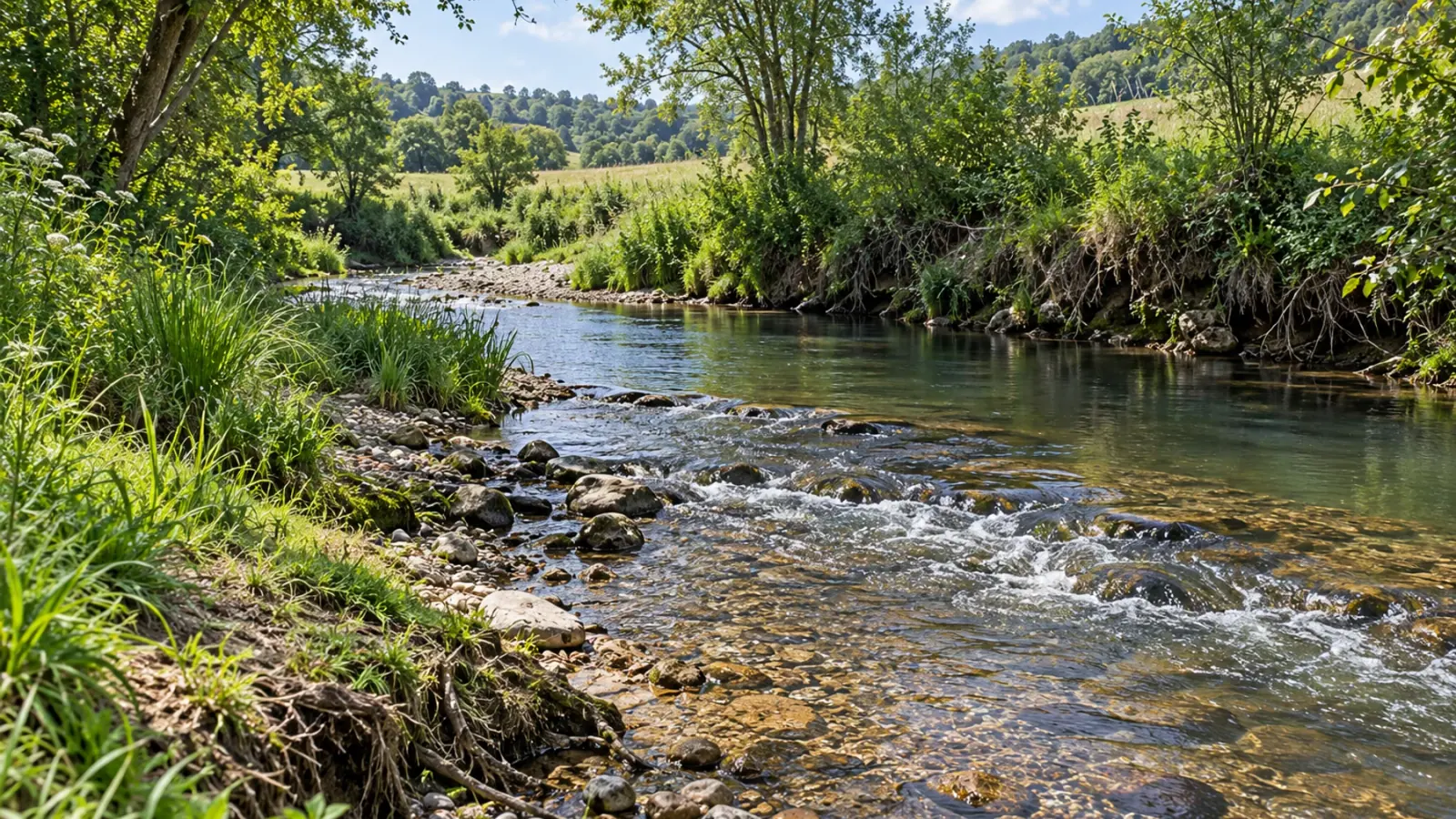
Restored rivers: design monitoring that can be interpreted
A more sinuous river channel has not necessarily regained all its ecological functions. France’s minimum scientific monitoring framework combines before-and-after surveys with control stations, linking habitats and biological responses to hydrological conditions.
- Content type
- Practical guide
- Sector
- Environment
- Animal group
- FishCorals and invertebrates
- Keywords
- TemperatureOxygenStress
Decide what the restoration is expected to change
A project has reintroduced meanders, removed a barrier or added bed material. These describe the intervention. Assessing its ecological value requires a further step: state the functions expected to recover and the observations that would show their trajectory.
France’s Agency for Biodiversity published a guide to minimum scientific monitoring, known as SSM, in 2019. This technical framework brings together river form and processes, biological communities and environmental conditions. It supports evaluation. It does not guarantee a successful project or create a universal legal requirement.
For managers outside France, the framework offers principles to examine against local conditions and monitoring arrangements. The protocols have a defined scope, and their transfer should not be assumed simply because another project also concerns a river.
Match indicators to an ecological hypothesis
Hydromorphology concerns the river’s physical form and functioning. More varied flows can change the habitats available to aquatic organisms, but a photograph of a new channel alignment does not establish a biological response.
The question needs to be specific. Is the project intended to restore passage, diversify bed material or recover particular flow conditions? Indicators should address that objective. An easily collected measurement may provide little useful evidence if it does not describe the process expected to change.
Fish and benthic macroinvertebrates, which live on or within the river bed, provide complementary information. The guide sets out methods and interpretative approaches for these different components. An overall index can be useful, but it should remain possible to examine community composition alongside the physical conditions observed.
This connection matters when reporting results. A change in a headline score should not erase the underlying records needed to understand which organisms, habitats or processes contributed to it.
Compare before and after with control stations
Improvement after construction is not necessarily caused by the restoration. A wetter year, a changed discharge or work upstream could influence the site. A before–after, control–impact design, usually abbreviated BACI, aims to distinguish local project responses from changes also occurring elsewhere.
Monitoring stations therefore need to be considered before construction. A comparable control station helps describe variation outside the treated reach. Proximity does not make it a perfect comparison: tributaries, barriers, land use or differences in channel slope can limit its usefulness.
The catchment supplies this wider context. Recording events within it helps avoid assigning every local change to the restoration works. Where there is no pre-project baseline, that limitation should be stated. Older records may still contribute, but their methods and representativeness need examination before combining them with a new survey.
The purpose of a control is to strengthen interpretation, not to remove every uncertainty. Its relevance needs to be revisited if conditions at the control and restored stations diverge for unrelated reasons.
Maintain comparable methods over sufficient time
Biological communities and channel form do not all respond at the same rate. The 2019 guide recommends a baseline, preferably covering several years, followed by prolonged observation after the works. Its general programme includes monitoring over at least seven post-restoration years, with details adapted to the operation and the components being followed.
This does not establish a deadline by which every project should produce a benefit. Floods can redistribute bed material, while droughts can alter conditions for recolonisation. Hydrology belongs in the interpretation of biological records throughout the programme, rather than appearing only as an explanation for an unwelcome result.
Sampling needs to remain comparable between stations and survey rounds. Changing season, surveyed area or fish capture method can change the observations without representing an equivalent ecological change. Any adjustment should remain documented, including its reason and implications for the series.
A practical monitoring plan should also identify who retains the original records. Continuity becomes difficult if method changes and missing surveys are discovered only when the final assessment is being written.
Examine disagreement between biological components
An encouraging invertebrate response alongside a limited fish response is not a reason to select whichever indicator looks better. The groups use different spaces, have different life cycles and may be exposed to different pressures.
Interpretation should return to plausible mechanisms: habitat availability, access from source populations, water conditions and continuing disturbance. Temperature and dissolved oxygen can contribute where measured using suitable methods. A reassuring reading during a visit may not represent conditions between surveys.
Biodiversity also involves more than the total number of species captured. Community composition, ecological requirements and the representation of life stages matter. Results need their uncertainty and detection limits, rather than being reduced to a binary verdict about the entire river.
These are reasons to examine a mixed response, rather than claims that every restoration will produce a particular sequence of fish and invertebrate recovery.
Respect the framework’s scope
The SSM guide concerns permanent streams that can be surveyed on foot, with a wetted width of at least one metre, outside impounded reaches. Deep rivers, temporary streams and estuaries require specific consideration before adopting the same protocols. Standardisation remains useful when its limits are recognised.
The monitoring budget and record keeping need to support the original question. Stations, survey dates, methods, raw files and contextual events must remain retrievable when contractors or staff change. Monitoring costs belong in project planning, because an interrupted series may leave the original question unresolved.
Use monitoring to guide the next decision
Useful monitoring can reveal a missing response, continuing pressure or an initial hypothesis that needs revision. That evidence can inform management and subsequent work without making every disagreement a definitive project failure.
Vetofish can help connect fish observations and animal health with environmental context through its advisory support for environmental managers. The starting point is a measurable question and a suitable observation plan, followed by the choice of indicators.


