

Danionella cerebrum: planning an adult imaging model
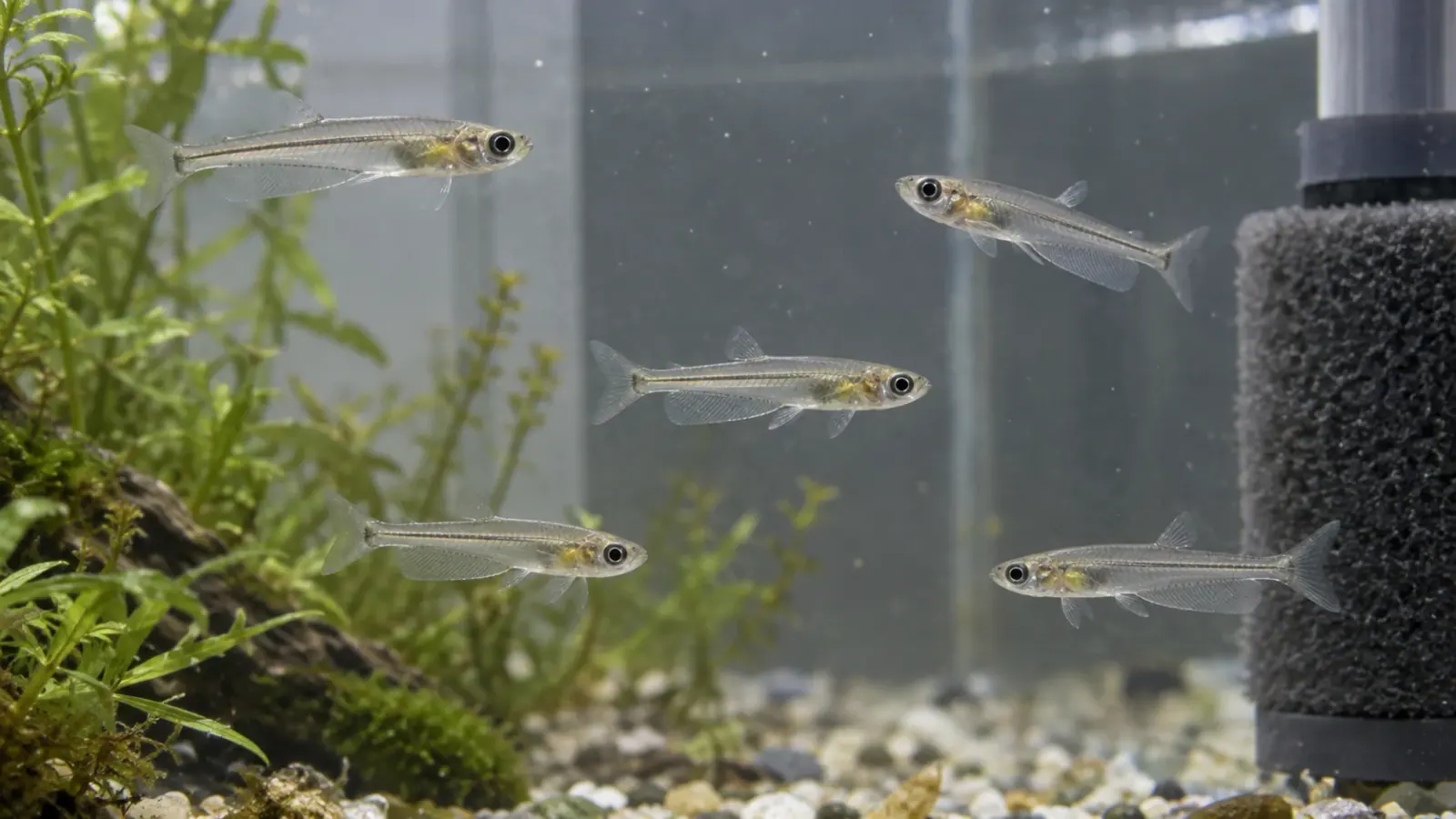
Small size and substantial adult transparency make Danionella cerebrum useful for longitudinal imaging. Adopting the model requires documented species identity, suitable husbandry and a study plan that treats imaging as an intervention.
- Content type
- Species profile
- Sector
- Research
- Animal group
- Fish
Choose a model for the question
The small size and substantial adult transparency of Danionella cerebrum provide useful optical access. For a research team, the question is which observations that access can support and whether they answer the planned experiment. Those features do not make the fish an automatic replacement for zebrafish or another established model.
Pui-Ying Lam’s 2022 methodological study demonstrated longitudinal imaging opportunities in adults using standard confocal microscopy. It relied on fluorescent lines and a purpose-built arrangement for maintaining the animal during observation. The work establishes feasibility under defined conditions. It is not a validation of every biological question or every facility considering the species.
Treat species identity as experimental information
Britz, Conway and Rüber described D. cerebrum in 2021 after establishing that fish used in some earlier work were not D. translucida. The names should therefore not be used as interchangeable labels in colony records. A model’s identity affects how its literature can be interpreted.
The animals can appear very similar, and an ordinary photograph may be insufficient to establish identity. Retain the supplier’s declared name, provenance and the identification evidence actually available for an acquisition. Where evidence is incomplete, record that uncertainty and seek appropriate confirmation before describing the colony as positively identified.
Apply the same care when reviewing earlier publications. A study using another name cannot automatically be assigned to the new colony. Examine what the authors reported about their animals and the basis for identification. Continuity of a supplier or a technique is useful information, but it does not replace this taxonomic check.
Specify what optical access must deliver
Transparency is only one part of the imaging system. The result depends on the animal, fluorescent labels, microscope, acquisition settings and analysis. Lam’s work used lines providing immune-cell signals and a vascular reference. Those observations do not establish that an unlabelled fish would reveal the same structures.
Write the desired outcome before adopting the model. Following the same cells, comparing a structure between individuals and observing a change through time are different objectives. Each needs suitable acquisition and analysis criteria. Starting with those criteria makes it easier to decide whether the model and available equipment can meet the actual question.
Repeated access to an adult can be valuable for a longitudinal study. It also requires dependable individual identity and session records. A sequence of images is not an interpretable within-animal time series unless the team can connect those images to the same animal and reconstruct the conditions under which they were acquired.
Prepare husbandry as a separate task
Taking on a new species should not mean copying a zebrafish husbandry sheet. Preparation needs to cover the incoming animals, the available installation, feeding, intended breeding and opportunities for routine observation. Practical requirements should follow documented colony information and an appropriate assessment of the proposed facility.
Biosecurity deserves its own planning discussion. Identify intended contacts with other species or lines, the way batches and their equipment will be recorded, and the response to a change in an animal’s clinical condition. A microscopy paper does not answer every question about running a colony.
For an initial adoption trial, agree on the husbandry observations that will be recorded and the decisions they will inform. This is Vetofish’s suggested planning approach, not a complete protocol validated by the two cited publications. Its purpose is to establish whether the team can care for the animals and obtain reliable information before scaling the work.
Recognise imaging as an intervention
The arrangement in Lam’s study did not simply record freely swimming fish in a holding tank. It involved specific immobilisation and ventilation conditions. These are part of the method and its assessment. They should remain visible when the work is described as using a standard microscope.
A proposed experiment needs a plan for sessions, recovery observations and reassessment criteria. Anaesthesia, maintenance during acquisition and return to housing should be reviewed by competent personnel within the framework applicable to the project. This article provides no dosing instructions or ready-to-use assembly procedure.
Repeated imaging may also affect what the experiment can establish. Keep exposure duration, handling and observation conditions in the study record. Treating them as variables makes their possible effects available for discussion, rather than attributing every visible change to the biological process under investigation.
Build records that support comparison
Connect animal identity, line, session, acquisition conditions and intervention history in the data plan. Image files can use stable identifiers without carrying every detail in their filenames. A documented correspondence table is more dependable than reconstructing these connections from memory when analysis begins.
Define what makes an image usable. An unsuitable orientation, a different field or inadequate signal should not be compensated for by a stronger interpretation. Retain explainable exclusion decisions with the data, including those that reduce the available image set. The purpose is a defensible comparison, not the largest possible collection of pictures.
Record deviations as well as the planned method. The procedure described in advance and the procedure actually carried out may differ. A documented adjustment helps a reviewer judge whether two sessions remain comparable. An unrecorded change can create an appearance of continuity that the observations do not support.
Conclusion: connect feasibility to facility readiness
D. cerebrum offers useful opportunities for adult observation. The open studies cited here establish the species’ taxonomic identity and an imaging approach under specified conditions. They do not amount to a complete husbandry programme or a general validation of all potential uses.
Vetofish’s advice and support service can help prepare colony reception and monitoring. Our aquatic research expertise brings experimental requirements, facility organisation and veterinary questions into the same planning discussion before the first series of acquisitions.


