

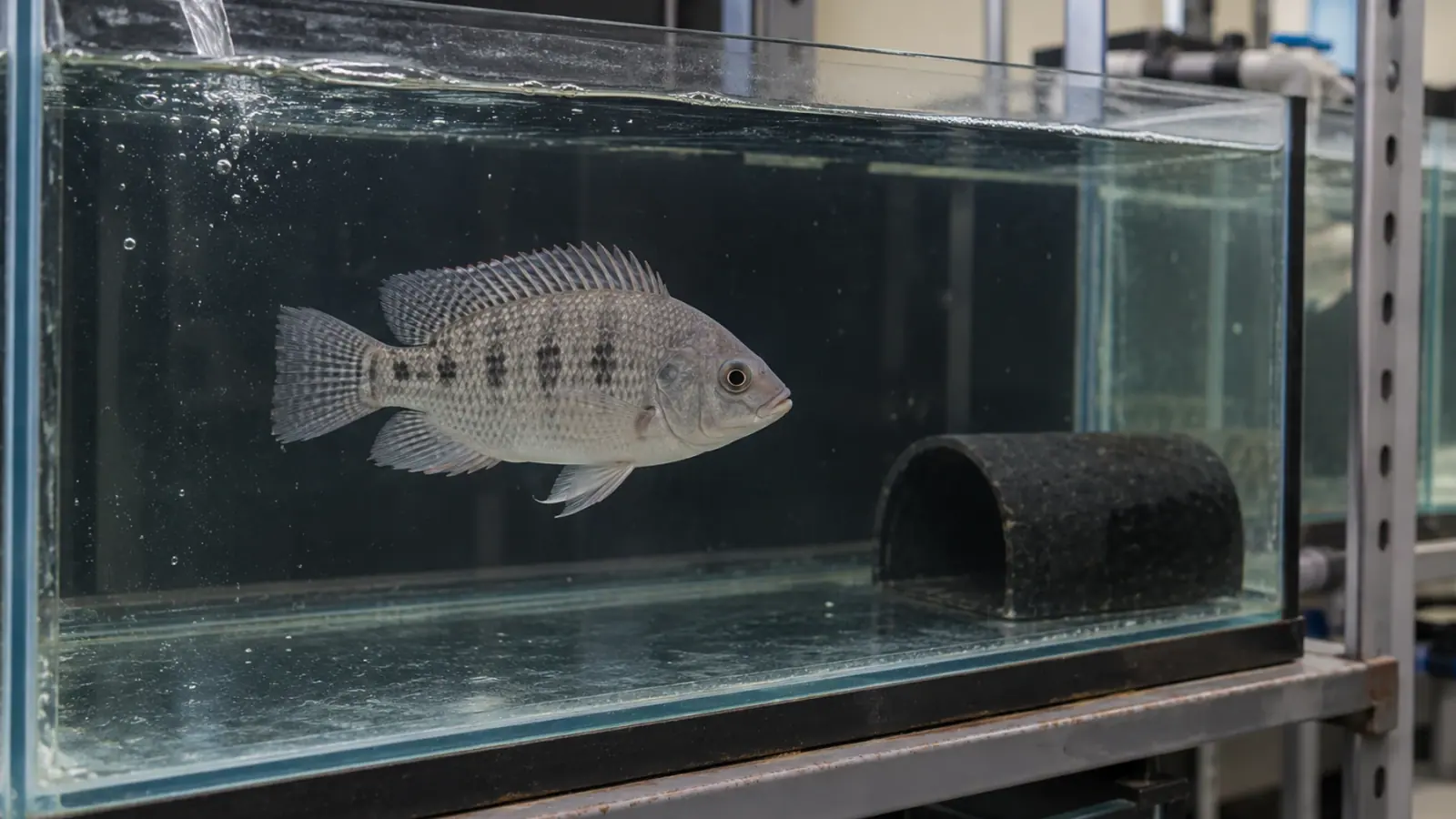
Serial blood sampling in tilapia: measure recovery
A tilapia can survive repeated blood sampling while remaining anaemic. Research in Oreochromis mossambicus supports assessing cumulative withdrawal, body mass and haemoglobin recovery together, rather than adopting a universal sampling schedule.


- Content type
- Practical guide
- Sector
- Research facilities
- Animal group
- Fish
- Keywords
- AnaesthesiaStressOxygen
Earlier samples remain part of the experiment
Repeated measurements in the same fish can reduce between-animal variation, but sampling also changes the animal being followed. Blood loss, restraint and successive handling become part of its experimental history. A result obtained late in a series may therefore describe a different physiological state from the starting condition, even while the fish continues to swim and feed.
Haemoglobin carries oxygen in the blood. A reduction after serial sampling may affect carrying capacity without causing immediate death. The study design needs to consider the cumulative effect of the series alongside the technical success of individual collections. Survival is an essential outcome to report, but cannot establish recovery on its own.
Evidence from Mozambique tilapia
Sihoka and Wagenaar’s 2018 study used adult Mozambique tilapia, Oreochromis mossambicus. The 24 fish were approximately eight months old, with a mean body mass of 55.4 g. Sixteen contributed to model development linking post-sampling haemoglobin with cumulative withdrawal, body mass and time. A further eight were used to test the selected model.
The first experiment caused substantial mortality: half of its 16 fish died. No deaths were recorded among the eight fish in the model-testing group. Those findings must remain attached to the group sizes and their different roles in the study. The comparison does not establish general safety, and the first group cannot be left out of the welfare assessment.
The investigators also followed haemoglobin recovery in surviving fish. By day 21, they no longer detected a statistically significant difference from the initial value. This observation applies to those fish and conditions. It neither proves that every animal had recovered all functions nor establishes three weeks as a suitable interval for every fish species or experimental protocol.
Why a single withdrawal volume is insufficient
The selected model includes cumulative volume relative to mass, time and interactions between these variables. It illustrates why successive small collections can still impose a physiological burden. Repeating a volume described as small, without counting earlier withdrawals, conceals part of the animal’s actual exposure to the procedure.
Anaemia reduces the blood’s oxygen-carrying capacity through changes involving red cells or their haemoglobin. Following blood loss, restoration of circulating volume is not equivalent to restoration of its cellular constituents. An apparent improvement in behaviour is therefore insufficient evidence that blood parameters have returned to their starting values.
The study does not supply a collection recipe. Body size, baseline condition, life stage, nutrition and water conditions constrain interpretation. The authors discuss temperature and oxygenation among factors that can influence recovery. A model developed in small groups of O. mossambicus should not be transferred directly to zebrafish, another tilapia species or fish maintained under different conditions.
Recovery needs a defined measure
A non-significant comparison with baseline is not an equivalence test demonstrating complete recovery. Small samples may also provide limited precision. Preserve individual measurements, clinical observations and reasons for withdrawal from the study instead of reducing the series to a mean calculated only from surviving animals.
Fish that die or are removed may have shown the strongest responses. Excluding them without explanation would make a protocol appear less harmful. Likewise, zero deaths in a group of eight leaves uncertainty about uncommon events and other biological consequences. Reports should distinguish measured outcomes, observations and assumptions, including what was not followed after the sampling period.
The distinction also affects the scientific outcome. If sampling alters the physiological process under investigation, a technically reliable assay can still describe a procedure-related change. Recording cumulative sampling history allows that possibility to be examined rather than treating each collection as an independent, consequence-free event.
Plan the complete series before collecting blood
Inventory every intended collection, including those used to assess recovery. Measuring haemoglobin may itself require blood, so that volume belongs in the cumulative record. Discuss analytical requirements with the laboratory to avoid adding collections or volumes without a defined scientific benefit. Alternatives should be assessed against the actual question, rather than assumed to be equivalent.
The Canadian Council on Animal Care’s 2005 fish guidance calls for haematological recovery to be considered before subsequent collection. It also notes that restraint and anaesthesia may alter physiological measures such as glucose and some hormones. These are Canadian professional recommendations, rather than French legal requirements or approval for a particular research protocol.
Specify clinical observations, stopping criteria and opportunities for veterinary reassessment in advance. Sampling design should address the research question while also considering the effects of the procedure. Avoiding unnecessary handling, standardising its context and documenting deviations help separate biological variation from variation introduced during collection and follow-up.
Make continuation decisions traceable
A timetable should not be repeated solely because an earlier series ended without deaths. Continuation depends on animal condition, the indicators being followed and the study’s approved framework. Record any changes: delaying a collection, stopping an individual’s series or modifying an analysis can affect interpretation as well as animal care.
Our advice and support service can help research teams examine these choices with their scientific and veterinary leads. Within research facilities, this support focuses on aligning the experimental question, health monitoring and recovery criteria, without turning one published result into a universal sampling protocol.


