

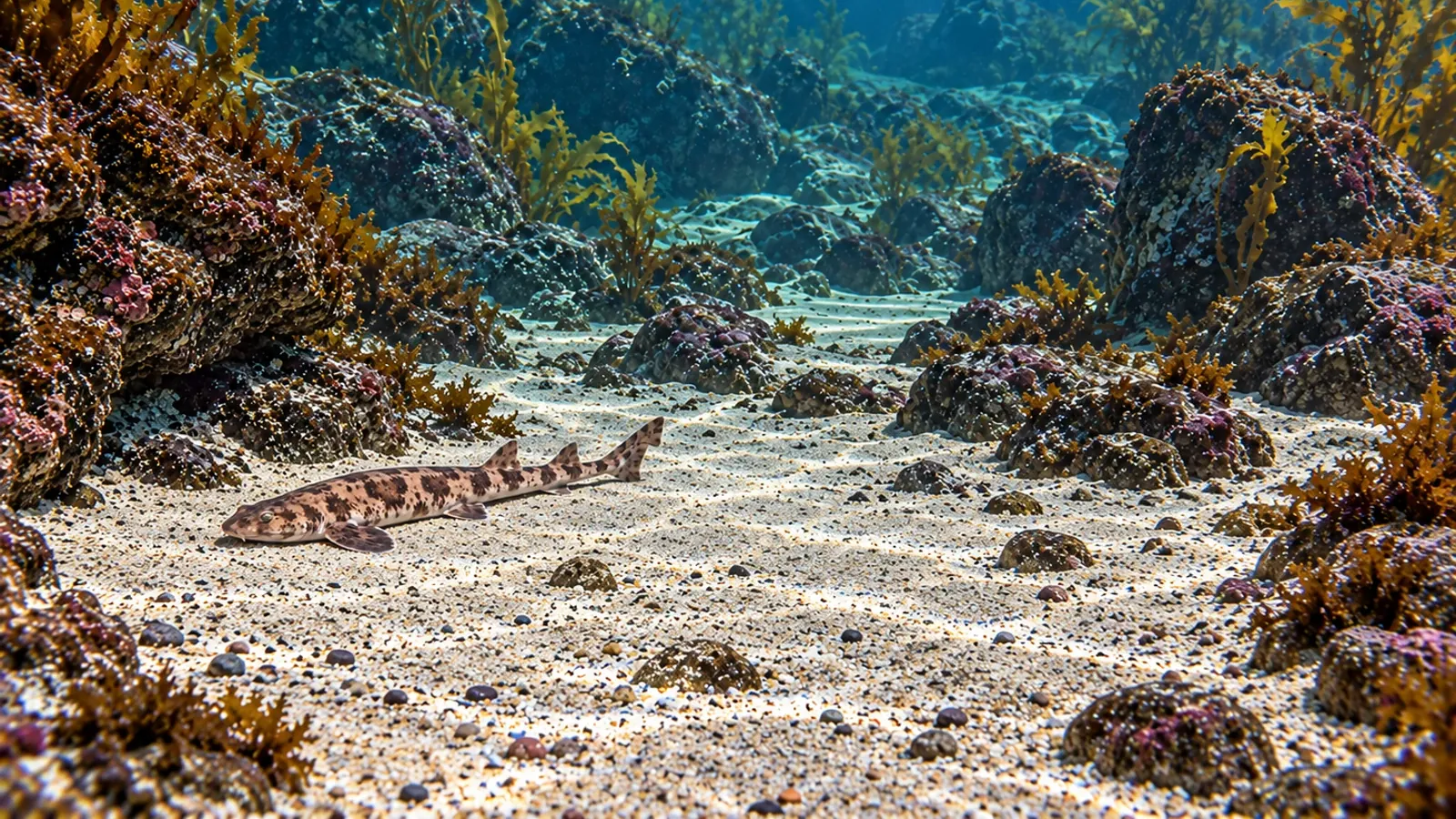
Draughtsboard sharks can sleep with their eyes open
Open eyes do not rule out sleep in a draughtsboard shark. A study combining oxygen uptake and video in seven animals found lower metabolic rates during prolonged inactivity. For aquarium teams, the useful lesson is to record posture, duration and lighting together, while keeping a health assessment separate.


- Content type
- Scientific news
- Sector
- Public aquariums
- Animal group
- Elasmobranchs
A physiological study of one resting shark species
In 2022, Kelly and colleagues reported observations from seven draughtsboard sharks, named Cephaloscyllium isabellum in the paper, collected in New Zealand’s Hauraki Gulf. After acclimation to the apparatus, each shark was recorded for twenty-four hours at a constant 17.5 °C under a twelve-hour light and twelve-hour dark cycle.
This bottom-dwelling species can pump water over its gills while stationary. It is therefore a different case from sharks that depend on continuous swimming for ventilation. The experimental setting and the animal’s respiratory strategy matter when interpreting an apparently familiar sight: a shark lying on the bottom of an exhibit.
The researchers paired video observations with intermittent-flow respirometry. Oxygen decline during measurement periods, separated by water flushes, provided an estimate of oxygen uptake. This is physiological information about metabolism under the trial conditions. Ordinary exhibit video does not supply the same measurement.
Prolonged inactivity was associated with lower metabolism
The analysis separated swimming, rest lasting less than five minutes and inactivity lasting more than five minutes, classified as sleep. That classification drew on earlier behavioural work showing reduced responsiveness during prolonged immobility. The five-minute boundary is an analytical definition for this species and setting, rather than a rule for aquarium collections generally.
Oxygen uptake was lower during prolonged inactivity than during swimming. The result supports energy conservation as a function of sleep. It was not a recording of brain sleep stages and does not identify counterparts of every mammalian sleep stage.
Short rest also differed between the light and dark periods. Daytime resting metabolism resembled sleeping metabolism, whereas brief rest at night could be associated with higher values. Time of day therefore changed the relationship between a short period without movement and the underlying physiology.
For care teams, that distinction is useful because an observation category should not acquire more meaning than its evidence supports. A record of inactivity is a visible event. Interpreting it as sleep requires the species-specific context established by the study, while evaluating the animal’s health requires further information.
Open eyes did not exclude sleep
The sharks kept their eyes open while swimming. Eye closure was common during inactivity, especially in the light period, but their eyes remained open in approximately 38% of the observed night-time sleep cases. This figure describes sleep observations in the experiment; it is not the proportion of sharks that always sleep with open eyes.
Body position supplied another clue. Sharks could remain raised on their pectoral fins or lie flat against the bottom. The flatter posture was associated more closely with low-metabolic states. Posture consequently adds information to the duration of inactivity in this species, without providing a stand-alone clinical test.
The light environment may help explain why eye closure was an imperfect indicator. Eye state alone did not reliably distinguish the physiological states in this experiment. For an exhibit, a daytime photograph contains much less information than a sequence showing the onset and end of a resting bout.
Turn the finding into clear observation categories
A proportionate application is to record visible facts separately: time, lighting, duration, body position, eye state and spontaneous return to activity. Several observers should be able to apply the same descriptions. An unusual new posture and an individual’s familiar resting posture should not receive an identical interpretation simply because both involve immobility.
Comparisons over several daily cycles can include feeding, maintenance, habitat changes and technical interventions. An animal’s circadian rhythm does not follow visitor opening hours by definition. Observations need to include its usual active periods as well as the times when it normally rests.
Video may reduce the need to enter the exhibit, provided the team checks blind spots, reflections and the effects of the recording illumination. Repeatedly disturbing sharks to test responsiveness is not a justified routine consequence of this study. Its experimental approach does not amount to an instruction to wake resting animals during rounds.
Keep health assessment alongside behavioural interpretation
New immobility, altered posture or abnormal ventilation needs to be considered with the individual’s history and exhibit conditions. Dissolved oxygen and temperature remain part of that context. A study of sleep cannot exclude disease in a stationary shark, nor can a posture alone establish an overall welfare problem.
The evidence is limited to seven animals, one species, one temperature, a controlled light cycle and an individual apparatus. It does not define normal sleep duration for every displayed shark, prescribe exhibit lighting schedules or establish a target oxygen uptake for a large collection.
The useful conclusion is specific: open eyes were compatible with sleep in the draughtsboard sharks studied, and posture was more informative when interpreted with duration and lighting. Keeping observation, behavioural interpretation and clinical assessment distinct helps avoid both unnecessary alarms and unwarranted reassurance.
Vetofish can support the development of observation categories and their interpretation alongside health records through its animal welfare service, for teams working in public aquariums.


