

Keeping sardines in aquariums: plan the tank, then track acclimation
A sardine school may appear settled while capture injuries and feeding problems are still emerging. Published holding studies suggest a practical question for aquariums: how will the team measure safe swimming, food intake and survival beyond the first few days?
- Content type
- Practical guide
- Sector
- Public aquariums
- Animal group
- Fish
Start with the fish’s swimming life
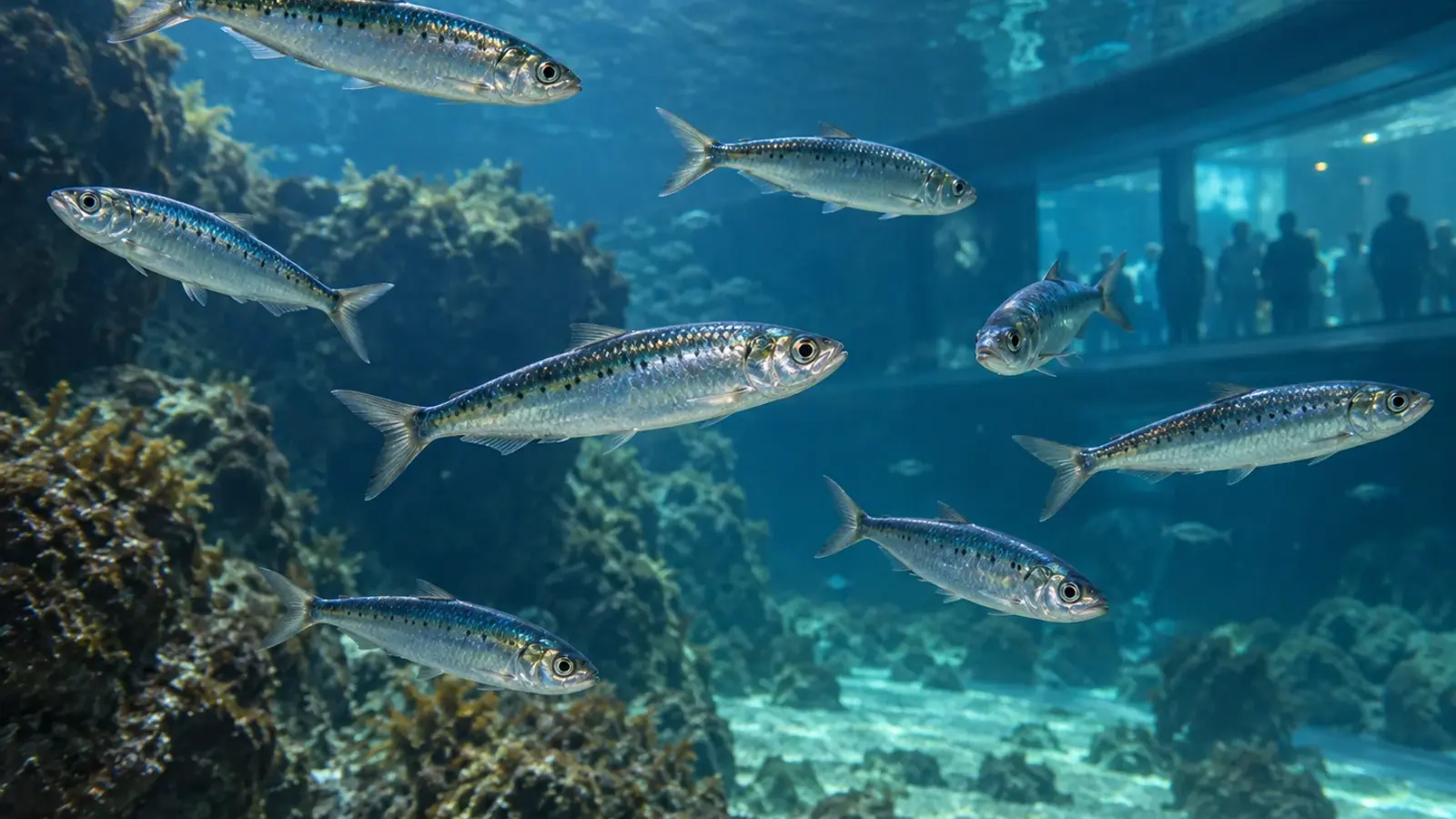
European sardines, Sardina pilchardus, live in moving schools in open water. A public aquarium therefore needs to think beyond a plausible salinity and a generous volume. Fish must be able to swim together without persistent contact with walls, recover from transfer and begin to feed. A 2023 RESAMA meeting abstract identified wild capture, acclimation and long-term conditioning as practical challenges for using sardines as a research species. It is a useful account of the questions, not a tested husbandry standard.
Two peer-reviewed studies offer narrower evidence. Marçalo and colleagues captured sardines at sea and monitored them for 28 days in holding tanks while studying different fishing and release methods. Garrido and colleagues, in a study of larval survival, describe breeding adults held in a 15,000-litre cylindrical tank at Lisbon’s Oceanário. Together, these observations show that captive holding and reproduction are possible. They do not establish a universal minimum tank size, stocking density or survival forecast for a new collection.
Transport history remains part of the clinical record
The condition of a sardine on arrival reflects events before it enters the exhibit. In the Marçalo study, three groups experienced different levels of crowding and abrasion during a single fishing operation. Estimated survival at 28 days was 43.6% for the less disturbed control group, 44.7% for fish handled by a modified release method and 11.7% for the more abrasive standard method. Those figures belong to that experiment. They are not expected mortality rates for public aquariums.
Scale loss was associated with later death, and most deaths occurred early in the holding period. A fish swimming after transport may still have delayed injury. An introduction record should therefore describe capture and transfer methods, time in transit, visible abrasion, water conditions and early losses, rather than saying only that the shipment arrived alive. Fewer handling steps and a planned transfer can reduce avoidable disturbance, but the exact procedure must match the species, facility and veterinary assessment.
Give the school a route through the tank
Marçalo’s team used black circular 3,000-litre outdoor tanks with flowing seawater and central aeration that helped the school maintain a circular movement. That equipment was designed for a research holding period, not prescribed as a public display template. The larger cylindrical broodstock tank reported by Garrido had another purpose. Quoting either volume without the number and size of fish, current, holding time and observation goals would be misleading.
Tank design should instead be checked against actual swimming paths. Can the school turn without repeatedly compressing against a wall or corner? Do individuals lag behind, collide, remain trapped in a current or repeatedly search for an exit? Filtration outlets, viewing windows and service structures all alter usable space. A short, consistent behaviour record and video taken at comparable times can show whether a change in flow or layout improves movement. It should record the school and the individuals that cannot keep up.
Keep the water steady and document feeding
Mobile marine fish depend on water conditions throughout the volume they use. Record dissolved oxygen, temperature, salinity, circulation and the trend across the day, not merely a controller setting. In the Marçalo experiment, the team attempted to keep holding-tank temperatures near those at capture while still observing daily variation. The lesson is to measure the actual environment and its change. The paper does not define a universal temperature or oxygen threshold for sardines in exhibition.
Lighting and shaded areas may alter where the school spends time, so any adjustment should be linked to observed movement, feeding and a documented photoperiod. The 28-day study also shows why “food offered” is not the same as “fish feeding.” Initially, a few sardines left the school to investigate pellets or fish eggs; feeding developed over several days. That diet is a report of one facility, not a ready-made ration. The aquarium needs to see which fish eat, where food is taken, what remains uneaten and whether the system can carry the resulting organic load.
Follow the first weeks, not only the first day
Daily mortality counts are necessary but incomplete. Track scales and fins, collisions, schooling, food intake, isolated fish and relevant water measurements. Repeat photographs from fixed positions can document the use of the tank; close observation is still needed to assess an individual lesion. A fish leaving the school might be responding to current, competition, injury or disease. The observation is a signal for investigation, not a diagnosis.
Density needs the same contextual approach. Too few fish may change school dynamics, while crowding can increase contact, competition and the load on life-support systems. Neither study supplies a density optimum transferable to every tank geometry or fish size. Follow-up should also distinguish initial survival from sustained adaptation. In Marçalo’s study, deaths clustered in the first several days, while surviving fish later gained mass and condition. An apparent recovery at the end of week one is useful, but it does not close the monitoring record.
Interpret the evidence at its proper scale
These sources answer different questions. Marçalo’s experiment primarily compares fishing-related injury and subsequent survival in captivity. It used one fishing event, and its tank groups do not capture all the variation among capture operations. Garrido’s paper addresses larval survival and mentions an established broodstock tank; it does not test an ideal visitor-facing exhibit. The RESAMA abstract describes a husbandry development programme without publishing a comparative trial in that summary. None of them shows that one tank shape, feeding schedule or acclimation period guarantees success.
For a public aquarium, a credible plan joins capture history, transport, tank geometry, flow, water quality, feeding and dated observations. Vetofish’s animal welfare support can help teams define what change should prompt action and how to judge a tank adjustment without overstating the evidence. A school that survives a few days has passed an early hurdle; sustained safe swimming and feeding are the more meaningful goals.


