

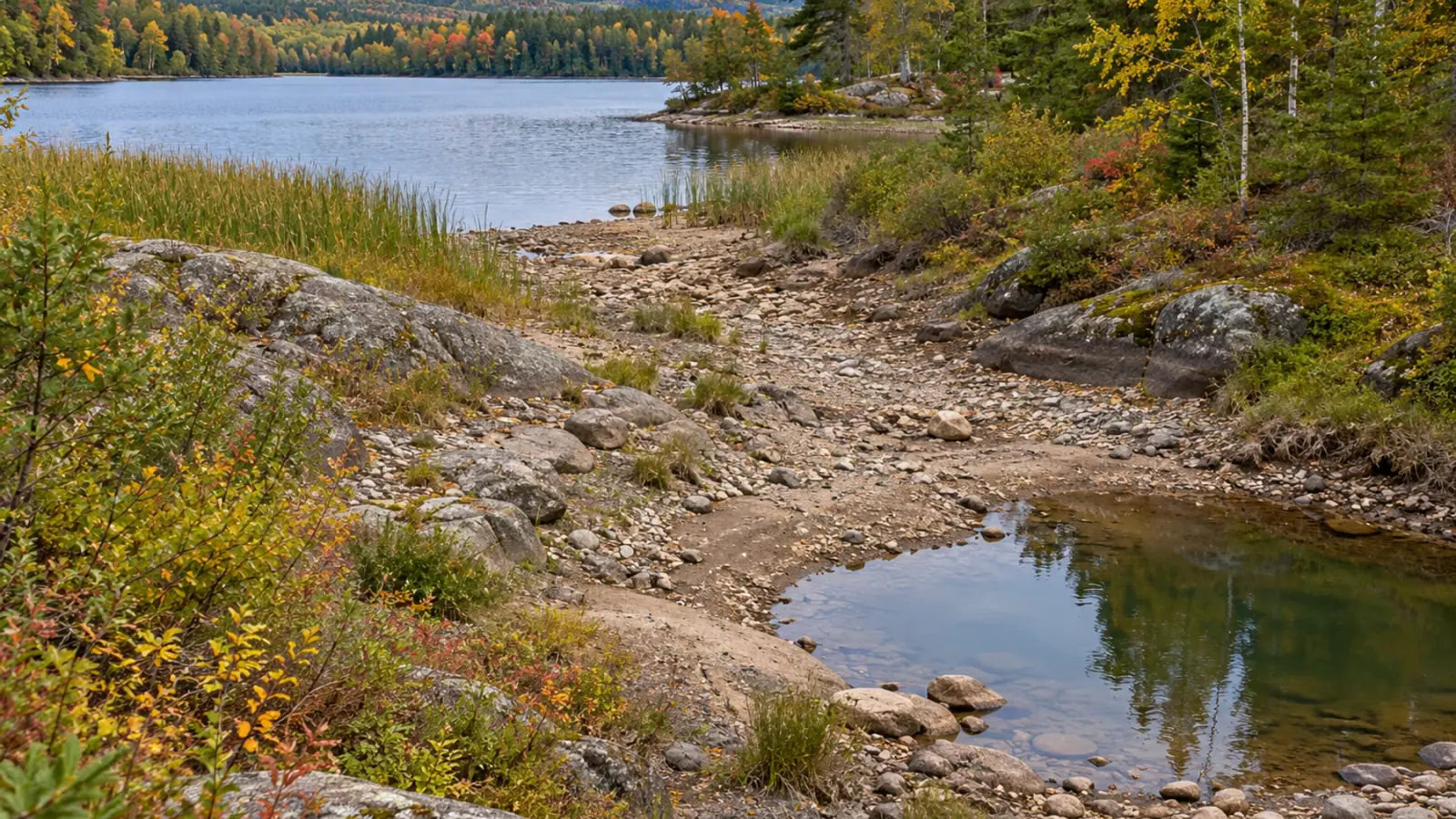
Drought can turn a fish nursery into a migration trap
Juvenile alewives trapped in a Connecticut nursery lake during drought showed poorer growth and body condition. A study published in 2026 highlights the need to monitor nursery exits, as well as whether water remains in the lake.


- Content type
- Scientific news
- Sector
- Environment
- Animal group
- Fish
- Keywords
- TemperatureStressReproduction
Water in a lake does not guarantee a way out
A nursery can remain full of water while its connection to the sea disappears. Burgess and colleagues examined this situation at Bride Lake in Connecticut, United States, in juvenile alewives, Alosa pseudoharengus. This migratory fish spawns in freshwater; juveniles of anadromous populations subsequently move towards marine habitat.
Published in February 2026, the study compares observations from 2021 and 2022. During the second season, drought interrupted the connection through the lake outlet for about five months. Juveniles gathered near the exit but were unable to continue their migration.
Fish remaining alive in a nursery do not demonstrate that the habitat is performing every part of its ecological role. The opportunity to leave at the appropriate stage of the life cycle also matters.
Growth and body condition revealed a cost
The researchers measured juvenile length and mass and examined growth indicators. In the drought year, fish that remained trapped showed less favourable growth and body condition patterns than those sampled during the preceding year.
Condition was assessed by relating body mass to length. This is not a complete clinical examination or a diagnosis of disease. It provides a way to investigate whether fish are relatively heavier or lighter for their size under the study conditions.
Otoliths, small structures in the inner ear, were used to estimate age and reconstruct growth over particular intervals. Some late-season age estimates were excluded because the increments had become difficult to read. Not every captured fish therefore contributed to every analysis, and that qualification belongs with any account of the findings.
The results draw attention to effects that might be missed by a survey focused only on dead fish. Reduced growth and poorer condition can be relevant observations even when an immediate mortality event is not being recorded.
What a two-year field comparison can establish
The investigation covers one site and two years with different hydrological conditions. It is not a replicated experiment in which drought was assigned to comparable lakes while other influences were held constant. Daily trapping duration and sampling frequency also differed between seasons.
The findings are consistent with adverse effects of entrapment in the nursery. Competition for food and seasonal changes may contribute to those effects. Comparing these two years cannot isolate the exact contribution of each process or remove every alternative explanation.
The study does not directly measure survival after the fish reach the sea, their later return as adults or the loss of an entire year class. Nor does it provide a minimum flow threshold that can be transferred to a French river. Those limits preserve the ecological importance of the result without turning it into an unsupported population forecast.
Managers should also distinguish condition indices from physiological measurements of stress. The study’s observations support a concern about juvenile performance; they do not make every possible mechanism a measured result.
Monitor access during the migration window
The practical implication is to assess connectivity over time. A map showing a lake connected to a stream describes the layout. It does not establish that fish can use the outlet throughout the season when they need to move.
A local monitoring plan can bring together fish observations, water level, flow, temperature and the state of the outlet channel. Record fish gathering near a passage with the date, conditions and evidence of whether movement is possible. Behaviour alone cannot identify every reason why animals remain in one place.
Sampling should distinguish fish that successfully leave from fish attempting to leave while the connection is interrupted. Combining both situations in one series may hide the loss of passage. Keep interruptions in survey effort visible as well: no catch is not necessarily evidence that no fish are present.
The relevant window is biological as well as hydrological. Observation dates need to match the movement period of the local population, rather than a convenient fixed date borrowed from another basin.
Apply the question locally in Mediterranean catchments
The connectivity question is relevant beyond Connecticut, but this study does not describe French fish populations. Species, migration seasons, structures and flow regimes differ. A local application begins with the life cycle of the fish involved and the evidence available for that catchment.
The French DREAL bulletin dated 7 October 2026 illustrates why locations need to be distinguished. In Provence-Alpes-Côte d’Azur, it describes very rapid rises in some rivers after rainfall while flows continued to fall in less affected Provençal and Alpine areas. This dated bulletin cannot establish conditions on 23 October in advance.
Heavy rain in part of a basin therefore does not demonstrate that every passage has become usable again. Decisions require recent measurements and a field check. Administrative drought categories and biological passage are different kinds of information; one cannot simply stand in for the other.
Plan the response and the follow-up
An interrupted outlet calls for discussion with the responsible habitat and water managers. Altering a structure, changing flow or moving fish is not an automatic recommendation arising from this paper. Each option has ecological, animal health and administrative constraints to assess locally.
Follow-up should include what happens after flow returns: whether fish actually pass, their condition and whether another barrier remains. Physical reconnection is an important stage, but does not prove that the effects of prolonged entrapment have disappeared.
Our advice and support service can help aquatic environment professionals connect biological observations with catchment records and prepare an animal health investigation where fish condition warrants it. The aim is to assess migration as a habitat function before mortality becomes the only signal being watched.


