

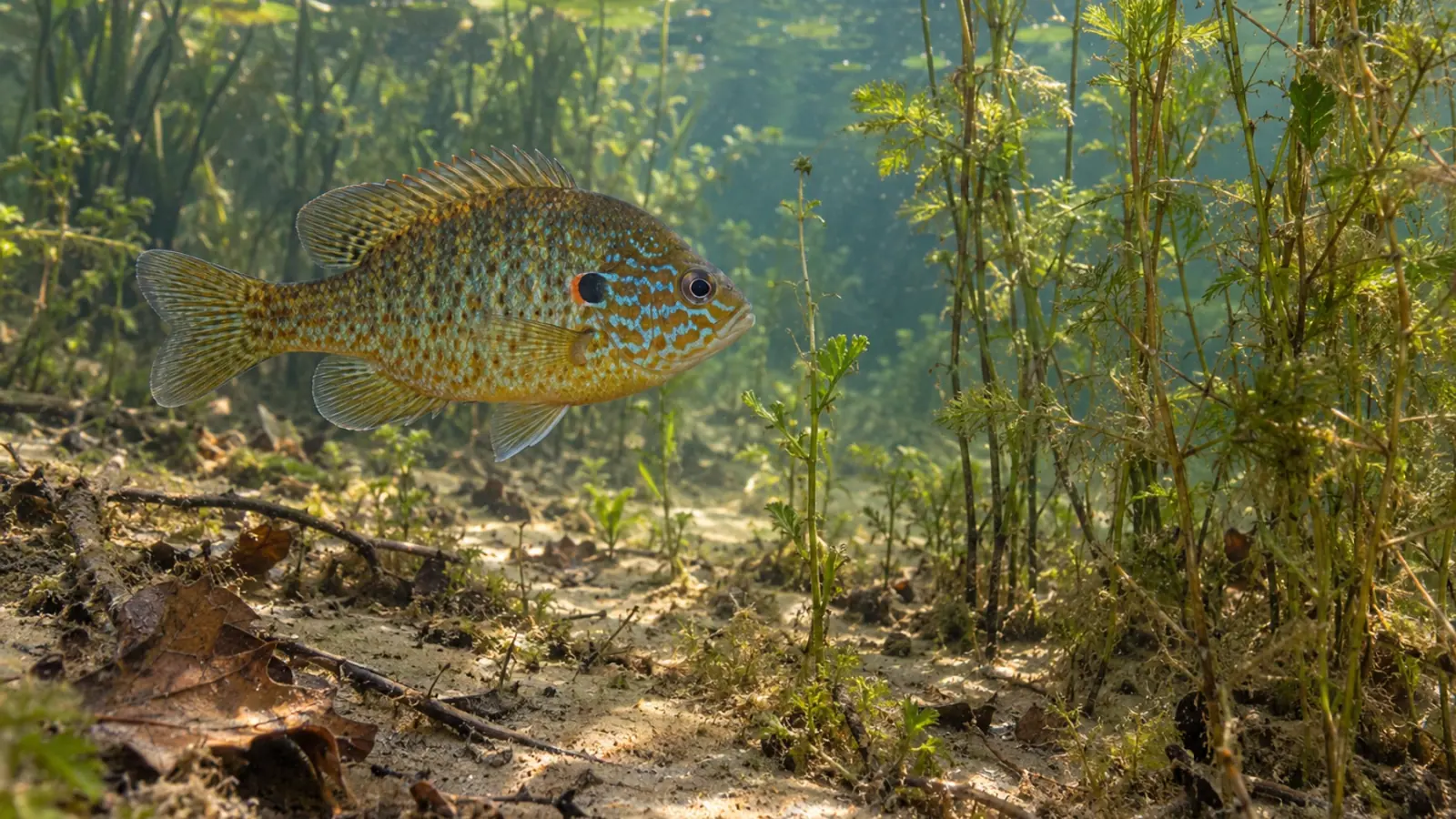
Pumpkinseed warming risk: follow the young fish
Warmer water may produce larger young pumpkinseed before winter without increasing their number. A British pond experiment and French invasive-species resources show why reproduction, recruitment and local ecological impact need separate measurements.

- Content type
- Species profile
- Sector
- Environment
- Animal group
- Fish
- Keywords
- TemperatureReproductionStress
Counting adult pumpkinseed alone cannot predict a pond population’s future. The number of young fish surviving to the next spring can substantially change the cohort entering a monitored size or age class. Recruitment depends on reproduction, growth, resources and winter conditions. Temperature can affect these stages differently, so one response should not be assumed to describe the whole population.
Pumpkinseed, Lepomis gibbosus, is a North American freshwater fish in the Centrarchidae. France’s invasive-species resource centre, coordinated by OFB and the French IUCN committee, describes its nineteenth-century introduction and subsequent spread through further introductions and connections between catchments. A long history of establishment does not remove the need to investigate local change.
Ask separate questions about presence and impact
An alien species occurs outside its original range because of human activity. Establishment concerns persistence of a population; ecological impact requires additional evidence. A photographic record, the discovery of juveniles and a change in the surrounding community therefore answer different questions. Treating them as interchangeable can make a monitoring report appear more conclusive than it is.
The French resource notes the limited number of impact studies and describes Iberian research reporting predation on native fish eggs and molluscs. Such findings justify attention without quantifying an effect in every French pond. The institutional list updated in July 2025 also includes pumpkinseed among invasive alien species of Union concern. That classification is not a measurement of damage at a particular site.
A useful field record begins with reliable identification and location, date, habitat, approximate size, observed number and the presence of different size classes. Record survey effort and equipment as well. More reported sightings can result from more observation, rather than an equivalent increase in abundance. Managers need that distinction before comparing years or allocating further survey effort.
A pond experiment separates size from number
Zięba, Fox and Copp published a British outdoor experiment in 2015 using six independent ponds. Three followed ambient temperatures and three were heated with a target difference of 2–3°C. The work included acclimation of adults, reproduction and measurement of young-of-year fish before winter. It examined a potential response to warming rather than a forecast calibrated for French water bodies.
Ponds were the independent units for comparison. Hundreds of young fish from a single pond share conditions and history; they do not create hundreds of independent temperature treatments. With three ponds per regime, the geographical and experimental scope remained limited. This matters when deciding how strongly a result can support a management prediction.
Young fish recovered from heated ponds were significantly larger and individually heavier. In contrast, about 2.8 times as many juveniles were recovered from ambient ponds, although that numerical difference was not statistically significant. Total juvenile biomass also did not differ significantly between temperature regimes. Describing the study as “warming produces more fish” would therefore misrepresent the reported results.
Earlier growth may affect the winter bottleneck
The authors discuss the larger pre-winter sizes in relation to favourable growing conditions, including earlier spawning documented in their associated research. They also consider food resources, competition and possible cannibalism. The experiment did not independently isolate every proposed mechanism, so these explanations should remain distinct from the measured size differences.
A follow-up through winter found better survival among the larger young produced under heated conditions. However, that component used only one pond per temperature regime. The authors explicitly acknowledge the lack of replication. It supports a monitoring hypothesis about size and winter survival, rather than a transferable survival estimate for introduced populations throughout Europe.
Context also limits extrapolation. A British population studied more than a decade ago cannot provide a validated prediction for a Mediterranean reservoir or a pond in Brittany. Depth, resources, predators, hydrological connections and stressful environmental episodes may alter the response. Annual mean temperature can conceal the timing of conditions that juveniles actually experience during growth and winter.
Design monitoring around the life stages
Temperature records should be paired with observations taken at comparable times and with comparable effort. Surveys before winter and in spring can document size classes, provided the method’s detection limits are understood. Failure to catch a cohort is not proof that it disappeared when sampling efficiency is unknown. Repeated records should retain enough methodological detail to assess that possibility.
Keep a record of events that could change the observations, including water level, bank maintenance, temporary connections to another water body and changes in survey technique. Data on native species and habitats complement the pumpkinseed records. Together they can support investigation of a possible pressure without attributing every community change to this one fish.
These suggestions concern an interpretable monitoring programme, not an eradication protocol. Captures, animal movements and interventions in a water body need discussion with the relevant organisations under the applicable local rules. Moving fish merely to compare sites could change the ecological situation being investigated. Monitoring design should not create an avoidable spread pathway.
Use recruitment evidence to refine the question
The British study’s central practical lesson is that individual size, juvenile number and winter survival need separate assessment. A warmer growing season may affect them in different ways. Following those stages gives a manager testable questions and helps prevent conclusions based on one visit, one adult count or one temperature average.
Vetofish can help define the monitoring questions, organise observations and connect fish health findings with ecological interpretation. Our advisory service supports aquatic environmental projects in developing evidence that can inform a management choice, while retaining the limits of the methods and data.


