

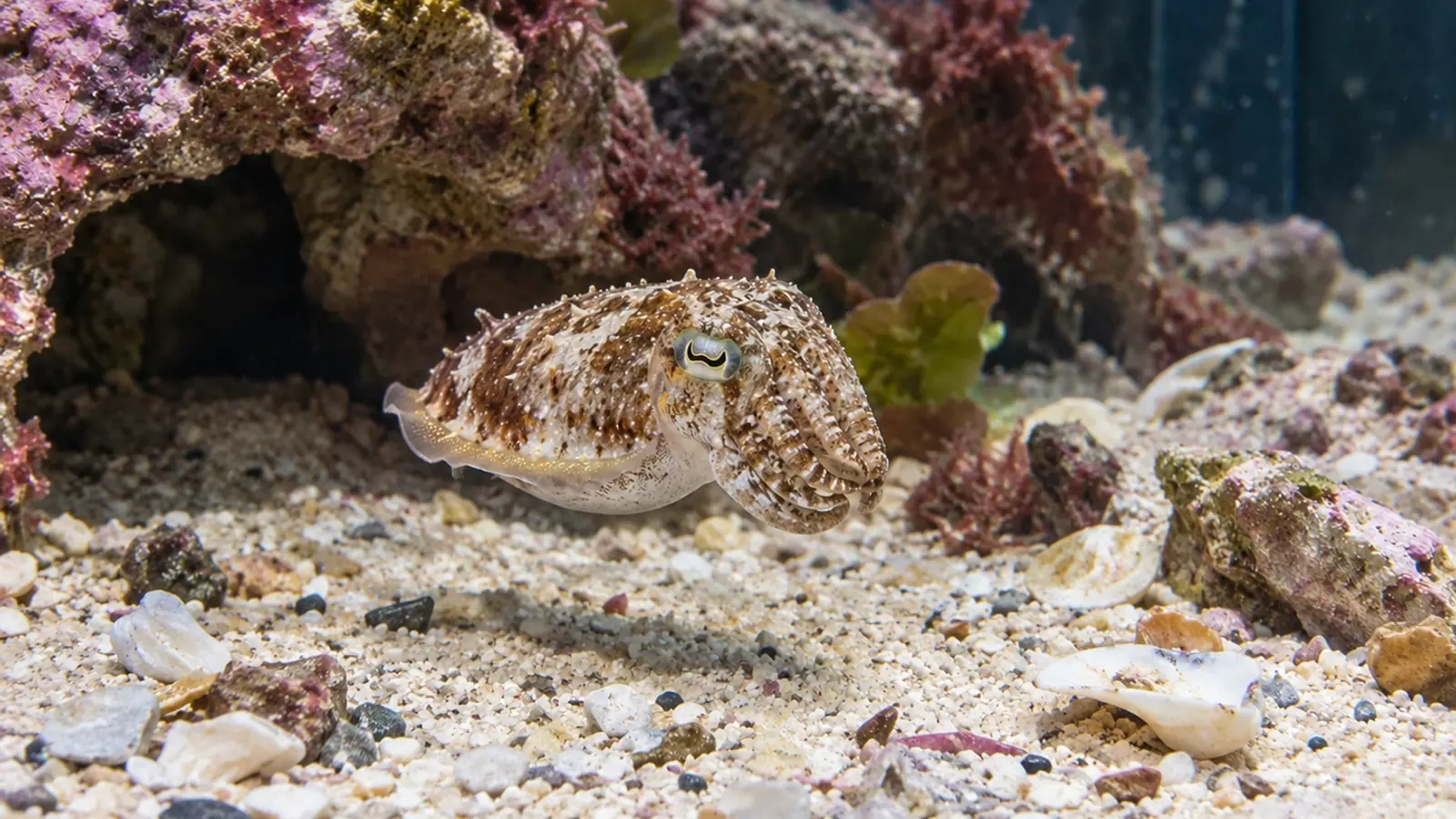
Dwarf cuttlefish: what hesitant choices reveal about husbandry
Dwarf cuttlefish exposed to a combination of poorer housing and handling responded differently to an ambiguous cue in a 2024 study. The findings encourage aquarium teams to consider animals’ experiences alongside physical health, while recognising the limits of a trained behavioural task.


- Content type
- Practical guide
- Sector
- Public aquariums
- Animal group
- Cephalopods
- Keywords
- StressEthogramEnrichment
Physical appearance gives an incomplete account of an animal’s response to its surroundings. A cuttlefish may still feed and show no visible injury while responding differently to an uncertain situation. Sarah Giancola-Detmering and Robyn Crook explored that question in a study published in 2024.
The species is now accepted as Ascarosepion bandense in WoRMS and appears as Sepia bandensis in the original paper. Public aquarium teams can use the findings to examine animals’ experiences alongside health observations. It does not provide an immediate clinical test that can be applied to any cuttlefish in a display.
What the animals had learned
The researchers trained cuttlefish to distinguish striped visual cues associated with a food reward or no reward. Once an animal had learned those associations, an intermediate pattern created an uncertain situation.
A judgement-bias task examines responses to that uncertainty. It does not directly ask whether an animal is happy or unhappy. The observations have to be defined first, and their possible affective meaning assessed afterwards.
In this study, measurements included which compartment was entered first, the delay before entry and the time spent there showing a hunting body pattern. These describe different parts of a response. Calling an animal “hesitant” compresses those observations; calling it “pessimistic” adds an interpretation that needs evidence.
For a collection, the distinction helps prevent an experimental term from turning into a permanent label attached to an individual.
The final comparison involved selected learners
The work began with 32 captive-bred subadult cuttlefish aged two to three months. Twenty-one reached the initial learning criteria. A further check using unrewarded cues left 17 animals eligible for the final comparison.
This progression matters. Animals that did not meet the criteria are not represented in the judgement-bias results. The task therefore describes the individuals able to learn it under these conditions, rather than a sample that could be assessed without prior training.
The final group was allocated randomly to nine animals exposed to a combination of poorer housing and repeated handling, and eight controls kept under their usual conditions. The study did not isolate the two elements of that treatment. It cannot establish whether removing enrichment or handling alone accounted for the response.
Public aquarium teams should retain that limitation when discussing the paper. It supports scrutiny of husbandry experiences, rather than a claim that any one husbandry component has been tested independently.
Choice, timing and hunting behaviour changed together
Following the treatment, exposed cuttlefish took longer to approach the compartment marked by the ambiguous cue. They spent less time displaying the hunting body pattern there and were less likely than controls to enter it first. The test was repeated on two days.
The value lies in bringing several defined observations together. A change in movement speed alone could have many explanations. A description that also includes choice and food-search behaviour gives a fuller account of what the animals did.
Those observations are not independent replications of an entire population. The same individuals contributed to several measurements and both test days. The small final sample remains central to the strength and scope of the evidence.
The authors interpret the combined findings as consistent with a more negative judgement bias after the challenging conditions. This extends the discussion beyond visible injury without giving direct access to an animal’s subjective experience.
Ambiguity also applies to the interpretation
The paper discusses an unusual feature of the task: the ambiguous cue was offered alongside a familiar cue signalling no reward. That arrangement differs from many judgement-bias tests. A preference could also be influenced by neophobia or by how well an individual had learned the task.
The hunting observations and movements support the authors’ interpretation but do not remove every alternative. A response to a new cue is an indicator whose meaning depends on the experimental design, not a direct measurement comparable to weighing an animal.
The findings should also remain species-specific. They cannot describe all cuttlefish, still less all cephalopods. There is no clinical latency threshold here, and hesitation in an enclosure does not by itself establish compromised welfare.
Such distinctions are useful when scientific findings enter staff training. They preserve what the study contributes while making clear which questions it leaves open.
Use the question to improve routine observation
The practical lesson is to consider how housing and interventions may change an animal’s subsequent responses. Reproducing challenging conditions is not necessary to begin reviewing the experience of animals in a collection.
A team can define observations it can collect without adding disruption: feeding, shelter use, posture, responses to familiar maintenance and recovery afterwards. A shared ethogram makes it easier for keepers to describe comparable events rather than rely on broad impressions.
These records can be read alongside water measurements, captures, maintenance and changes to the enclosure. If several events occurred together, keeping that uncertainty visible is more informative than immediately selecting one explanation. Health assessment and the needs of the species remain part of the same review.
The study does not replace those observations with a single score. It demonstrates why considering only an absence of physical damage may overlook part of the effect of husbandry.
An additional perspective on welfare
This 2024 work illustrates the contribution of carefully defined behavioural indicators and documented comparisons. Its usefulness depends on retaining the learning requirements, selected sample and limits of interpretation.
Vetofish can help an aquarium team develop an observation framework, review changes in husbandry and choose criteria for following their effects. The aim is to support discussion and traceable decisions, without claiming that one response can diagnose an animal’s overall welfare.
To move from evidence to action, explore our animal welfare service and our expertise for public aquariums.


