

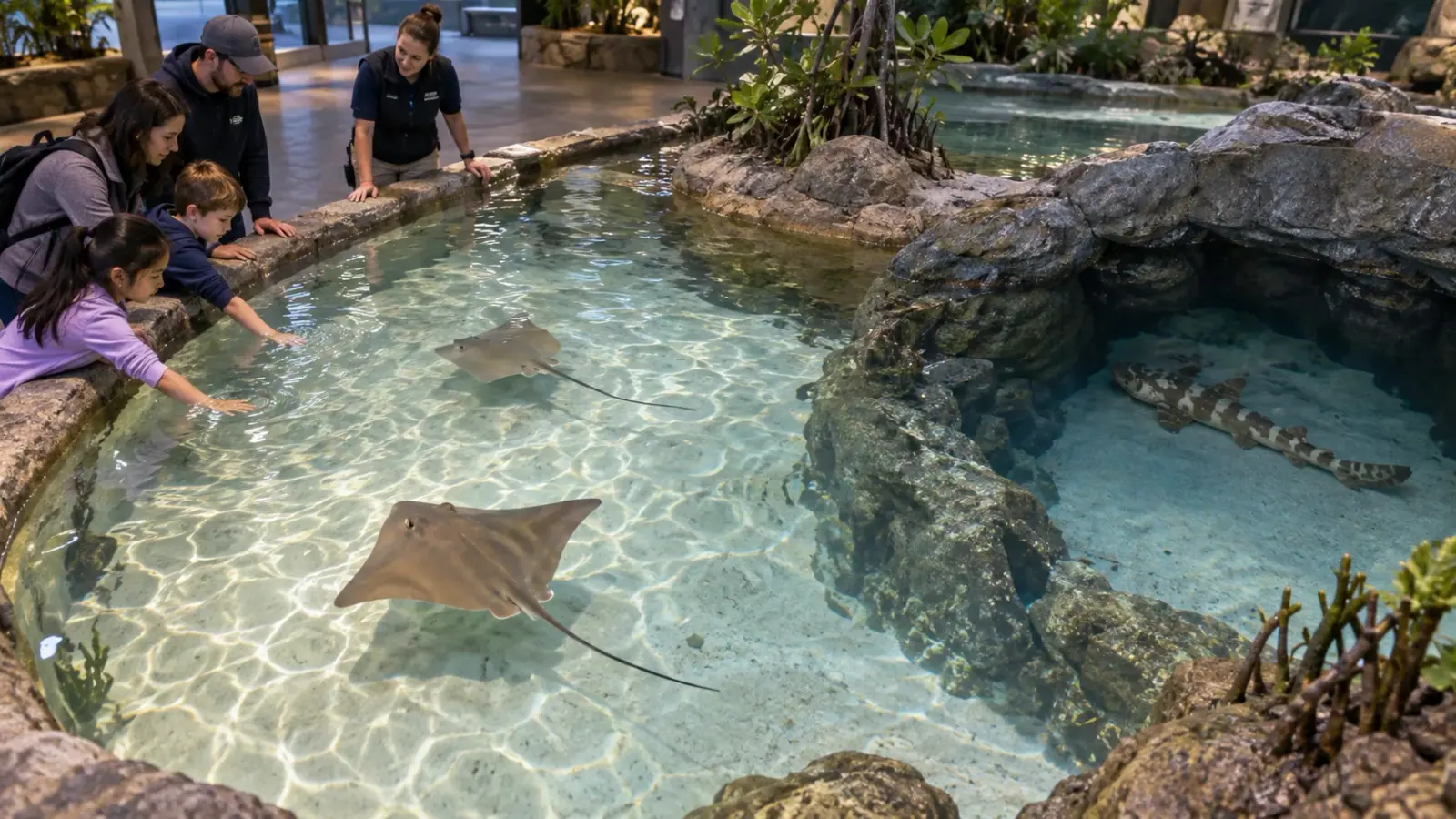
Touch pools: crowd size changes habitat use
A 2026 study found sharks and rays used the contact ledge less as crowds grew. That is a signal to measure, not an automatic diagnosis of stress.
- Content type
- Practical guide
- Sector
- Public aquariums
- Animal group
- Elasmobranchs
- Keywords
- EthogramStressEnrichment
In a touch pool, visitors are not simply part of the scenery: their presence is part of the animals’ environment. A 2026 study at the Aquarium of Niagara found that three elasmobranch species spent less time on the touch ledge as the crowd grew. This result does not by itself prove suffering or aversion to people. It does show that habitat use changes with crowd size and that aquariums should measure that change before describing an interaction as neutral or voluntary.
What the study observed
Galante and colleagues used security-camera footage from the Shark and Ray Bay exhibit collected between November 2022 and January 2024. The study followed whitespotted bamboo sharks, Atlantic stingrays and yellow stingrays. Five-minute periods were coded hourly during opening hours, alongside estimates of crowd size.
All three species spent significantly less time on the ledge where visitors could touch them when crowds were large. The association was especially strong for both ray species. This spatial response matters because it reveals a choice used by the animals: remaining near contact or moving away. It does not identify whether touch, sound, movement, feeding, competition or several factors caused that choice.
A 2023 study of ten rays from four species reported more active behaviour at higher visitor densities, without significant group-level increases in negative or social behaviour. Individual responses varied. The authors cautioned that greater activity might be adaptive or maladaptive depending on context. The findings are therefore not contradictory. They show that “more active” and “farther from the ledge” must be interpreted with species, individual and other welfare indicators in view.
Withdrawal must be a real option
An interactive exhibit cannot assume that every visible animal consents to contact. Its design should include an area that hands cannot reach and that is attractive, deep or distant enough for animals to remain there without being pursued. The option is ineffective if competition, flow, lighting or food distribution makes that area unusable.
Refuge use should be recorded throughout the day. Increased use during peak attendance may represent avoidance. Failure to withdraw can also have several meanings: tolerance, feeding motivation, habituation or simply no practical escape. None can be diagnosed from a photograph or a single visit.
Contact rules should protect skin integrity and the animal’s control over the encounter. They can define where and how touch is permitted, limit the number of hands and prohibit grabbing, blocking or following individuals. Staff need clear criteria for suspending contact and the authority to intervene immediately rather than relying only on signs that visitors may not read.
Build an ethogram staff can use
Before changing the programme, the aquarium can define a short set of observable behaviours: time in contact and retreat areas, swimming speed, resting, abrupt turns, wall contact, aggression, voluntary approaches, food refusal and visible injuries. Definitions should be precise enough for two observers to code the same event consistently.
Visitor exposure must be recorded in the same time blocks. A head count combined with the number and duration of contacts and the presence of feeding separates “crowd” from “interaction”. Time, lighting, cleaning, temperature, meals and changes in group composition are important contextual variables.
A stable baseline is needed before testing capacity limits, breaks or new operating rules. Analysis should consider both trends and individuals, not only the pool average. If one ray consistently retreats while others approach, the difference may matter biologically even when it disappears in a group statistic.
Connect behaviour, health and environment
Behaviour alone cannot establish welfare state. Johnson and colleagues compared selected health measurements in cownose rays held in a seasonal touch pool with rays in an off-exhibit habitat. Their work illustrates the value of pairing daily observation with clinical and environmental data, but it is not a universal approval for all touch-pool designs.
Monitoring should include body condition, skin and fin integrity, food intake, injuries, treatments and water quality. A rise in lesions during a busy period warrants investigation without proving visitor causation. Conversely, the absence of mortality is far too insensitive an endpoint for judging repeated interaction.
Husbandry risks also belong in the assessment: feeding competition, animals congregating near people, contaminants introduced on hands and the effects of rotation. Visitor hygiene, supervision, water control and species compatibility are part of one plan. Food should not be used to hold animals artificially in the contact zone without measuring competition and adverse responses.
Test reversible management changes
Several adaptations can be evaluated without rebuilding the exhibit: visitor capacity limits, shorter contact sessions, scheduled breaks, moving feed points, additional educators and temporary closure of part of the ledge. Each change needs a stated objective, an indicator and a review date.
The aim is not to maximise touches but to maintain an experience compatible with animal choice and health. If reducing crowd size increases voluntary use of the contact area without worsening other indicators, it provides management evidence. If nothing changes, teams should investigate other variables rather than dismissing the monitoring exercise.
Vetofish can support ethogram design, sampling plans, clinical review and combined interpretation of visitor, behaviour and health data. A responsible touch pool is a programme that remains open to revision: it can show when animals participate, when they withdraw and when staff decide that contact should stop.
To move from evidence to action, explore our animal welfare service and our expertise for public aquariums.


