

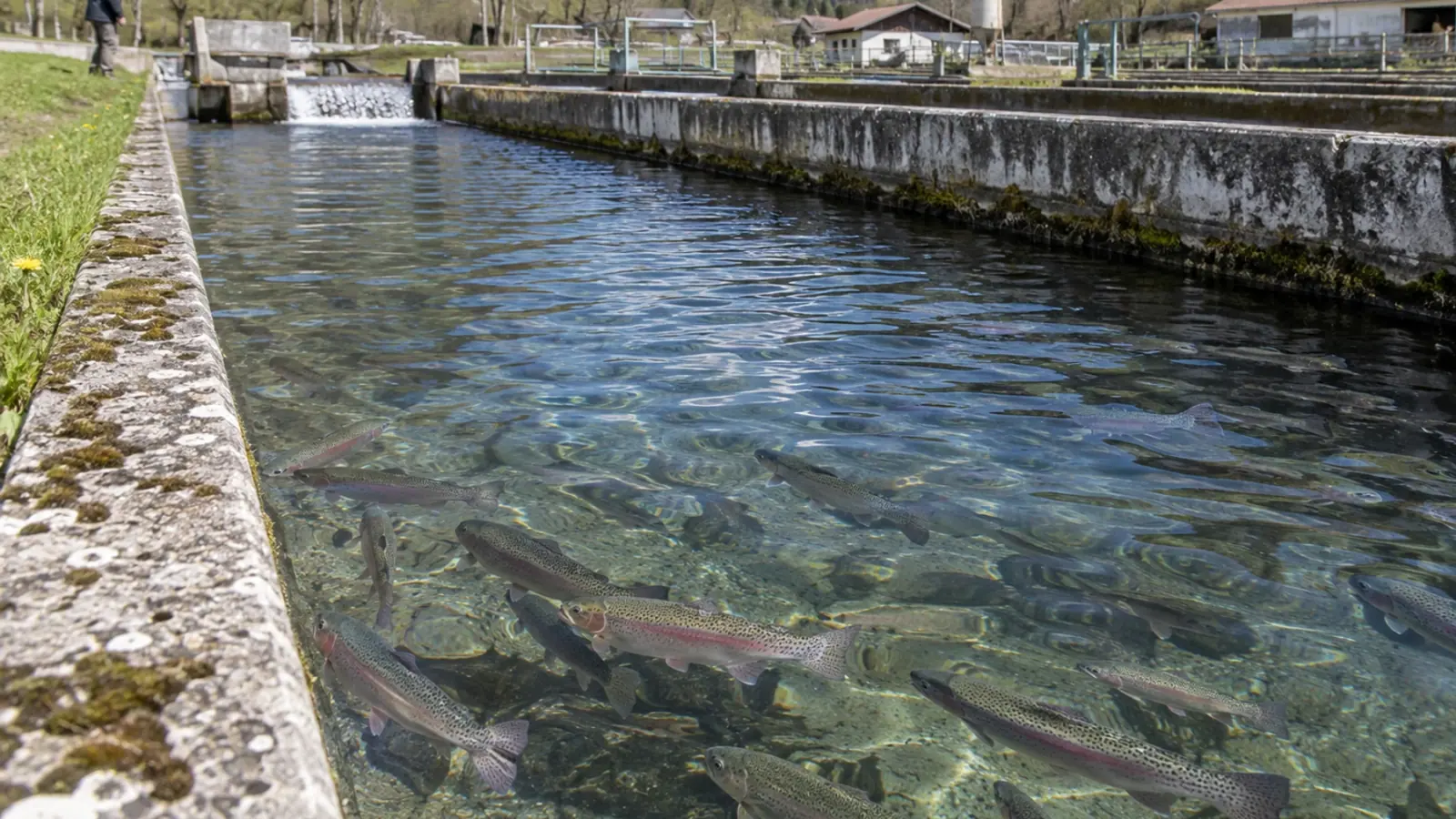
Farmed trout: making welfare observations comparable
Observing trout from the bank avoids capture but does not automatically produce reliable welfare data. France’s AQUA BIEN-ÊTRE project combines health and behavioural indicators while identifying the need for further repeatability work.
- Content type
- Practical guide
- Sector
- Aquaculture
- Animal group
- Salmonids
- Keywords
- EthogramStressOxygenEnrichment
A farm visit offers many impressions: trout gathering in one area, interrupted swimming, a response to a passing worker or damaged fins. Turning those impressions into useful welfare information requires observations that different people can interpret in the same way. Otherwise, a change in the record may reflect who visited the raceway rather than a change in the rainbow trout (Oncorhynchus mykiss) living there.
Messager and colleagues describe this process in their 2025 account of France’s AQUA BIEN-ÊTRE project. Researchers and fish farmers developed a practical approach to on-farm assessment. The work helps teams structure their farm visits; it does not supply an automatic diagnosis or a universal threshold that certifies a cohort’s welfare after a single inspection.
Choosing indicators that staff can actually record
Protocols were tested at seventeen sites over two years and across different production stages. The resulting set comprises thirteen health indicators and twelve behavioural indicators. Visibility, staff time and practical feasibility influenced their selection. A scientifically interesting measure has little operational value if it cannot be collected consistently in the raceway where decisions must be made.
External health observations include fin condition. Behavioural observations describe activity and how fish use their surroundings. These are complementary forms of evidence. Trout may change their swimming before an external lesion is visible, while apparently ordinary swimming does not rule out a health problem. Neither family of indicators should be used to dismiss information supplied by the other.
The project contributed to the development of the EBENE® tool for trout. The article describes further farm testing as part of consolidating the approach. It would overstate the evidence to present the application as fully validated for every production system or fish species. Its value depends on the assessment protocol and the circumstances in which that protocol is used.
Give the observer’s arrival its own place in the sequence
Fish responses when a person approaches are themselves observations. The described protocol considers the return to usual behaviour over a period of up to three minutes. Starting another task immediately makes the response harder to interpret: fish may be reacting to the arrival, equipment or a feeding event. Agreeing the order of the visit helps staff record comparable situations.
A five-minute continuous observation then records events such as sudden acceleration, jumps, aggressive interactions and hyperventilation. Instantaneous observations at one-minute intervals describe activity, orientation relative to the current, grouping and position in the water column. An event count and a snapshot of an ongoing state answer different questions, even when both concern the same group of fish.
An ethogram provides explicit descriptions of the behaviours being recorded. Staff need to agree what qualifies as an acceleration or a chase before comparing totals. Short recordings can help colleagues discuss their criteria, provided that image quality and perspective allow the behaviour to be seen. Video does not remove uncertainty when fish are hidden or important movements cannot be distinguished.
Avoiding capture does not solve every sampling problem
For external health indicators, the method describes observing thirty fish per indicator from the bank without handling them. Avoiding capture limits the disturbance caused by the assessment. Visibility still varies with reflections, depth, turbidity, water movement and the distribution of the cohort. Some body areas may be much easier to inspect than others.
An obscured fin should be recorded as unassessable rather than assumed to be intact. Keep the number of fish actually observed separate from the total stock in the raceway. Finding no abnormality among visible animals does not demonstrate that the entire cohort is unaffected. That distinction is especially relevant when water or lighting conditions differ between successive visits.
Recording the time, recent feeding, handling, temperature and oxygen conditions helps interpretation. This is a practical monitoring recommendation, rather than a new threshold derived from the project. A shift in where fish gather can prompt checks of water quality and recent events, but cannot identify its own cause. The context determines which explanation should be investigated next.
Observer agreement needs deliberate attention
An initial repeatability assessment used two raceways measuring forty by five metres, with sixty observations made by two observers. Twelve of the twenty-five indicators were repeatable in that assessment. This finding belongs to that setting and stage of validation. It does not establish that every remaining indicator is permanently uninformative on all trout farms.
Fin erosion was among the features for which agreement between observers proved difficult. A difference in scores may consequently reflect how damage is classified. Before using small week-to-week changes to judge an intervention, staff can score the same situations, compare disagreements and develop shared descriptions of the categories. Training should make uncertainty visible rather than encourage confident guesses.
Repeatability also differs from biological validity. Two people can agree on a behaviour without knowing what it means in every circumstance. Retain health, behavioural and environmental findings together and examine where they support or contradict one another. Growth performance alone cannot describe the full welfare state of the animals, and a consistent score should not be treated as a complete explanation.
Connect the record with a decision
A raceway record can separate direct observations, unresolved questions and agreed actions. Persistent change warrants checking the environment and cohort history, with veterinary examination where indicated. Clinical signs or unusual mortality require an appropriate response without waiting for a complete series of welfare scores. The observation programme should support timely care rather than delay it.
Environmental enrichment is one possible management measure discussed elsewhere in the project. Comparable baseline observations help define the intended benefit and assess possible unwanted effects after a change. Installing equipment without a baseline makes its contribution difficult to judge. Water circulation and access for routine maintenance remain part of the decision, alongside how fish behave around the new structure.
Conclusion and Vetofish support
AQUA BIEN-ÊTRE offers a practical assessment approach that teams can refine through shared observation and further validation. Our animal welfare service can help aquaculture teams define indicators, align scoring criteria and connect the findings with the farm’s health investigations and management decisions.


