

Rainbow trout enrichment must work with the farm
Adding structures to a tank does not automatically improve welfare. Rainbow trout trials report behavioural and production benefits, but farms must protect water flow, cleaning and biosecurity.
- Content type
- Scientific news
- Sector
- Aquaculture
- Animal group
- Salmonids
- Keywords
- EnrichmentStressOxygenEthogram
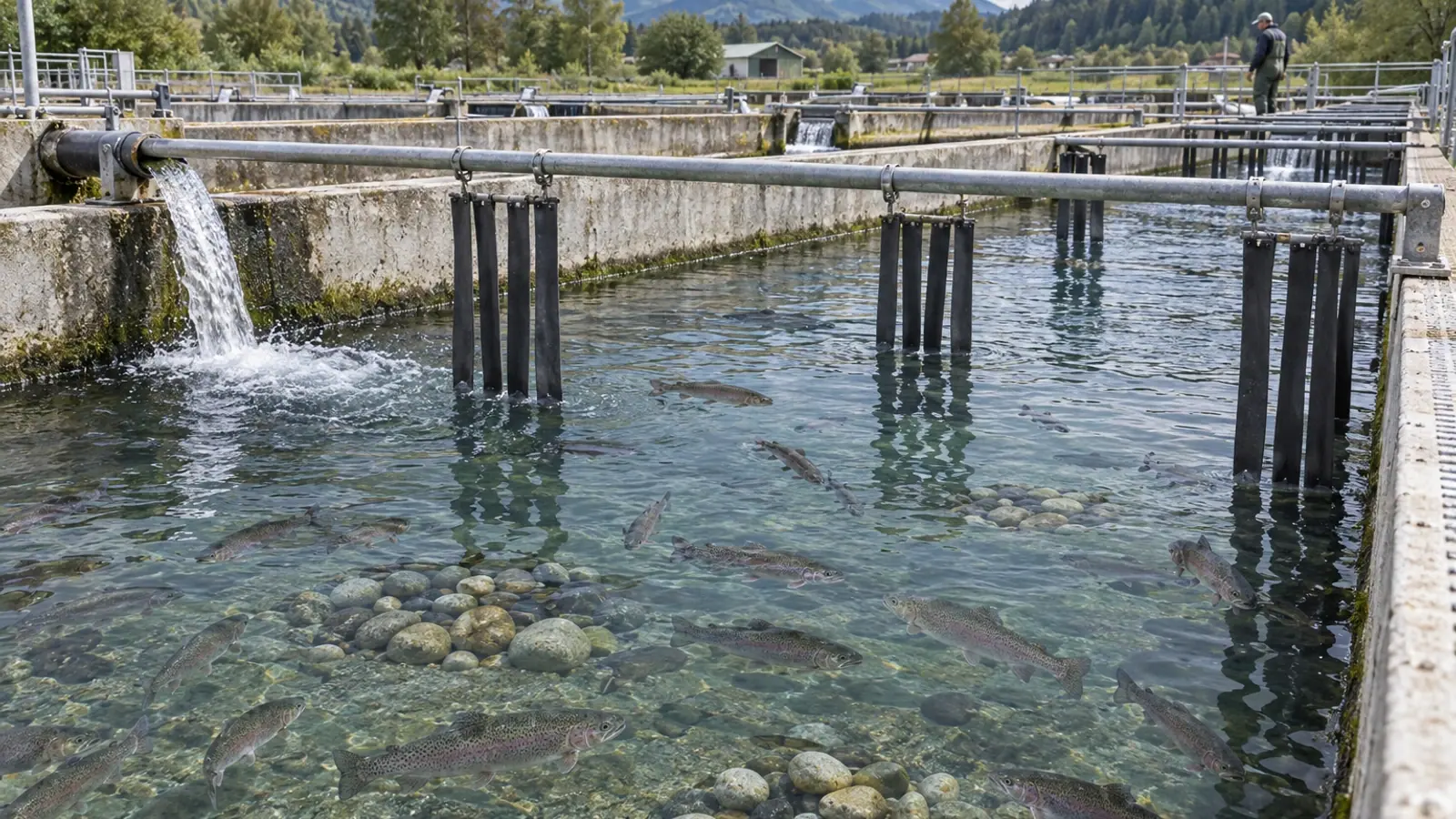
A bare production tank is easy to inspect and clean, but it offers fish few opportunities to explore or choose where to spend time. Environmental enrichment deliberately adds complexity. For rainbow trout (Oncorhynchus mykiss), the practical question is not whether every raceway should resemble a stream. It is whether a defined structure improves animal outcomes without compromising hydraulics, hygiene or routine husbandry.
Brunet and colleagues compared trout kept in standard tanks with fish provided with stones, pipes and artificial plants. They examined group behaviour, growth and health as well as responses to a novel tank and a novel object. This multidimensional design matters because no single measure can represent welfare on its own.
What the trout study established
Under the tested conditions, enriched fish showed less aggression, improved growth and less fearful responses during novelty tests. The measured immune status was not impaired. The findings support the idea that physical complexity can create exploratory opportunities, interrupt some aggressive encounters and change how trout experience their rearing environment.
They do not show that any object will have the same effect. The trial used a particular combination of structures, fish, life stage and husbandry conditions. It cannot separate the contribution of each item or define a universal amount of structure. Näslund and Johnsson’s broader review likewise found that effects vary with species, stage, enrichment type and context.
Improved growth is not sufficient evidence of improved welfare. It should be considered alongside fin condition, injuries, behaviour, space use, mortality, feeding and water quality. Conversely, no growth difference does not rule out a meaningful behavioural benefit.
Make enrichment compatible with production hydraulics
A structure is acceptable only when the tank can still perform its core functions. It must not create dead zones where faeces and feed accumulate, obstruct solids removal, lower oxygen locally or increase collision risk. Anchoring must withstand water velocity and routine operations without sharp edges, loops or gaps that could trap fish.
Suspended or removable devices can simplify inspection and cleaning. Fixed objects close to the floor require closer monitoring of deposits. The best option will differ between a high-flow raceway, a self-cleaning circular tank and a recirculating unit.
Define the purpose before installing anything. Is the aim to reduce aggressive contact, provide visual barriers, diversify flow or encourage exploration? A structure without a measurable purpose may become another obstruction rather than enrichment.
Measure the fish response
Start with a baseline period in comparable tanks. Record distribution, swimming cohesion, feeding responses, aggression, fin damage, growth, mortality and water parameters. Use the same measures and schedule after installation.
Actual use of the device is informative. Persistent avoidance, crowding in the remaining open area or increased rubbing indicates poor fit. More diverse space use without deteriorating health or conflict is compatible with benefit. Observations should cover different times because use may change with light, feeding, flow or fish size.
A short ethogram—a list of behaviours defined before the trial—reduces subjective interpretation. Observers need shared definitions. Fixed video can help compare distribution and interactions without adding a person beside the tank as another source of variation.
Protect biosecurity and water quality
Every immersed surface develops biofilm. That does not make enrichment incompatible with biosecurity, but it requires a material-specific cleaning, disinfection or replacement plan. Porous and intricate devices are harder to sanitise and may retain organic matter or parasite eggs. Equipment should remain within one health unit unless a validated transfer procedure is followed.
The trial needs stop criteria: reduced oxygen, impaired solids removal, injuries, hydraulic failure, inability to clean or persistent avoidance. Prompt removal of an unsuitable device is part of responsible testing, not a failure of the concept.
Labour also matters. A short-term animal benefit may not be sustainable if every cleaning event requires extensive handling or flow interruption. Evaluate time, durability, compatibility with grading and ease of daily inspection.
Keep routine husbandry stable during the comparison wherever possible. A feed change, density adjustment or major maintenance event can alter behaviour and growth independently of enrichment. Recording these events protects the interpretation and helps another production unit judge whether the result is transferable.
Scale up only after a controlled trial
Begin gradually with comparable enriched and reference tanks. Document duration, batches, stocking density, feed, flow, measurements and events that could bias the comparison. Decisions should rely on a coherent set of indicators rather than one observation.
Reassess the device as fish grow. A structure suitable for juveniles may later become narrow, disrupt circulation or allow dominant fish to control a preferred area. Enrichment is an element of husbandry that requires review, not a permanent fitting that can be forgotten.
Current evidence supports carefully designed trout trials, not a universal tank recipe. A useful device gives fish a relevant opportunity, produces a repeatable favourable signal and remains compatible with stock health and farm operation.
This assessment belongs within the wider challenge of health management and welfare in aquaculture, where any expected improvement must remain compatible with the production system.
Vetofish can help farms design enrichment trials, select behavioural and health indicators, assess water and biosecurity constraints and interpret the results. The aim is a demonstrable husbandry improvement, not decoration added to a production tank.
To move from evidence to action, explore our animal welfare service .


