

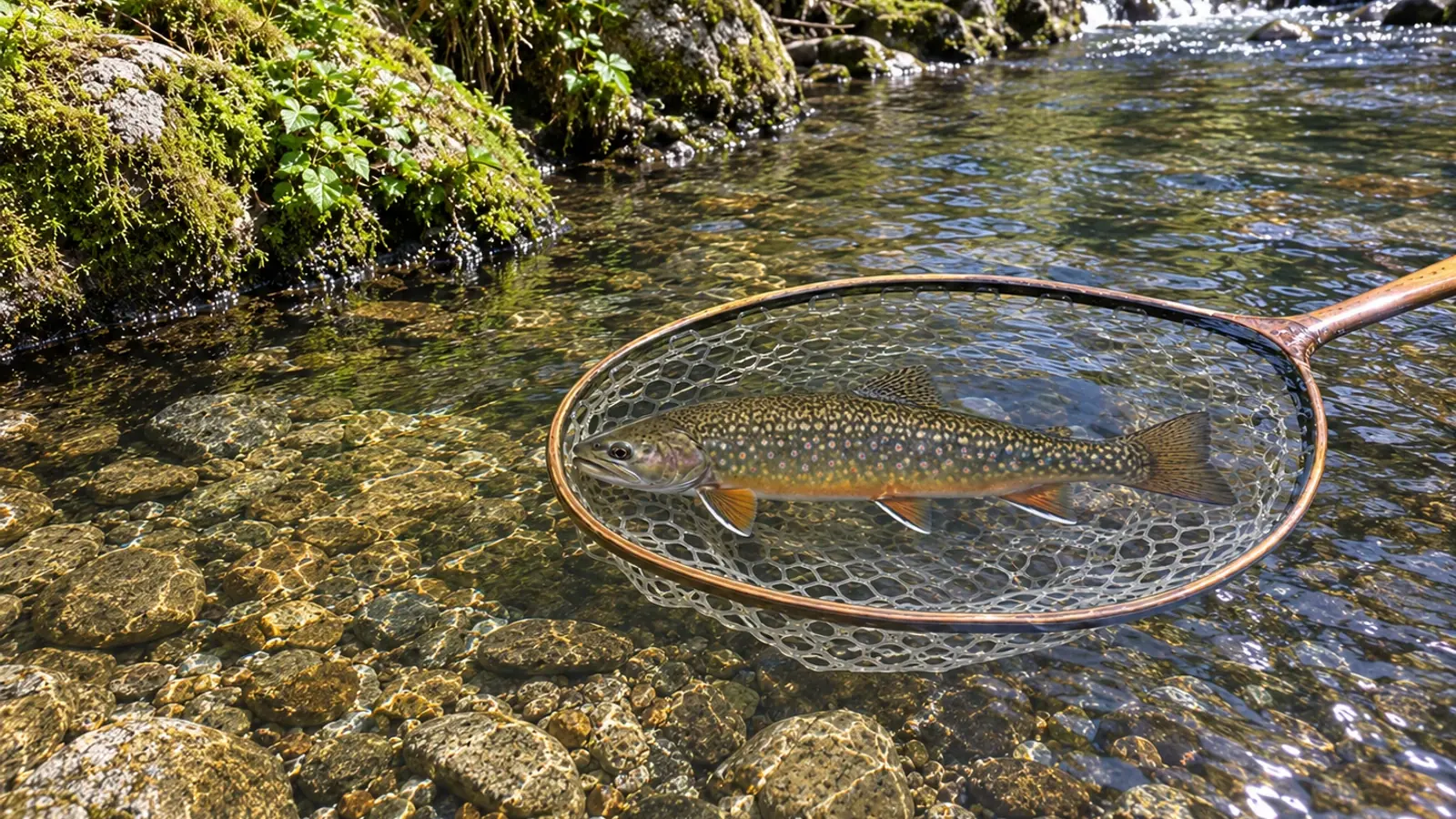
Fish landing nets: match the mesh to the handling task
A landing net can prevent a fish being dropped while also abrading its fins or skin. Two studies help assess mesh material and entanglement risks. Equipment should be judged against the species, fish size and complete handling sequence rather than a material label alone.


- Content type
- Practical guide
- Sector
- Environment
A landing net affects the entire handling sequence after capture. It can prevent a fish being dropped, while its mesh may rub the skin, catch a hook or trap a fin. Field teams need suitable equipment and a prepared sequence that limits those incidents. The material label is only one part of that decision.
Two angling studies provide useful comparisons: Barthel and colleagues studied bluegill, Lepomis macrochirus, while Lizée and colleagues studied brook trout, Salvelinus fontinalis. Their findings help explain damage mechanisms. They do not establish a universal net for all fish or validate every ecological monitoring operation. This guide separates their results from operational recommendations for reviewing a field procedure.
Preserve the scope of each comparison
In the 2003 experiment, fish were retained in different nets for thirty seconds after angling at a water temperature of 26°C. Fin and body-surface damage were observed, and extended monitoring identified delayed mortality. The experimental exposure is not a recommended handling duration. Interpretation remains tied to the species and study arrangement.
The 2018 study compared several materials with landing by wet hands in 146 brook trout. Large, knotless rubber mesh was considered the least damaging option tested. Some netting increased difficulties during hook removal. Survival follow-up was short and cannot establish absence of later mortality.
Different advantages for hand landing and particular nets do not make the studies contradictory. Species, equipment, conditions and outcomes differed. Field decisions should retain those distinctions instead of turning a local comparison into a permanent ranking of materials. The comparison can inform an equipment review, but its findings remain tied to the task tested.
Inspect the surfaces that contact the fish
Mucus and scales contribute to protection of the body surface. Evaluate a net for the rubbing and entanglement it can produce. Removing knots eliminates some raised contact points, but says little by itself about flexibility, mesh dimensions or surface condition. Inspect the net itself; a product description does not establish its suitability.
Fins, spines and body shape should inform selection. Mesh that accommodates a deep-bodied fish may trap a smaller individual or an appendage in another species. Check actual dimensions: the opening, bag depth and access to the fish must match the planned action. A size designation alone may conceal differences important to the operator.
Preparation can include an equipment trial without an animal. Staff can check hand access, placement of instruments and how to keep the bag submerged. Damaged mesh or a prominent seam should be identified before deployment. Being available in the field kit does not make an item suitable for continued use.
Have the next stage ready before capture
Measuring equipment, records and any receiving container should be ready before the fish arrives. Assign tasks to specific operators so tools do not have to be located during restraint. Searching for scales or an instrument adds handling time without adding scientific information. Equipment review therefore includes the layout of the work area.
The net should support the fish without compression or a pronounced bend. Keeping it submerged where the operation allows avoids unnecessary air exposure. A bag should not become a prolonged holding system merely because it contains the animal. Support, access and the planned next action need to be considered together.
Where hooks are present, entanglement risk forms part of mesh selection. Plan access for removal without repeated movements of the fish. Other capture methods create different conditions. An angling comparison should not be described as a direct test of net performance during handling after electrofishing or another sampling method.
Record incidents as well as duration
Timing is useful, but a rapid movement can still cause trauma. A field record may also capture entanglement, drops, contact with surfaces, abnormal swimming and visible damage. Definitions should be clear enough for different staff to record comparable events. An unexplained category such as “handled well” gives little basis for reviewing a problem.
Distinguish damage known to precede capture from damage seen afterwards with an uncertain origin. A photograph may document a finding when obtaining it does not add unnecessary exposure. No visible lesion does not establish that mucus is intact or that no physiological effect occurred. The recorded endpoint should remain narrower than a general claim of harmless handling.
Follow-up after release depends on the project and what observation is feasible. A fish swimming away immediately is not complete evidence of survival. Reports should state the observation window and avoid extending absence of short-term mortality to the following days or to the entire population. Missing follow-up is a limitation, not a result.
Include the net in the sanitary workflow
Equipment shared between water bodies or fish groups belongs in the biosecurity assessment. Identifying uses and zones prevents an unnoticed sanitary connection. Cleaning and, where the protocol requires it, disinfection must suit the material and the receiving environment. Storage and transport should preserve the intended separation between ready-to-use and previously used equipment.
This is an operational recommendation, not a disinfection experiment performed in the two cited studies. No universal chemical, concentration or contact time is supplied here. The procedure must also prevent treatment residues reaching animals or the water body. A site-specific method should be established before equipment moves between locations.
Maintenance needs to remain practical. A design that reduces entanglement but cannot be inspected or treated within the sanitary procedure warrants another assessment. Keeping a record of defects, maintenance and replacement makes equipment condition traceable. That record is as relevant as the original procurement choice when an incident is investigated.
Conclusion: assess the complete handling arrangement
Material, mesh and form need evaluation alongside species, body size and the handling sequence. The studies show measurable consequences of net contact and explain how hook entanglement can alter exposure time. They justify preparation and incident review without guaranteeing harmless capture in every setting.
Working with Vetofish
Vetofish can help review equipment, incident records and fish observations around an operation. Our animal welfare service supports teams working in the environment sector. Species, size range, capture method and site constraints provide a practical starting point for assessing the handling sequence and its risks.


