

Fish sutures: choose the whole protocol, not just a thread
A thread that performs well in one species or water body is not a universal choice: sutures belong within the complete surgical and monitoring protocol.

- Content type
- Practical guide
- Sector
- Environment
- Animal group
- Fish
Selecting a suture for fish is not a matter of transferring a preference from mammalian surgery. Skin, mucus, continuous immersion, water temperature and healing rate change the wound environment. Species, body size, incision site and the purpose of the procedure add further constraints.
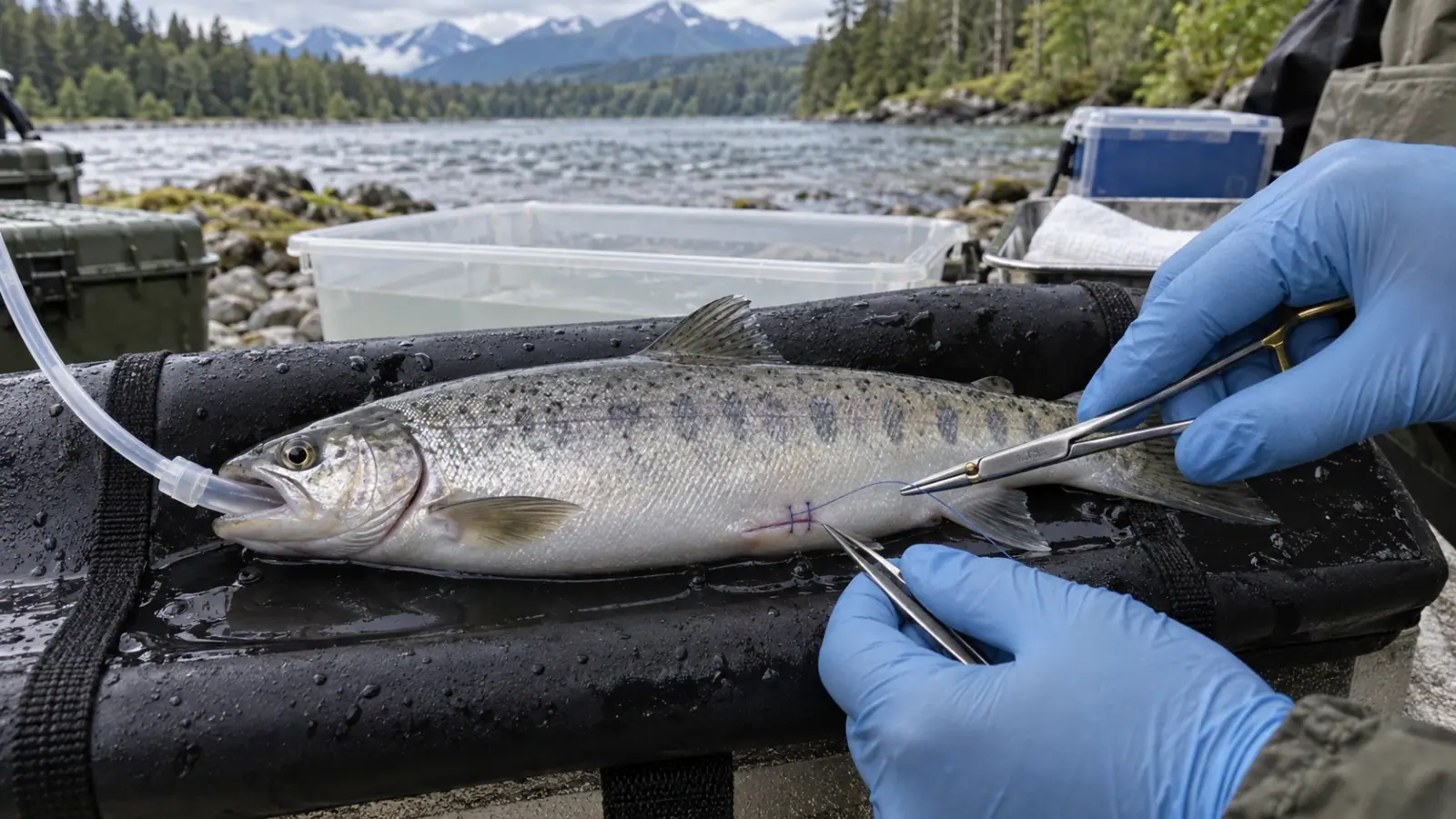
An open study involving 3,198 subyearling Chinook salmon shows why no thread property should be interpreted alone. Fish received a small ventral incision closed with two simple interrupted absorbable monofilament sutures. Two intact sutures still present at day seven, higher tagging temperature and foreign material on the sutures were associated with lower survival. This does not mean that losing sutures is always protective. It describes one combination of species, size, technique and environment.
Start with the required function
A suture apposes wound edges until tissue has enough strength. It should not strangulate tissue, create excessive tension or remain unnecessarily as a surface for deposits. Selection therefore concerns a system: material, diameter, needle, pattern, number of sutures, knots and expected retention time.
Monofilament generally has less surface area and capillarity than braided material, but it may be stiffer and require a suitable knot technique. An absorbable material may remove the need for later removal, yet its loss of strength may not match healing under the relevant water temperature. Diameter should be sufficient to hold while remaining the smallest compatible with the required tension.
Studies often compare several variables at once. A survival difference cannot be assigned to material when surgeon experience, procedure duration, animal size or internal trauma also differ between groups.
Standardise the procedure before comparing threads
The Chinook salmon study used a 2–3 mm ventral incision, two simple interrupted sutures and continuous anaesthetic irrigation over the gills while fish rested on a neoprene platform. These details show that wound quality begins before the first stitch: stable anaesthesia, wet support, suitable irrigation, prepared equipment and a defined incision path.
Edges should meet without inversion or crushing. Excessively tight sutures compromise perfusion; loose ones allow gaping and snagging. Knots and tag ends should not irritate skin or interfere with swimming. A photographic scoring guide and scale allow teams to compare apposition and inflammation among operators.
Training should use objective outcomes: time out of water or under irrigation, incision accuracy, spacing, tension, number of attempts, tissue trauma and recovery. Repeating a poor technique more quickly is not improvement.
Operator identity should be retained in the dataset. If several people perform procedures, randomisation across treatment groups and dates helps prevent operator experience from becoming an invisible treatment effect. Periodic blinded scoring of photographs can reveal drift in technique.
Control temperature, hygiene and recovery
Higher tagging temperature was associated with lower survival in the study. The authors did not propose a universal threshold, but the finding shows that temperature belongs in the record and decision. It affects metabolism, oxygen demand, stress response, microbial growth and healing.
Asepsis is difficult in aquatic settings, but that difficulty does not justify improvisation. Instruments, implants and sutures should follow a validated preparation procedure. Baths and topical products do not replace clean technique. The four treatments tested—hydrogen peroxide, salt, an iodine product and a water conditioner—did not improve wound healing or survival compared with the reference group, and two may have been contraindicated at the tested doses.
That result blocks a common assumption: adding an antiseptic “just in case” is not automatically protective. Any treatment needs species-, dose-, duration- and regulatory justification, with attention to gills, mucus and behaviour.
Monitor the wound and the animal
An incision photograph is not enough. Follow-up combines apposition, inflammation, ulceration, deposits on thread, tearing, suture loss, behaviour, ventilation, balance, feeding and survival. Observation windows should cover the period in which delayed complications remain plausible.
In telemetry research, surgery may also bias the variable being measured. A surviving fish whose swimming remains altered for several days may not yet represent baseline behaviour. Analysis plans should define an exclusion period, recovery criteria and appropriate controls where possible.
Environmental follow-up is equally important after release. Temperature, flow, salinity and habitat can influence both healing and transmitter-derived behaviour. A wound result obtained in a protected holding tank cannot automatically predict recovery in a migratory fish exposed to current, handling and transport.
Records should link implant identity, surgeon, suture batch, anaesthetic exposure, water conditions, procedure time, recovery observations and later detections. Without that chain, a missing signal may be attributed to animal mortality when tag failure, expulsion or altered movement remain possible explanations.
Stopping rules are set before surgery. Progressive dehiscence, bleeding, deteriorating equilibrium or inadequate recovery should trigger a specified response. Release should never depend on elapsed time alone.
Validate choices locally
The best thread is the material–diameter–pattern combination validated for the species, body size, temperature, procedure and follow-up duration. When evidence is missing, a limited and supervised pilot is safer than generalising from another species.
Vetofish can support field and research teams with protocol design, technical training, wound-scoring systems and complication review. A successful suture is more than a closed incision: it is an animal recovering against defined criteria and a scientific measurement with controlled bias.
To move from evidence to action, explore our advice and support service and our expertise in aquatic environmental health.


