

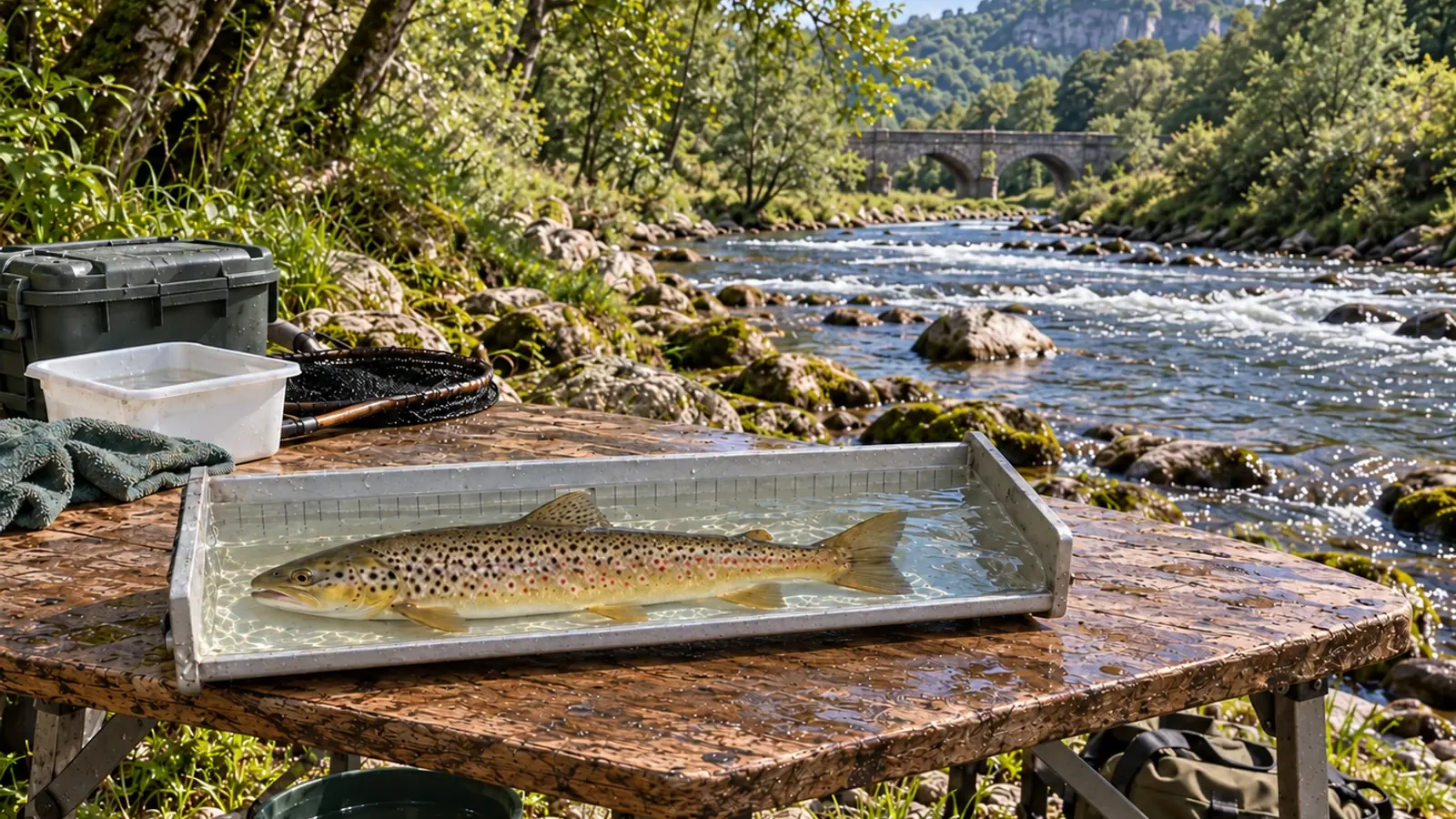
Fish length records need a consistent measurement
A fish recorded as twenty centimetres long may have been measured in several different ways. Total, fork and standard length use different landmarks. This practical guide draws on a FAO fisheries manual to explain why a monitoring series must retain its measurement convention.


- Content type
- Practical guide
- Sector
- Environment
- Animal group
- Fish
A monitoring table may record a fish as “20 cm” without saying where the measurement ended. That omission matters. The distance to the tip of the tail differs from the distance to its fork or to the base of the caudal rays. The same fish can therefore generate several valid length measurements.
Holden and Raitt’s 1974 FAO fisheries-science manual stresses the need to declare the convention used. This article treats it as longstanding methodological guidance, rather than a statement of current fishing-size regulations. For environmental monitoring, the useful principle is that a convention belongs with the number if surveys are to be compared without creating an artificial change in growth or population structure.
Name the anatomical landmarks
Total length extends to the end of the caudal fin. A complete definition also specifies the fin position used. Maximum total length with the lobes brought together is not automatically equivalent to a reading taken with the tail in another position.
Fork length ends at the fork of the tail where that landmark is identifiable. It is different from measuring to the longest caudal lobe. For species without a clear fork, the record needs an appropriate, explicitly stated convention rather than an unexplained use of the same label.
Standard length stops at the base of the caudal fin, at the anatomical landmark associated with the hypural region. It excludes the terminal fin portion included in the other measurements. That endpoint can be less immediately obvious to an operator working quickly than an external fin tip.
A variable abbreviation cannot communicate all these choices. The procedure should retain a reference diagram, mouth position and defined start and end points. This helps different teams avoid entering measurements made by different methods into a field with the same name.
Do not silently convert one convention into another
The FAO manual describes the risk of comparing studies that use different lengths without declaring them. An apparent growth difference may instead be a measurement difference. The same problem can arise within one monitoring series when operators, contractors or procedures change.
There is no single amount to add to every fish length to make the conventions interchangeable. A conversion relationship needs evidence appropriate to the animals and size range involved. A published relationship for another species does not establish a valid conversion for the survey in hand.
If an older dataset does not name its convention, look for the original field sheets, procedures and metadata. Do not quietly replace missing historical information with the team’s present practice. If it cannot be recovered, that uncertainty belongs in the analysis and interpretation.
When data move between organisations, retain the method code and its definition. A column heading that appears self-explanatory may leave these details unresolved. Retaining the original measurement also allows later users to distinguish an observed value from a derived one.
Fine graduations cannot correct an uncertain endpoint
A finely graduated board does not guarantee an accurate result if the fish is bent, the zero position is wrong or the caudal fin is damaged. Record animal condition and the landmark that could actually be seen. A missing fin tip does not become a measured endpoint because a spreadsheet requires a number.
For operational monitoring, we suggest separating measured values, documented estimates and measurements that could not be made. This preserves useful information about injured fish without implying false precision. It also allows the team to check whether missing values are concentrated in particular size groups or samples.
The manual also highlights communication errors between measurer and recorder. Calling out the unit with the value, confirming a doubtful reading and retaining identifiable corrections can reduce confusion. Digital equipment may change where transcription occurs, but it does not remove the need to check which variable was recorded.
These checks concern the quality of the observation. They are separate from the wider question of whether the captured fish represent the population. Both questions matter, but they require different evidence.
Keep survey methods comparable over time
A concise procedure should preserve the chosen dimension, units, rounding rule, equipment and treatment of exceptions. Where fish are assigned to length classes, define the class boundaries. Two teams can use the same class labels while grouping different fish if one rounds values and the other truncates them.
The length distribution also depends on sampling. A change of gear, site, season or selection among captured fish can shift the observed distribution without indicating that every fish in the population has changed size. Examine those conditions before drawing a biological conclusion.
Handling should remain proportionate to the monitoring objective. Preparing the station and avoiding unnecessary repeat measurements can reduce restraint time. Water temperature and fish condition affect how work should be organised. This guide provides neither a universal handling duration nor an anaesthetic protocol.
A length record includes its convention
A useful measurement remains understandable after the field visit. A stable convention supports comparison. When a change is necessary, date it, explain it and retain it in the metadata. Length alone does not provide a certain individual age or a complete assessment of health.
Our training programmes can help teams harmonise anatomical landmarks, data sheets and the treatment of uncertain measurements. Our environmental expertise places these records within the objectives of the survey and the animals’ constraints. The aim is an interpretable monitoring series, rather than a table filled with numbers whose apparent comparability exceeds the evidence.


