

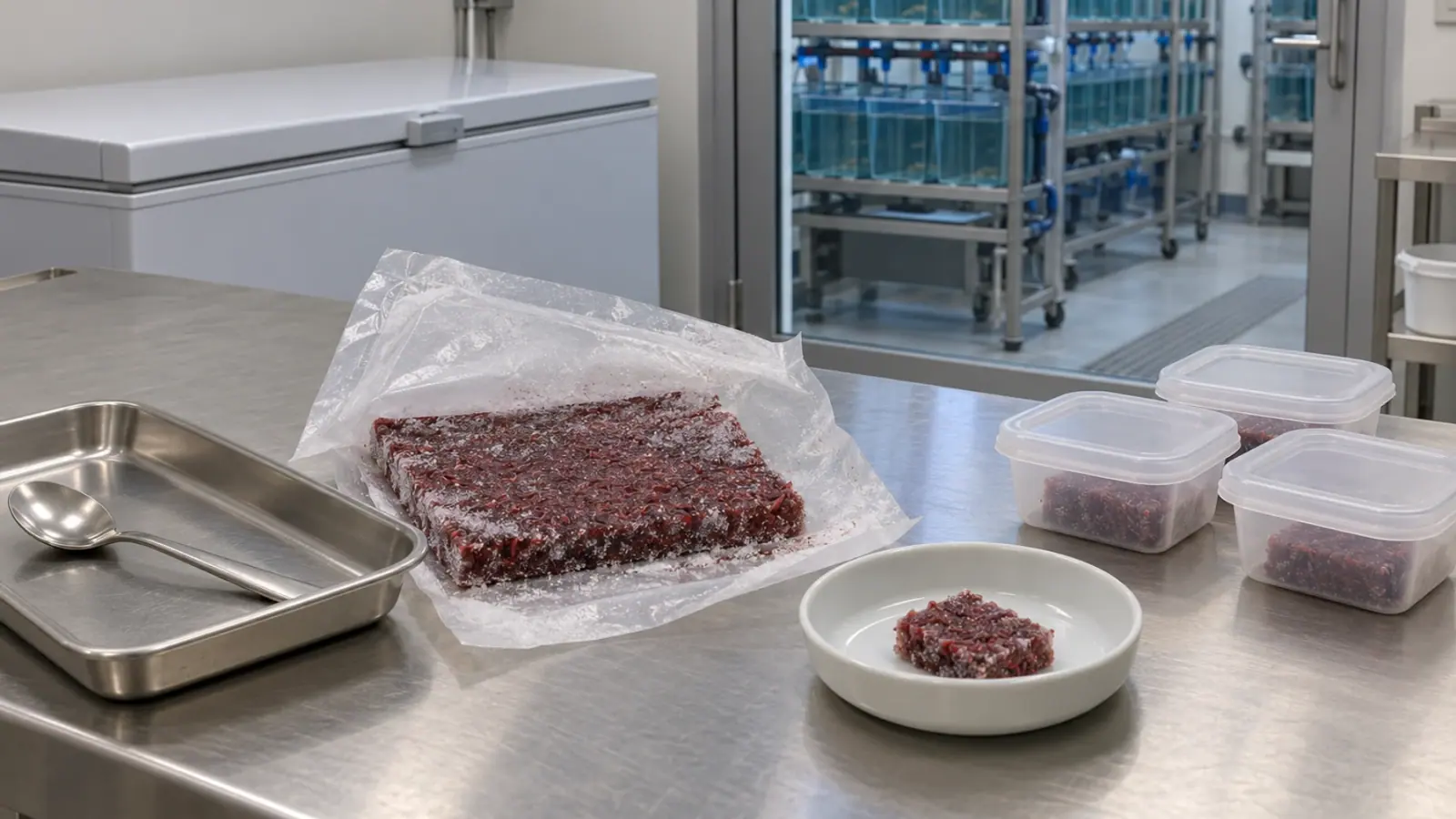
Frozen feeds: managing risk in aquatic research facilities
Freezing preserves feed without establishing microbiological safety. Aquatic facility guidance supports tracing batches and assessing nutritional quality, storage and the risk of introducing pathogens as separate questions.


- Content type
- Practical guide
- Sector
- Research facilities
- Theme
- BiosecurityNutrition
- Keywords
- BiosecurityTemperatureQuarantine
Feed storage belongs within the biosecurity plan
An aquatic research facility may give incoming animals and water more visible health attention than feed. Yet a frozen product enters the facility, moves through a preparation area and may be distributed across several tanks. Cold storage does not demonstrate freedom from pathogens. The route from delivery to feeding therefore belongs within the facility’s biosecurity assessment, including the equipment and people involved along the way.
The 2022 FELASA-AALAS recommendations state that drying or freezing does not always eliminate contamination in feeds. The Canadian Council on Animal Care also notes that frozen food can introduce disease. These documents support prevention planning. They do not measure the contamination rate of every commercial product, establish that frozen feeds are uniformly unsafe or identify the source of a particular facility outbreak.
Assess nutrition and microbiological safety separately
A feed can be readily eaten without meeting the needs of every life stage or providing sufficient health assurances for a particular colony. For zebrafish (Danio rerio), diet selection needs to account for animal requirements and research objectives. Particle size, composition and delivery remain distinct questions from whether an infectious agent might be introduced. A favourable feeding response cannot resolve all these questions at once.
Descriptions such as frozen, dry or live identify a condition or process, not a comprehensive safety certificate. Replacing a product to address a health concern may also alter the experimental diet. The change should be discussed with the relevant staff and documented. This article concerns feed as a possible entry route and operational exposure, rather than prescribing a universal ration or replacing nutritional assessment for the animals concerned.
Examine the evidence available before accepting a product
A receiving record can identify supplier, raw material, product reference, batch and specified storage conditions. Available documents need to be read for their actual scope: composition, processing, tests performed and limitations. A broad commercial assurance does not demonstrate absence of every organism relevant to an aquatic facility. Equally, a lack of information should be recognised as uncertainty rather than converted into a claim of confirmed contamination.
Veterinary and facility staff can rank concerns according to the material and the colonies exposed. The decision should identify which additional information would be useful and who can authorise acceptance. The cited recommendations provide neither one release test for every feed nor a freezing temperature that substitutes for a tailored health assessment. Product selection needs a defensible rationale that can be revisited if circumstances change.
Describe preparation as a series of traceable operations
The preparation record can follow each operation: receiving, shelving, opening, portioning, any required thawing and distribution. At each step, the local procedure should identify equipment, responsibility and information to retain. Temperature records and cold-chain incidents need interpretation against requirements for the particular product. A single handling time should not be invented for materials with different composition, packaging or supplier instructions.
Preparing quantities suited to the feeding round and using clean equipment dedicated to feed can reduce opportunities for cross-contamination. The aim is to prevent a utensil used at a tank from returning to bulk stock, or a container assigned to one health unit from circulating elsewhere without an appropriate procedure. The arrangement needs to work during weekends and reduced staffing as well as under ideal weekday conditions.
Protect the separation between health units
Shared feed handling can connect groups whose water systems are otherwise separate. Quarantine must therefore be considered when portions, utensils and staff move around the facility. The FELASA-AALAS recommendations include separation of equipment and practices within the prevention of introductions. Local organisation should make those boundaries practical to follow and possible to check, rather than relying on unwritten knowledge held by a few experienced technicians.
One operational option is to prepare identifiable portions for each destination before starting a feeding round. Staff should then be able to recover the original batch identity and identify the tanks that received it. This is a workflow choice, not a validated decontamination treatment. Its purpose is to limit equipment exchange and preserve an exposure record should an unexpected health problem subsequently require investigation.
Investigate an incident without assuming the source
When a health problem develops, the feed and batch history can help reconstruct exposures. A temporal association does not prove that food introduced the agent. Recent animal arrivals, water, equipment and handling also need consideration. Sampling and testing should address a hypothesis agreed with the laboratory, supported by information about the product and how it was stored, opened and used.
A negative result concerns the tested fraction and method; it does not automatically certify every package in a batch. A positive result requires interpretation according to the target organism and what the assay measures. The guidance does not justify assigning a specific disease to frozen feed without evidence. While a decision is pending, the status and handling of the products concerned should be explicit so that staff do not make conflicting assumptions.
Keep a record useful to both care and research
The essential connection is between product, batch, period of use, destinations and any incidents. Retaining these details can also help investigate altered growth or differences between experiments. Feeding conditions are part of an experimental environment. An undocumented change can complicate interpretation even when no infectious disease is demonstrated and the animals appear to be eating normally.
Vetofish can support this review through its advisory and support service for research facilities. The work can turn broad precautions into reviewable local decisions about supplier evidence, preparation, health-unit boundaries and incident response, with responsibilities that match the way the facility actually operates.


