

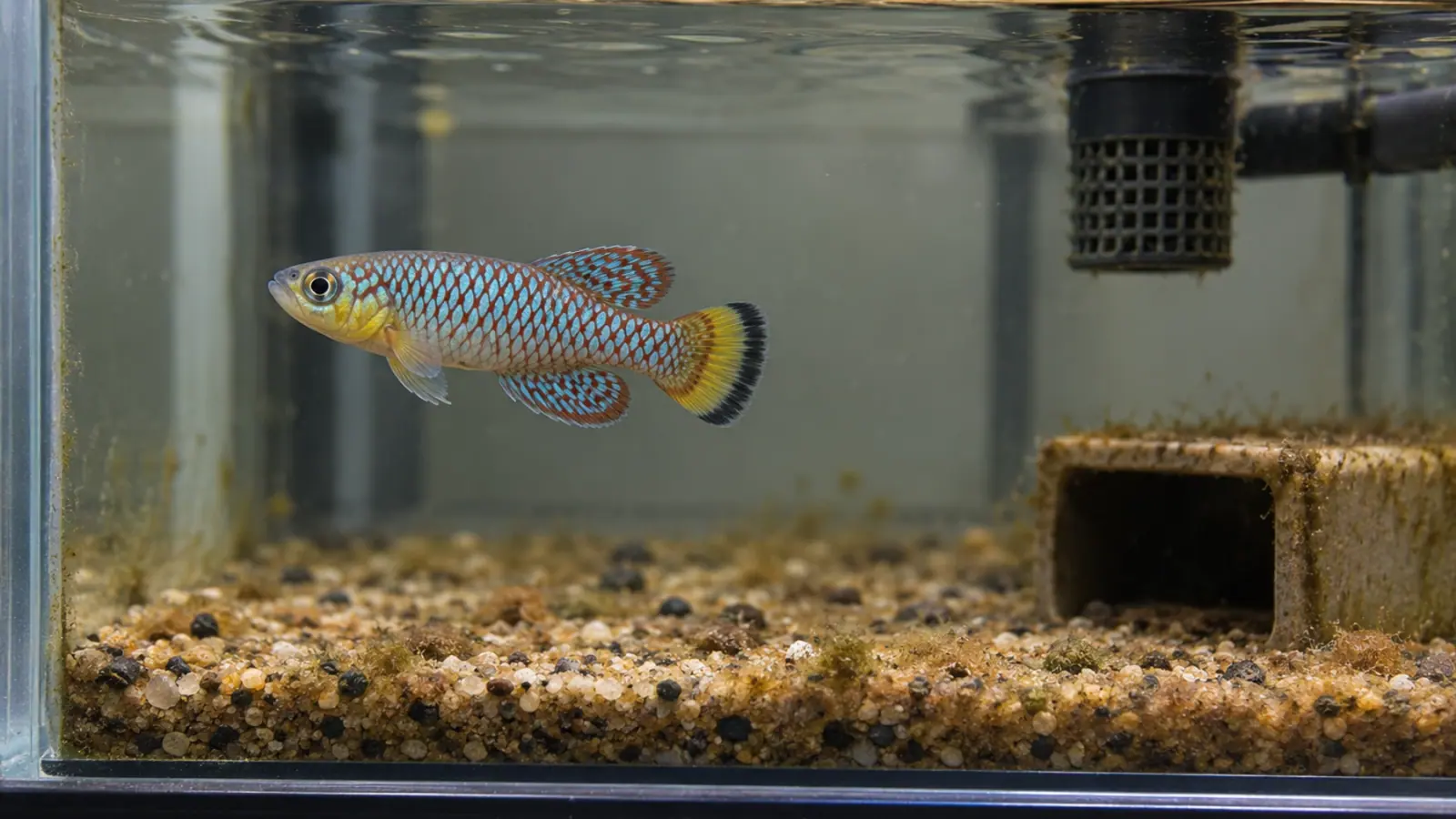
Killifish welfare scores need age and strain context
A 2026 study proposes an age-sensitive welfare scoresheet for African turquoise killifish. Developed in one facility, it offers a structure for observation while leaving functional impairment and clinical judgement central to decisions.


- Content type
- Scientific news
- Sector
- Research facilities
- Animal group
- Fish
- Keywords
- EthogramStressTemperature
Age changes the reference, not the need for assessment
Activity, body condition and appearance can change rapidly across the life of African turquoise killifish, Nothobranchius furzeri. A useful monitoring system needs to describe those changes while identifying impaired function. Age provides context; it does not explain every clinical deterioration.
A June 2026 Scientific Reports paper by Elena De Felice and colleagues proposes a species-specific welfare scoresheet. It draws on five years of observations in one fish facility and distinguishes stages across the lifespan. Its value is a structure for daily monitoring, with an important limit: the framework still needs adaptation and evaluation beyond the originating facility.
Strain and life stage belong in the record
The work considers two commonly used ageing-research strains, GRZ/GRZ-AD and MZM04-10. Their longevity trajectories differ, so the timing assigned to an adult, old or very old stage cannot simply be carried from one strain to the other.
The proposed framework distinguishes five life stages, beginning shortly after hatching. It considers body condition, external appearance, food intake, respiratory pattern, swimming activity, tank occupancy and clinical signs. This extends surveillance beyond mortality to the way an animal functions between experimental endpoints.
An observed phenotype should remain connected to the individual’s identity, strain and history. Otherwise, differences between two fish can combine age effects, housing differences and health changes. Giving both fish a score does not remove those sources of variation.
Start with observations in the home tank
Some observations can be made without catching the animal. Feeding response and opercular movements are examples. The operculum covers the gills, and its movement provides respiratory information that needs to be interpreted with water conditions and the fish’s overall behaviour.
To establish preliminary respiratory references, the authors assessed three fish per life stage and used three observers to count movements. Repeated counts of one fish are technical observations, not additional biological replicates. Those small biological sample sizes make the proposed ranges especially dependent on local conditions.
The paper also includes activity recordings made under a defined observation arrangement. They illustrate the usefulness of describing movement and tank position consistently. They do not establish that occupying a particular zone always means the same thing. Feeding position, shelter and the direction from which staff approach can shape spatial preferences.
Functional change takes priority over the total score
Age alters the expected baseline for some features, including pigmentation and activity. A familiar appearance in an older fish nevertheless does not establish that the change is harmless. Normal variation, impaired function and signs requiring intervention need to remain distinguishable.
Persistent loss of equilibrium, respiratory distress or a lesion interfering with feeding requires prompt assessment. The paper itself identifies severe signs that should not be normalised as ageing. Waiting for an overall score to cross a threshold can be inappropriate when a particular function is deteriorating.
The tables assign scores by category and age. Applying them unchanged could obscure differences between strains and facilities. Before using a numerical scheme, staff need to agree what will be observed, what response follows and who reviews an unusual case. Intervention criteria and humane endpoints belong in discussion with the veterinarian and those responsible for the project.
Establish a usable local baseline
An observation record can connect the date, age after hatching, strain, known sex, tank and feeding history. It should describe observable changes in feeding response, posture, movement, skin appearance and breathing. Comparison with previous records can reveal a change that a comparison with a younger fish would miss.
Temperature, lighting and tank organisation should accompany the assessment. Reduced activity after an environmental change cannot automatically be assigned to ageing. Nor does immobility by itself establish stress. Related observations and their sequence help distinguish the possibilities.
During preparation, several staff members can assess the same recordings and compare their descriptions. Disagreement reveals ambiguous terms or signs that are difficult to see. This improves local usability without, by itself, validating the scoresheet’s scientific performance.
The team also needs an agreed response to a change. A person recording a change needs to know whom to contact, how urgently and what information to preserve. A detailed score with no agreed response can leave a deteriorating animal waiting while the team debates terminology.
Validation remains a separate task
The study does not show that a given total predicts deterioration equally well across facilities. Morphometric measurements, respiratory observations and behavioural recordings did not all use the same sample size or design. Bringing them together in one monitoring framework does not make the work a multicentre trial.
Its contribution is a species- and age-sensitive structure for observation. In ageing research, welfare records and documented interventions can also help interpret trajectories beyond lifespan alone. They make it easier to understand whether a change occurred alongside altered feeding, housing or clinical management.
Vetofish’s animal welfare support can help review the signs selected, escalation arrangements and staff training needs. With research facilities, the objective is a monitoring system that the whole team can use and that remains connected to the animals’ actual functional changes.


