

Koi herpesvirus on carp farms: investigate before moving fish
Gill changes and rising carp mortality may raise suspicion of koi herpesvirus, but appearance cannot confirm infection. Sampling, interpretation and restrictions on fish movements need to form one investigation.
- Content type
- Disease profile
- Sector
- Aquaculture
A disease of common carp, not only ornamental koi
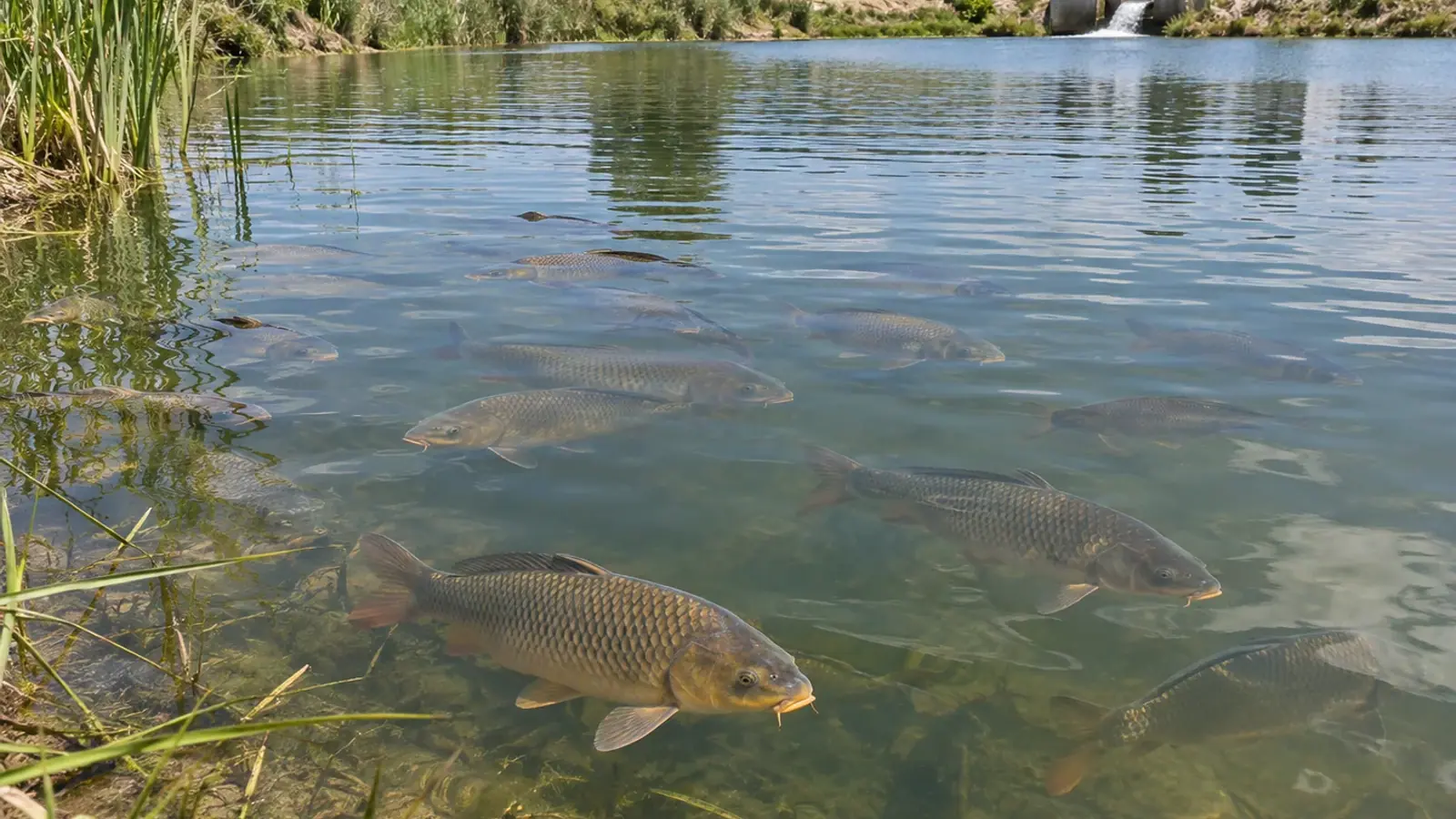
The familiar name can make koi herpesvirus sound like a problem restricted to decorative fish. WOAH’s Aquatic Code covers varieties and subspecies of common carp, Cyprinus carpio, as well as specified common carp hybrids. An ordinary food carp is therefore within the susceptible population. The agent is also called CyHV-3. Viral DNA reported in another aquatic species should not be turned into evidence that the species develops infection or transmits the virus: the WOAH manual distinguishes susceptibility from detection alone.
For a farm, the useful unit of investigation is the connected stock, not one photographed fish. Record the species and source of each group, the dates of introductions, shared water and shared equipment. Separate clinically affected fish, potentially exposed groups and stocks whose status is unknown. That map guides sampling and movement decisions. It also prevents a finding in one pond being presented as a tested result for every pond on the site.
Recognise concern without diagnosing by sight
WOAH describes increased mortality, lethargy, separation from the shoal, gathering around a water inlet and sometimes gasping near the surface. Skin and gill changes can occur. Gill pathology ranges from pale areas to extensive necrosis, but the manual explicitly notes that no gross lesion is pathognomonic. An outbreak without dramatic visible ulcers still warrants investigation when its pattern fits. Equally, damaged gills can have other causes or concurrent infections.
Temperature affects the expression of disease and the interpretation of a suspected episode. It is neither a diagnostic test nor a way to declare a stock safe. Exposed fish may look well under one set of conditions and show disease under another. The manual describes evidence that survivors of experimental infection may remain infected. The end of an obvious mortality event is consequently not proof that remaining carp are free from the virus.
Make each sample answer a question
Contact the attending aquatic veterinarian and diagnostic laboratory promptly. Send a chronology of mortality by pond, temperature records, recent movements and information on fish size and source. The laboratory can advise which fish and tissues to sample, how to preserve them and what test sequence suits the question. A convenient sample collected too late or transported badly may be much less informative than a planned one. Workers should also document which ponds were accessible to the same people and tools before restrictions began.
PCR detects viral genetic material. A positive result needs interpretation against sample type, method, clinical findings and epidemiological context. It does not quantify how readily a particular fish will transmit infection or establish that the virus caused every lesion. A negative result in a small number of fish does not certify the whole farm. Further sampling or a confirmatory approach may be needed under the manual’s diagnostic framework. A laboratory report should be read with its stated limits, rather than reduced to a single word.
Control connections while the result is pending
Pause avoidable movements of fish, water and equipment from potentially affected units to units that have not been implicated. Reconstruct recent transfers and organise work so that staff do not carry contaminated material between ponds. Dedicated equipment is useful only when its storage and cleaning preserve that separation. Disinfection requires a suitable product, preparation, contact time and material condition; writing “disinfected” in a log does not demonstrate an effective barrier.
WOAH’s Code sets international provisions for aquatic animal trade and disease status of countries, zones and compartments. Those provisions should not be presented as an identical legal instruction for every individual pond in every jurisdiction. Reporting duties and official response must be checked with the competent authority where the farm operates. Empirical treatment of an unconfirmed condition must not distract from diagnosis or permit movement of carp whose status remains unclear.
Design prevention around real pathways
Before introducing a stock, document its source, available health information and a separate arrival route. Quarantine helps when fish, water, tools and people do not bypass its boundary. It is not an absolute guarantee: duration, testing and observation need to fit the risk, the veterinarian’s assessment and laboratory advice. Retaining movement records alongside test results makes later tracing possible if a new event occurs.
The prevention plan should include incoming water, links to wild populations, contractors, shared gear and a response to unusual mortality. Its value becomes apparent when staff know which pond to contain, whom to call, what observations to record and how to obtain useful samples without delay. The aim is earlier recognition and containment, not a promise that a virus can never reach a facility.
Limits that matter for a farm decision
The signs in the WOAH manual overlap with other systemic and gill conditions. Co-infection can alter their appearance. The manual does not supply a universal probability of KHV for any carp seen at an inlet, nor does one test assign a disease status to an entire site. Conclusions depend on the sampled population, the timing and integrity of specimens and the question asked of the laboratory.
For farms assessing unusual carp mortality or a new stock, our aquatic health expertise can help structure the investigation with the laboratory and relevant authorities. Our aquaculture work then connects the findings to water routes and practical biosecurity decisions without replacing an on-site diagnosis.


